
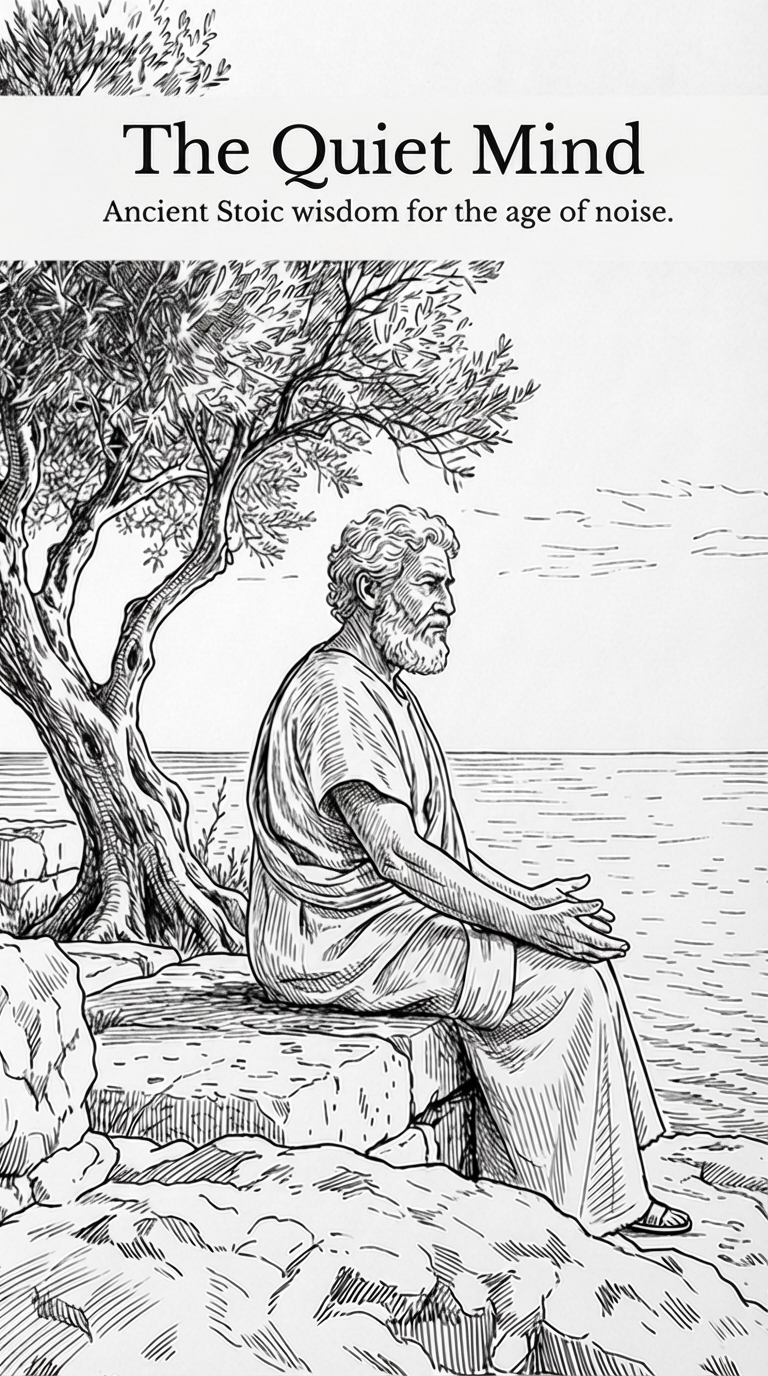
The Quiet Mind
You did not find this by accident. Something in you is looking for quiet — and has been for some time.
Not the absence of sound. The other kind. The kind that used to live somewhere behind your thoughts before the world grew so loud. You remember it, distantly, the way you remember a place you lived as a child. You are not sure when it left. Only that it has been gone for longer than you would like.
I will not promise to return it to you. That is not something one person can do for another. But I can tell you where it lives, and I can show you the path that others have walked before you — people who lived in times more violent, more uncertain, and more demanding than ours, and who found their way to a steadiness the world could shake but could not uproot.
━━━
The Quiet Mind is written as eight letters, in the tradition of Seneca's correspondence with Lucilius — the most-read Stoic text in history. Each letter takes one idea from the Stoic tradition and delivers it directly, as one person writing to another. Not as theory. Not as a system to be learned and filed away. As something to be lived with, turned over, tested against the specific texture of your specific days.
The men whose ideas fill these pages were a slave, an emperor, and a man of enormous wealth who could find no peace in any of it. Three very different lives. One philosophy. Two thousand years later, it still works — because it addresses not what happens to you, but what your mind does with what happens to you.
━━━
Eight letters. Eight practices.
The ruling faculty and why the mind cannot rest. The dichotomy of control — the one idea that reorganises everything else. Marcus Aurelius's private journal, written in the dark before any of it reached him. Negative visualisation and the Stoic cure for wanting more. The view from above. Seneca on time, and what you are doing with yours. Other people — the hardest letter. And finally, a ten-minute daily structure that holds everything together.
Each letter closes with a practice — written as an invitation, not an instruction. Small. Specific. Designed to work in an ordinary day, not an ideal one.
All primary source quotes are drawn from the Meditations, the Enchiridion, the Discourses, and Letters to Lucilius. Nothing has been invented or falsely attributed. The quotes your reader checks will be the quotes they find.
━━━
70-page PDF ebook. Designed to read like a book — not a workbook, not a template, not a checklist. A book.
Instant download.