
NICE NG3 Diabetes in Pregnancy: Study Notes and Question Bank
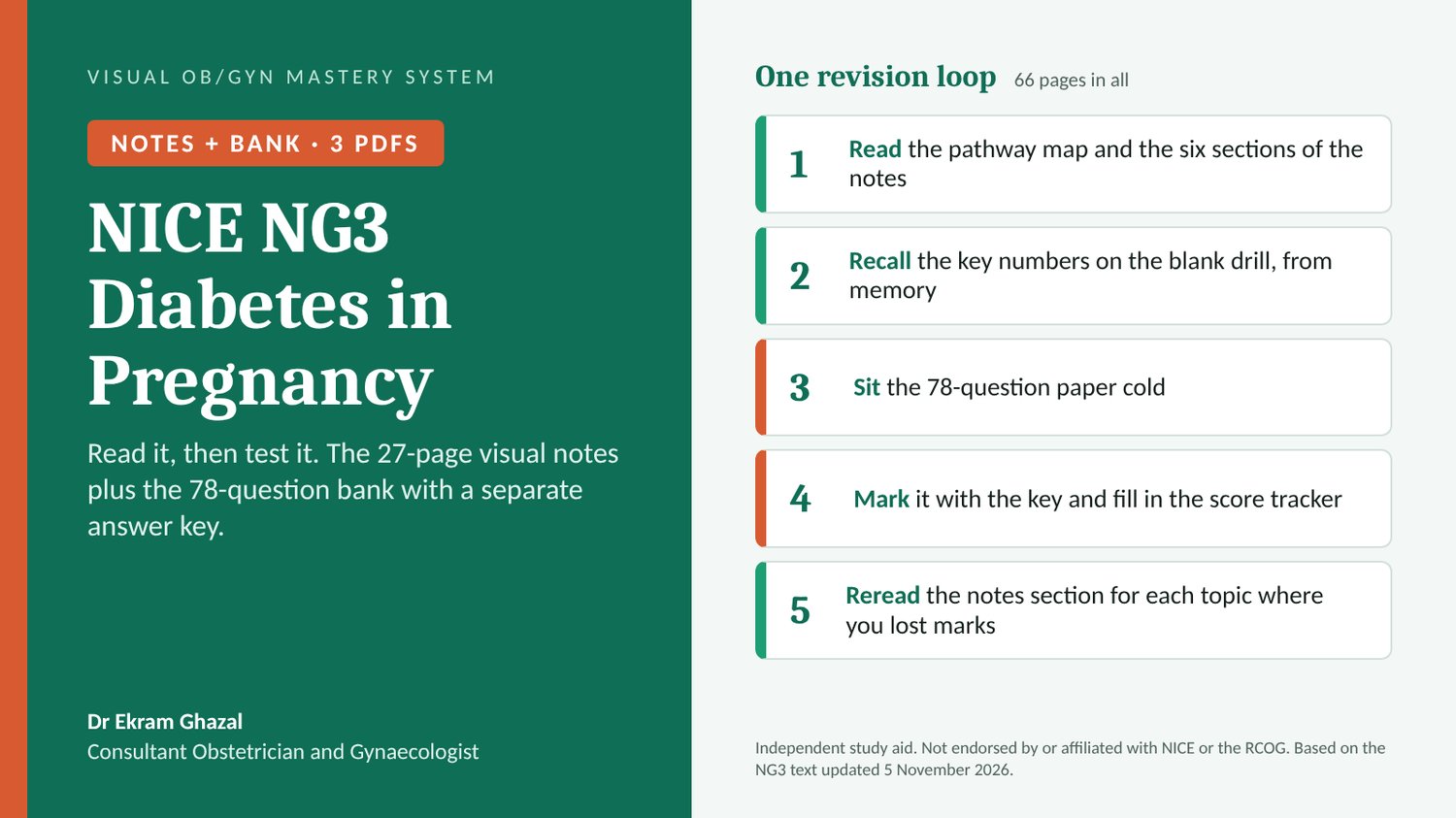
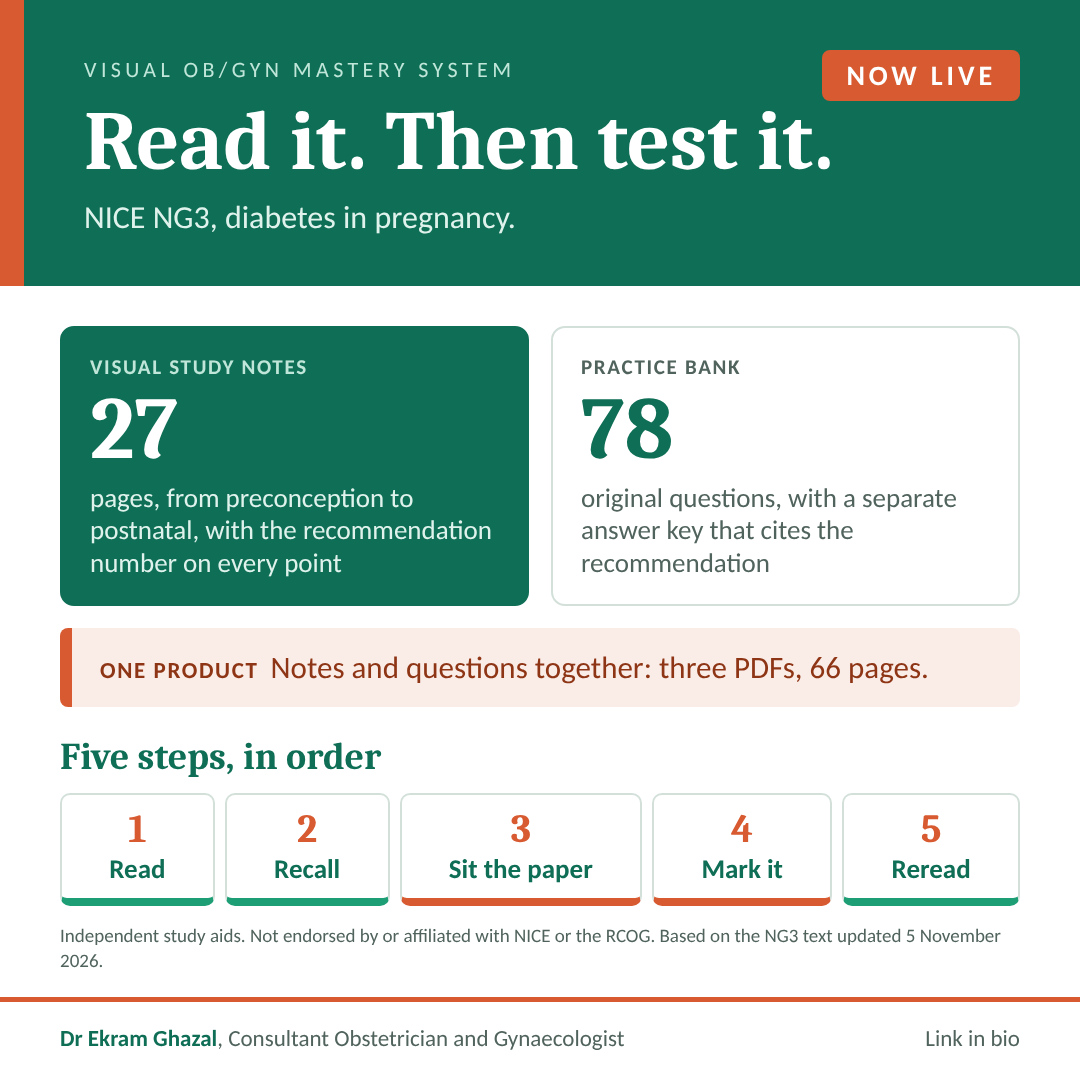
27 pages of visual study notes plus a 78-question practice bank with a separate answer key. Read NICE NG3, then test it. Three PDFs, 66 pages.
Read NG3. Then prove you can recall it.
NG3 is written for people using the guideline, not for people revising it. The HbA1c target before conception, three different fasting glucose cut-offs in gestational diabetes, a birth window that differs by diabetes type, and a second set of cut-offs after birth all sit in different places. You read it, it feels learned, and then a vignette asks for the number and you hesitate.
Recognising a recommendation and recalling it under time pressure are different skills. This product trains both: notes to put every threshold in one place, and questions to check that it comes back.
How the two parts work together:
- Read the pathway map in the notes, then work through the six sections.
- Fill in the blank recall drill from memory, then check it against the numbers list.
- Sit the 78-question paper cold, timed if you like.
- Mark it with the answer key and fill in the score tracker by topic.
- Go back to the notes section that matches each topic where you lost marks. The six topics line up: preconception, gestational diabetes, antenatal, birth, care of the baby and postnatal.
Part 1: Visual Study Notes (27 pages)
- A one-line pathway map with the anchor number for each stage
- Six sections in the guideline's own order, from preconception to postnatal, with the recommendation number on every point
- Trap boxes where numbers look alike: fasting 5.6 diagnoses, 6.0 to 6.9 can justify early insulin, 7.0 mandates it; the postnatal cut-offs of 6.0 and 7.0 are not the in-pregnancy thresholds; eGFR belongs before pregnancy, not during it
- Original visuals: the HbA1c ladder, the treatment flow by fasting glucose, a glucose targets chart, the antenatal appointment timetable and the postnatal result ladder
- 45 key numbers listed by stage, then the same list again as a blank recall drill you can print and fill in
- A 12-question self-test with answers and the reason for each
- An 'Is it still current?' check covering five items, including the insulin detemir withdrawal and the NICE update in progress on type 1 diabetes
Part 2: Practice Bank (two PDFs, kept apart so you can sit the paper cold)
Question Paper (18 pages):
- 20 single best answer questions
- 3 cases with 3 questions each (9 questions)
- 10 extended matching sets with shared option lists (49 items)
- A printable answer sheet, a how-to-use page and a contents page
Answer Key (21 pages):
- A quick answer grid for fast marking
- A score tracker by topic: preconception 16 questions, antenatal 19, gestational diabetes 14, birth 12, postnatal 9, care of the baby 8
- A written explanation for every question, with the common wrong turn named where there is one
- NG3 recommendation numbers on every answer, so you can go straight to the source text
- Currency notes on the two questions where NICE guidance is moving
Try one question free
A 32-year-old primigravida at booking has a BMI of 31 kg/m2 and no other risk factors. Her fasting plasma glucose is 4.9 mmol/L and HbA1c is 36 mmol/mol. Which is the correct plan for gestational diabetes?
A. Offer a 75-g oral glucose tolerance test at 24 to 28 weeks B. No testing, because her fasting glucose and HbA1c are normal C. Repeat a fasting glucose at 28 weeks D. Offer a 50-g glucose challenge test at 24 to 28 weeks E. Check a random glucose at each antenatal visit
Answer: A. A BMI of 30 or over is a booking risk factor, so she is offered a 75-g 2-hour OGTT. Option B tempts because the results look reassuring, which is exactly why those tests are not used to judge risk. (NG3 1.2.2, 1.2.3, 1.2.5, 1.2.7)
The other 77 work the same way: a vignette, a best answer, and a reason.
Who it is for
Obstetrics and gynaecology trainees and exam candidates who want the thresholds to come back under time pressure, clinicians who look after these women and want one structured read of NG3 and a way to test it, and anyone who learns by covering the answer and getting a question wrong.
Who it is not for
It does not replace NG3, it is not an official resource or question set, and it is not a tool for deciding the care of a real patient.
Why you can trust the content
Written by Dr Ekram Ghazal, Consultant Obstetrician and Gynaecologist (MBBCh, MSc Obstetrics and Gynaecology, MBA). Built on the NG3 text updated on 5 November 2026, with the recommendation number beside every point so you can check the source. Written in my own words, drawn as original visuals, and every vignette is original. Nothing is copied from the guideline's text or figures, or from an exam or another question bank. It tells you where it will date: two areas are flagged because NICE guidance is moving.
Sit the paper this week. Mark it. Know which part of NG3 to reread.
Disclaimer (keep at the foot of the description)
Independent study aid. Not endorsed by or affiliated with NICE or the RCOG, not an official or past paper, and not clinical advice for individual patients. It cannot promise exam results. Verify against the live NICE guideline before relying on any figure or answer. For your own revision only: please do not share or resell the files.