
Special Populations Quick Reference Bundle
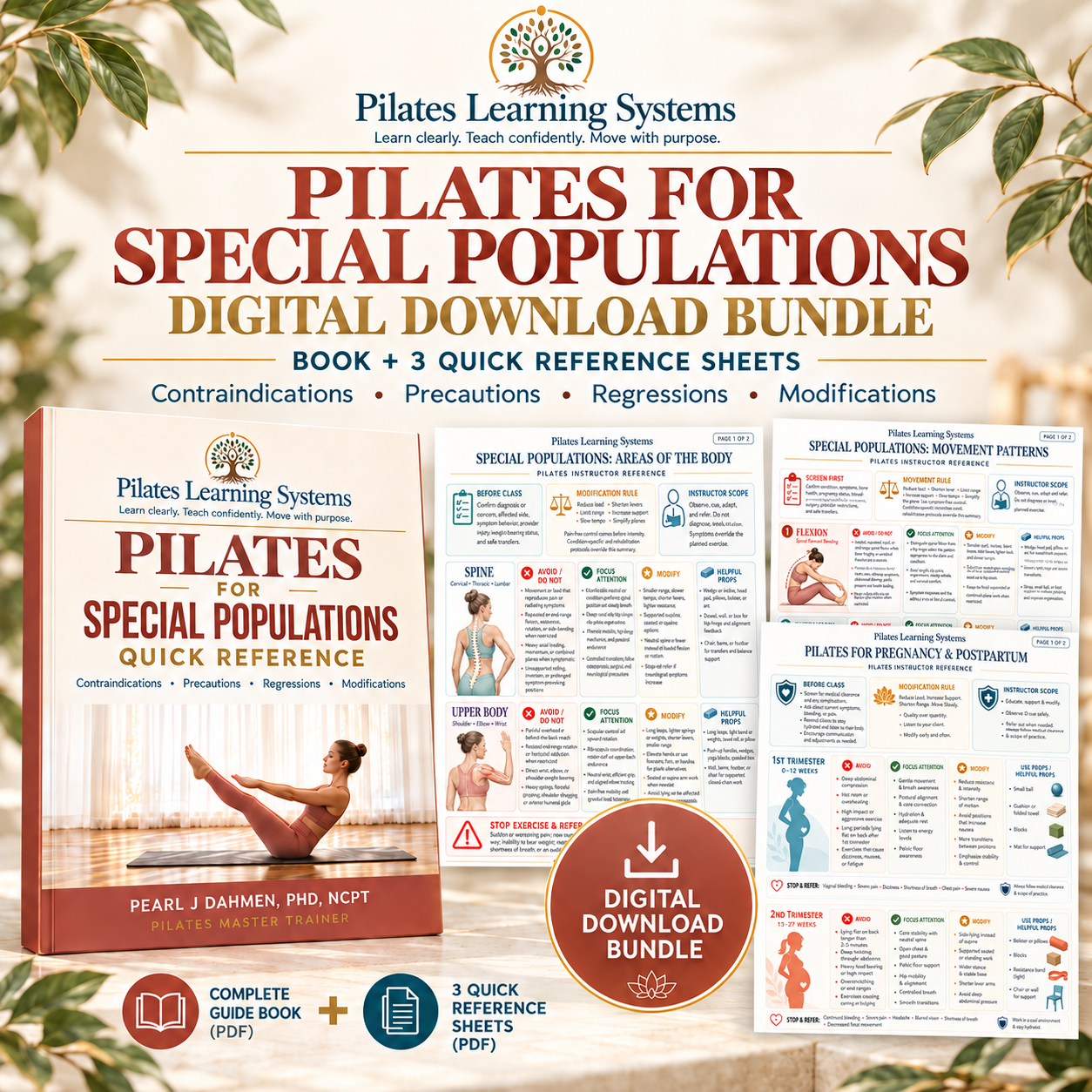
Pilates for Special Populations — Digital Download Bundle
Complete Guide + 3 Quick Reference Sheets
Teaching Pilates to special populations requires more than knowing exercises. It requires knowing what to observe, when to modify, when to reduce demand, and when to stop and refer.
The Pilates for Special Populations Digital Download Bundle combines the full Pilates for Special Populations Quick Reference Guide with three visual instructor reference sheets designed for faster access to essential teaching considerations.
Use the full guide when you want deeper study and context. Use the quick-reference sheets when you need a concise visual reminder while preparing sessions, reviewing material, or teaching.
What’s Included
1. Pilates for Special Populations Quick Reference Guide — PDF Book
The complete digital guide helps instructors organize considerations related to:
- Contraindications
- Precautions
- Regressions
- Modifications
- Universal warning signs
- Posture and movement considerations
- Modifications by area of the body
- Condition-specific considerations
- Instructor scope and referral decisions
- Supportive positioning and equipment choices
The guide is designed to support safer, clearer decision-making rather than rigid memorization.
2. Special Populations: Areas of the Body — 2-Page Reference
A visual quick-reference organized around four major body regions:
- Spine
- Upper Body — Shoulder, Elbow & Wrist
- Hips & Pelvis
- Lower Body — Knee, Ankle & Foot
Each section organizes information into practical categories:
Avoid / Do Not
Focus Attention
Modify
Helpful Props
The sheet also includes a Before Class checklist, modification principles, instructor-scope reminders, Stop Exercise & Refer guidance, and a Quick Decision Rule.
3. Special Populations: Movement Patterns — 2-Page Reference
This reference organizes special-population considerations by five common movement patterns:
- Flexion
- Extension
- Lateral Flexion
- Rotation
- Inversion
For each movement pattern, the guide identifies what to avoid, where to focus attention, how to modify the movement, and which props may provide useful support.
It also includes screening reminders, instructor-scope guidance, a general Movement Rule, Stop Exercise & Refer criteria, and a Quick Decision Rule.
4. Pilates for Pregnancy & Postpartum — 2-Page Reference
A stage-based instructor reference covering:
- 1st Trimester
- 2nd Trimester
- 3rd Trimester
- Postpartum
The sheet organizes recommendations into:
Avoid
Focus Attention
Modify
Use Props / Helpful Props
It also includes medical-clearance reminders, instructor-scope guidance, modification principles, and Stop & Refer indicators.
This gives instructors a concise visual resource for reviewing how support, range, load, position, and exercise choice may need to change throughout pregnancy and postpartum.
Designed for Real Teaching
This bundle gives you two levels of access:
Study with the book.
Use the complete guide to understand the reasoning behind modifications, precautions, and instructor decisions.
Teach with the reference sheets.
Keep the visual sheets available when planning classes, reviewing a condition, preparing for a private session, or refreshing key considerations.
The result is a system that supports both learning and quick application.
Designed For
This bundle is especially useful for:
- Pilates instructors in training
- Newly certified instructors
- Comprehensive Pilates instructors
- Private and group instructors
- Teacher trainers and mentors
- Instructors reviewing special-population considerations
- Teachers who want a concise reference alongside their comprehensive training
Digital Download
You will receive:
- 1 complete PDF guide
- 3 two-page quick-reference PDF sheets
The materials can be saved to your computer or tablet and printed for your personal professional reference.
Important Scope Reminder
These materials are educational references for Pilates instructors. They are not intended to diagnose, treat, or prescribe rehabilitation.
Use them alongside known diagnoses, client-reported restrictions, your professional scope of practice, and healthcare-provider guidance when appropriate.
Observe carefully. Modify thoughtfully. Refer when needed.
Learn clearly. Teach confidently. Move with purpose.