




Day in the Life of an Owner Running a Franchised Supermarket in South Africa (2026)
“Day in the Life of an Owner Running a Franchised Supermarket in South Africa (2026)” is a field-ready operating playbook for franchise owners and managers who don’t have the luxury of “best ”intentions”—they need controls that hold under pressure. Instead of theory, the book is built around a realistic trading rhythm: what to check, when to check it, and what “good” looks like in a South African store where margins are tight and small leaks become big losses fast.
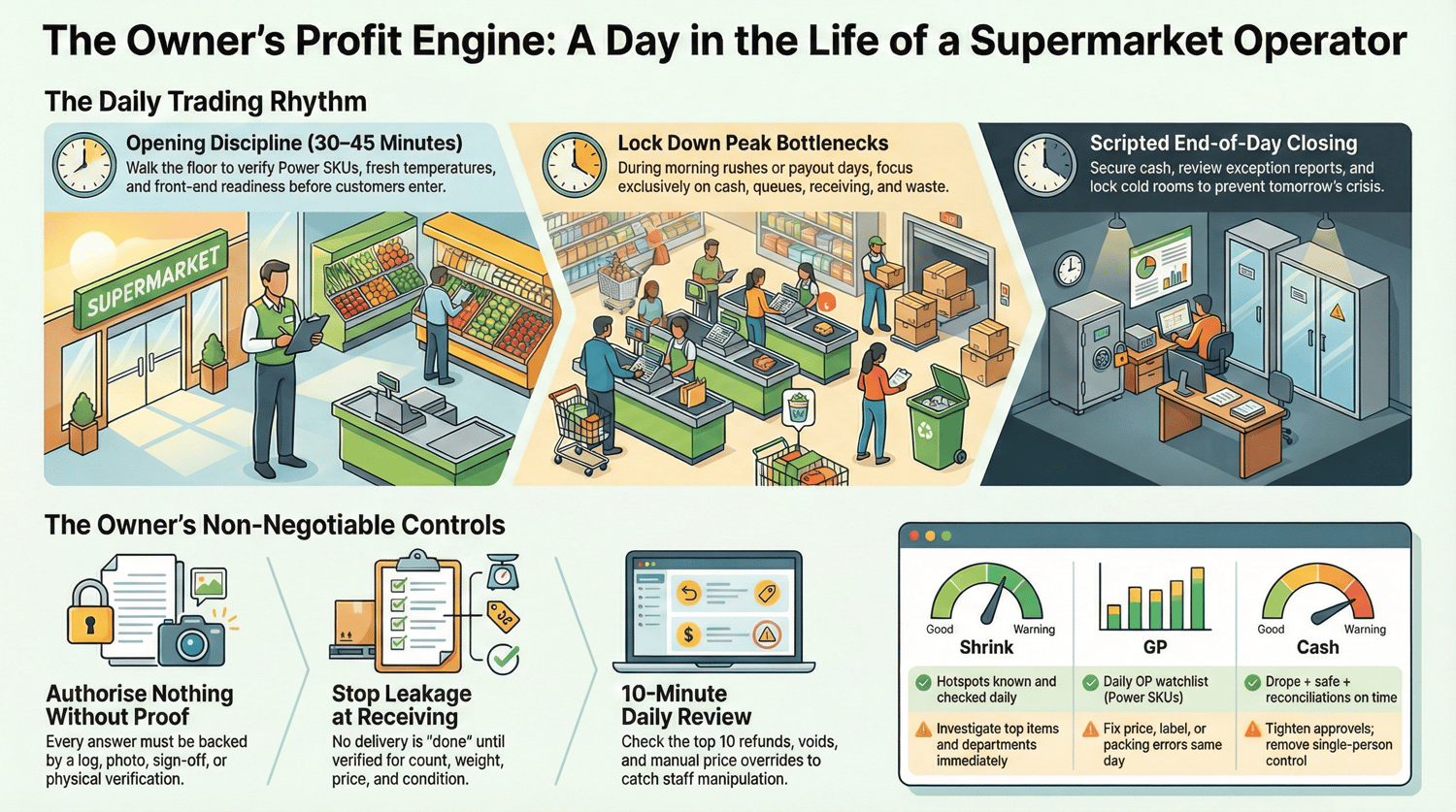
A core theme is that the owner’s job is a profit function, not admin (pages 3–4). The book makes a blunt but useful point: if something isn’t checked and verified, it effectively isn’t controlled. This mindset shift is practical because it turns daily management into a repeatable system—less arguing, fewer “stories”, more proof. The book also highlights where franchised stores typically leak first (page 4): refunds and voids, supplier credits that never materialise, receiving shortcuts, promo execution gaps, and stock adjustments used as “easy fixes”. That focus helps managers stop chasing symptoms and start fixing root causes.
Operationally, the strongest value is the book’s structured day plan. It starts with an “opening discipline” routine (page 5) that prioritises the few actions that protect availability, hygiene, pricing integrity, and cash control before customers flood in. It then maps peak-risk windows that are especially relevant in South Africa (page 6): month-end pressures, SASSA/payday surges, supplier delivery windows, and late-afternoon “looseness” when fatigue and shortcuts creep in. This framing is important because it aligns management effort with real-world trading patterns, not ideal schedules.
The heart of the book is a set of controls that actually work because they are simple, enforceable, and evidence-based. Receiving is treated as “where shrink is born” (page 8), with practical steps: verify counts/weights, spot-check high-risk categories, and treat “delivered” as “verified.” Cash discipline removes single-person risk (page 9) through segregation, scripted drops, and daily review of exceptions (refunds/voids/no-sales/overrides).
Merchandising and basket-size growth are approached as a managed process, not hope (page 10), reinforcing that sales and margin improvement come from execution habits, not motivational speeches. Fresh departments get specific, non-negotiable standards (page 11): production planning, waste proof, label discipline, and cold-chain verification — exactly where many stores quietly lose gross profit.
Another highly practical section is the breakdown of common staff tricks and manipulation patterns (pages 12–15). It spells out what these issues look like in receiving, front-end, fresh, and admin — then pairs each with the owner’s response: visibility, verification, and proof packs (logs, sign-offs, CCTV references, discrepancy reports). This is valuable because it helps owners intervene early without turning the store into a blame culture.
Lastly, the book concludes with end-of-day procedures and handover discipline (pages 16–19), which include exception reviews, secure cash-up, key control, fresh close checks, and a signed handover to avoid chaos tomorrow.
In short, it’s a practical resource because it gives owners and managers a repeatable operating system for operational efficiency, risk control, and consistent execution—tailored to the realities of franchised supermarkets in South Africa in 2026.
Don't Miss Out—Unlock Epic Deals & Bundles Now!
To see all our other offers and bundles, check the links below: