
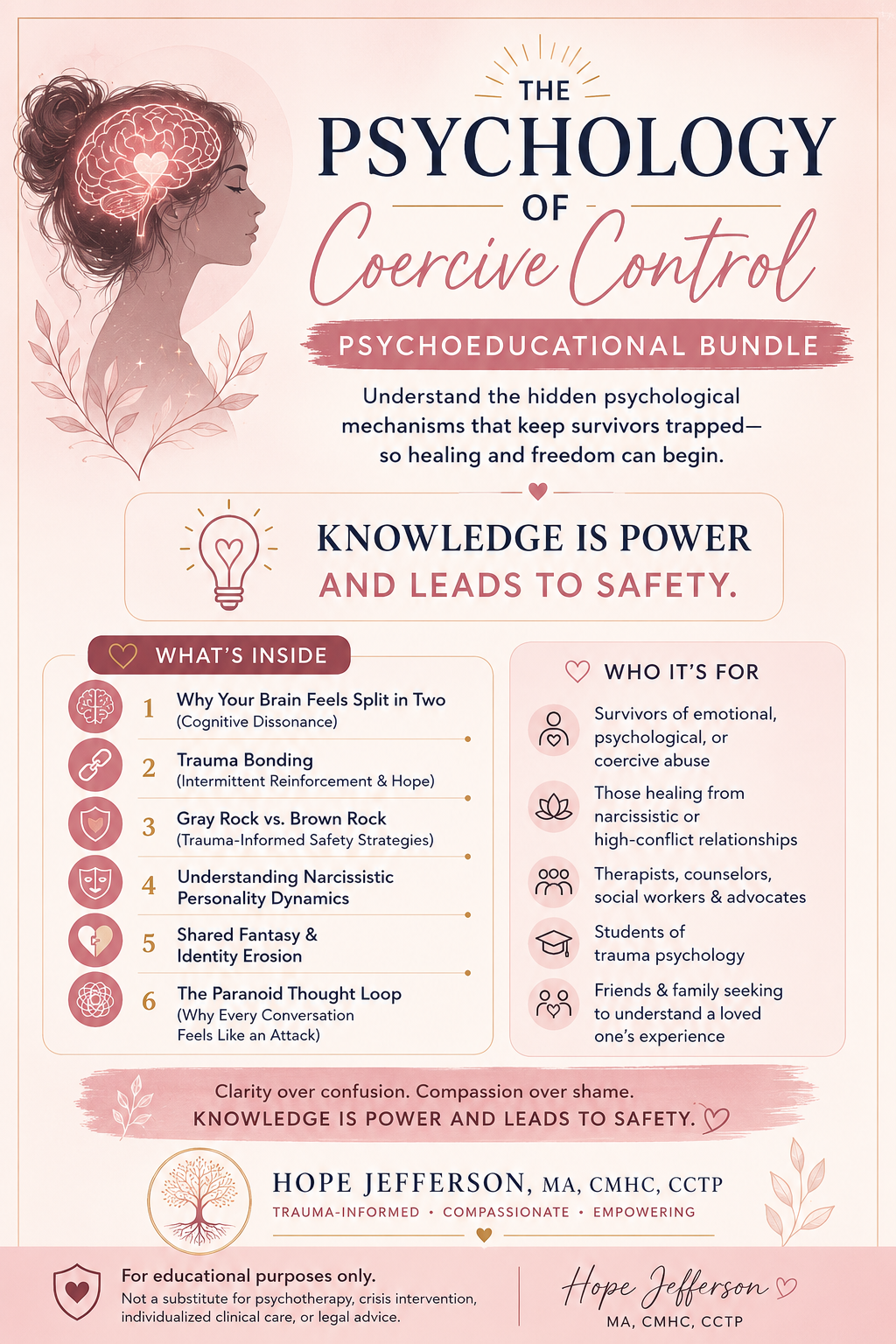
The Psychology of Coercive Control Bundle
The Psychology of Coercive Control
Psychoeducational Bundle
By Hope Jefferson, MA, CMHC, CCTP
You’ll receive seven in-depth psychoeducational handouts designed to help you better understand coercive control, trauma bonding, cognitive dissonance, and the psychology of abusive relationships. Written by Hope Jefferson, MA, LCMHC, CCTP, a licensed clinical mental health counselor and survivor advocate with over 13 years of experience working with trauma survivors.
Product Description
Understanding abuse is often the first step toward healing.
The Psychology of Coercive Control Psychoeducational Bundle is a collection of trauma-informed educational handouts designed to help survivors understand the psychological patterns that often develop in emotionally abusive, coercively controlling, and high-conflict relationships.
These resources translate complex psychological concepts into clear, compassionate language that is easy to understand.
Rather than asking,
“Why didn’t I just leave?”
this bundle explores questions like:
• Why does my brain feel split in two?
• Why do I keep hoping things will change?
• Why does leaving feel so difficult?
• Why do I question my own reality?
• Why do I keep feeling pulled back?
The goal is not to judge survivors.
The goal is to replace confusion with understanding.
Included in this Bundle
✓ Why Your Brain Feels Split in Two
(Understanding Cognitive Dissonance)
✓ Trauma Bonding
(Intermittent Reinforcement & Hope)
✓ Gray Rock vs. Brown Rock
(Trauma-Informed Safety Strategies)
✓ Understanding Narcissistic Personality Dynamics
✓ Shared Fantasy & Identity Erosion
✓ The Paranoid Thought Loop
(Why Every Conversation Feels Like an Attack)
Additional resources may be added in future editions.
Who Is This Bundle For?
This bundle may be helpful for:
• Survivors of emotional, psychological, or coercive abuse
• Individuals recovering from narcissistic or high-conflict relationships
• Therapists, counselors, social workers, and victim advocates
• Students learning about trauma psychology
• Friends and family members seeking to better understand a loved one’s experience
What Makes This Bundle Different?
Many resources focus on identifying abusive behavior.
This bundle focuses on explaining what happens inside the survivor.
Using trauma-informed psychology, attachment theory, learning theory, and nervous system education, these handouts help readers understand why abuse is often confusing, why leaving can feel extraordinarily difficult, and how healing begins.
Educational Disclaimer
This bundle is intended for educational purposes only.
It is not a substitute for psychotherapy, crisis intervention, individualized mental health treatment, legal advice, or emergency services.