
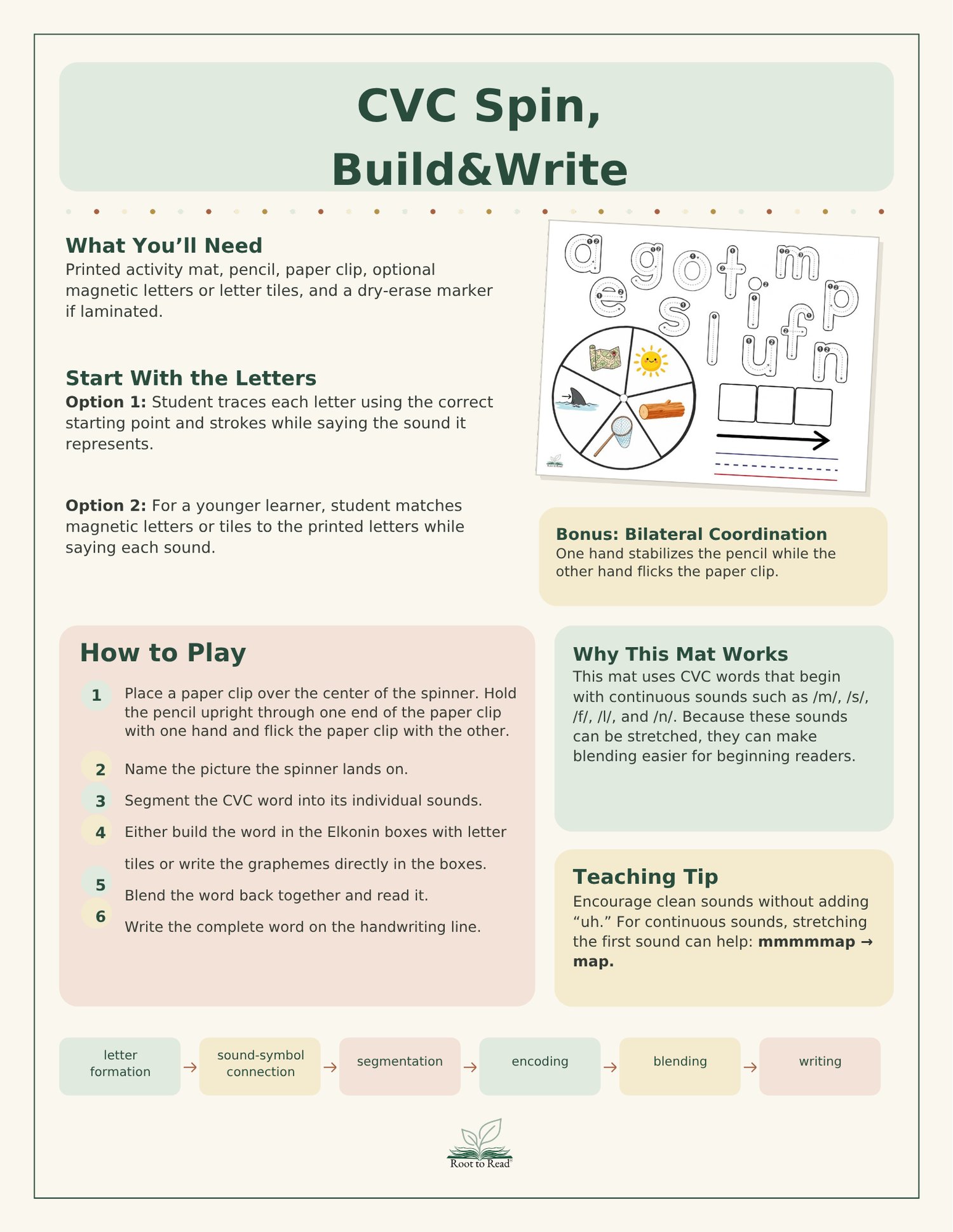
CVC Spin and Write- ONE GAME BOARD
ONE GAME MAT PROVIDED WITH PURCHASE!
Before we even spin, we review the letters. The student traces each one using the correct starting point and strokes while saying the sound it represents. For a younger learner, I can swap the tracing for magnetic letters or tiles so they’re still connecting the letter to the sound in a hands-on way.
This particular mat uses CVC words that begin with continuous sounds like /m/, /s/, /f/, /l/, and /n/. These sounds can be stretched, which can make blending a little easier for beginning readers.
Then comes the fun part. We use a pencil and paper clip to make our own spinner. One hand holds the pencil steady while the other flicks the paper clip, adding a little bilateral coordination practice along the way.
Whatever picture the spinner lands on becomes our word. We say the word, segment it into its individual sounds, and then either build the word in the Elkonin boxes with letter tiles or write the graphemes directly into the boxes. Because we’ve already practiced the letter formations, the writing piece gives us another chance to reinforce accurate formation while encoding the word.
Then we blend the word back together and write it on the line.
Why I like this activity: it moves from letter-sound knowledge → phonemic segmentation → encoding → blending → handwriting, all in one routine. That kind of repeated connection between sounds and print is exactly what helps early reading and spelling skills become more automatic.
And of course, the student just thinks we’re playing.
Purposeful, hands-on, and fun.