
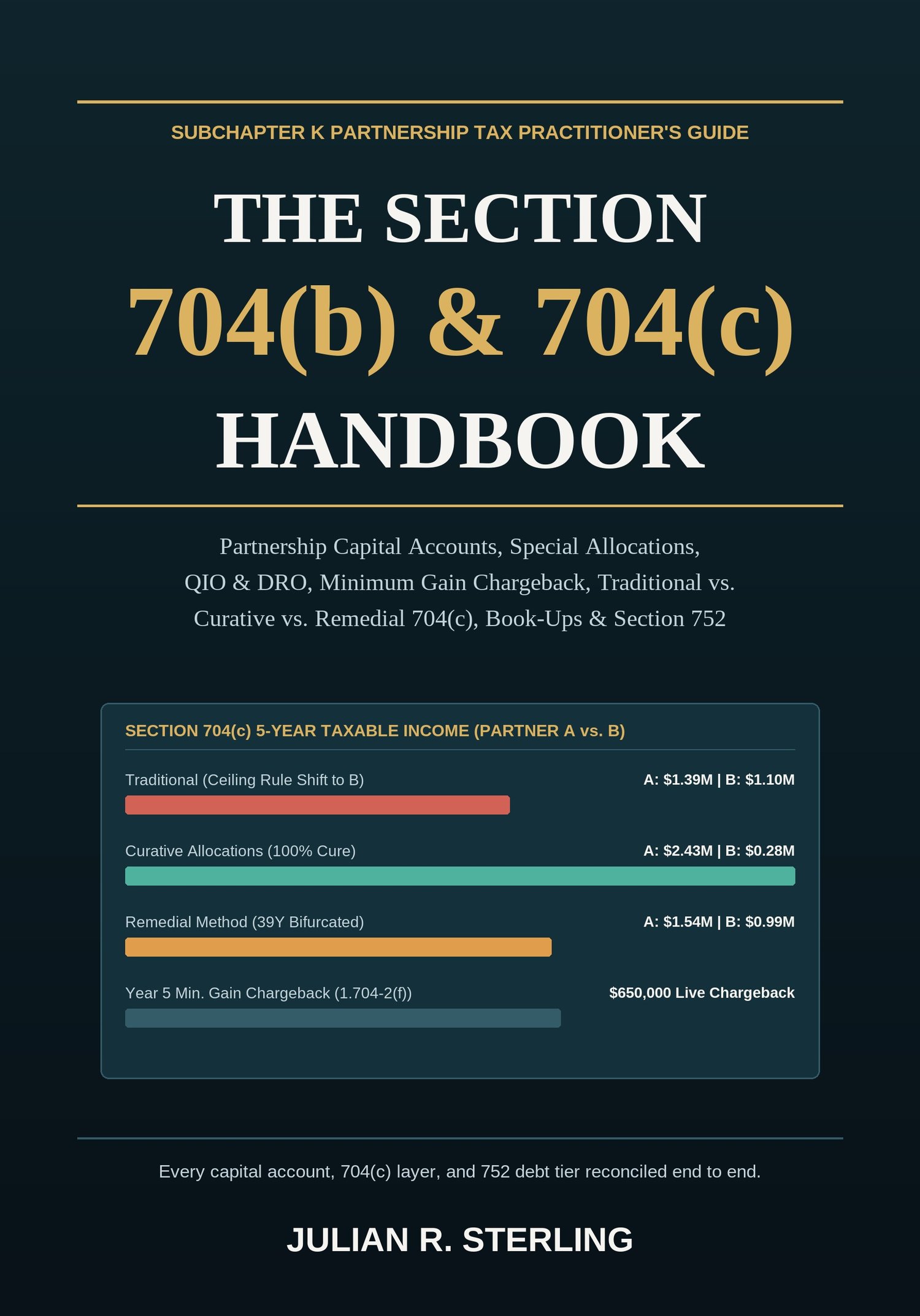
The Section 704(b) and 704(c) Handbook (PDF edition)
Every dollar of taxable income, depreciation, and cash flow inside a partnership passes through two interlocking engines: IRC Section 704(b) governs the economic split and capital account maintenance, while IRC Section 704(c) prevents partners from shifting precontribution built-in gain or loss onto one another. Layered underneath both is IRC Section 752, which allocates recourse and nonrecourse debt across partners and determines whether a negative tax capital account triggers immediate gain under Section 731(a).
One complete five-year partnership case study carries every computation from Day-1 formation to Year 5 Schedule K-1 reconciliation. In Oakridge Industrial Partners, LP (OIP), Partner A contributes Building A ($5,000,000 FMV, $710,000 tax basis, $4,290,000 built-in gain) subject to a $2,000,000 qualified nonrecourse mortgage, while Partner B contributes $3,000,000 cash. Under the Traditional Method, the ceiling rule shifts $179,000 per year of depreciation shortfall onto Partner B in Years 1-3, driving Partner B's five-year cumulative taxable income to $1,095,897.22 versus $281,597.22 under Curative Allocations and $993,823.18 under the Remedial Method. The exact same partnership then executes a Year 3 $2,200,000 nonrecourse cash-out refinancing, admits Partner C for $2,000,000 in Year 4 with a $3,340,000 Reverse Section 704(c) book-up, triggers a live $650,000 Minimum Gain Chargeback in Year 5, and tests the seven-year anti-mixing bowl rules under Sections 704(c)(1)(B) and 737.
What is inside:
- 15 chapters in four parts covering IRC Sections 704(b), 704(c), 704(d), 706(d), 707(a)(2)(B), 737, and 752 and Treasury Regulations 1.704-1(b)(2), 1.704-2, 1.704-3, 1.704-4, 1.737-1 through -5, and 1.752-1 through -3
- Complete capital-account architecture: Big Three Basic Test, unconditional DRO, Alternate Test with QIO, shifting/transitory substantiality, PIP, and modern target/forced waterfall allocations
- Nonrecourse deductions, Partnership Minimum Gain, the four-part safe harbor, Minimum Gain Chargeback (and its (f)(2)/(f)(3) exceptions), Partner Nonrecourse Debt, and the three-tier Section 752 debt waterfall
- Side-by-side five-year comparison of Traditional, Curative, and Remedial Section 704(c) methods, ceiling-rule economics, NPV tax differentials, and LPA negotiation clauses
- Reverse Section 704(c) book-ups, multi-layer tracking, anti-mixing bowl triggers under Sections 704(c)(1)(B) and 737, disguised sales, loss stacking (704(d)/465/469/461(l)), and Schedule K-1 Item L reconciliation
This edition: PDF, A5, 107 pages, DRM-free.