
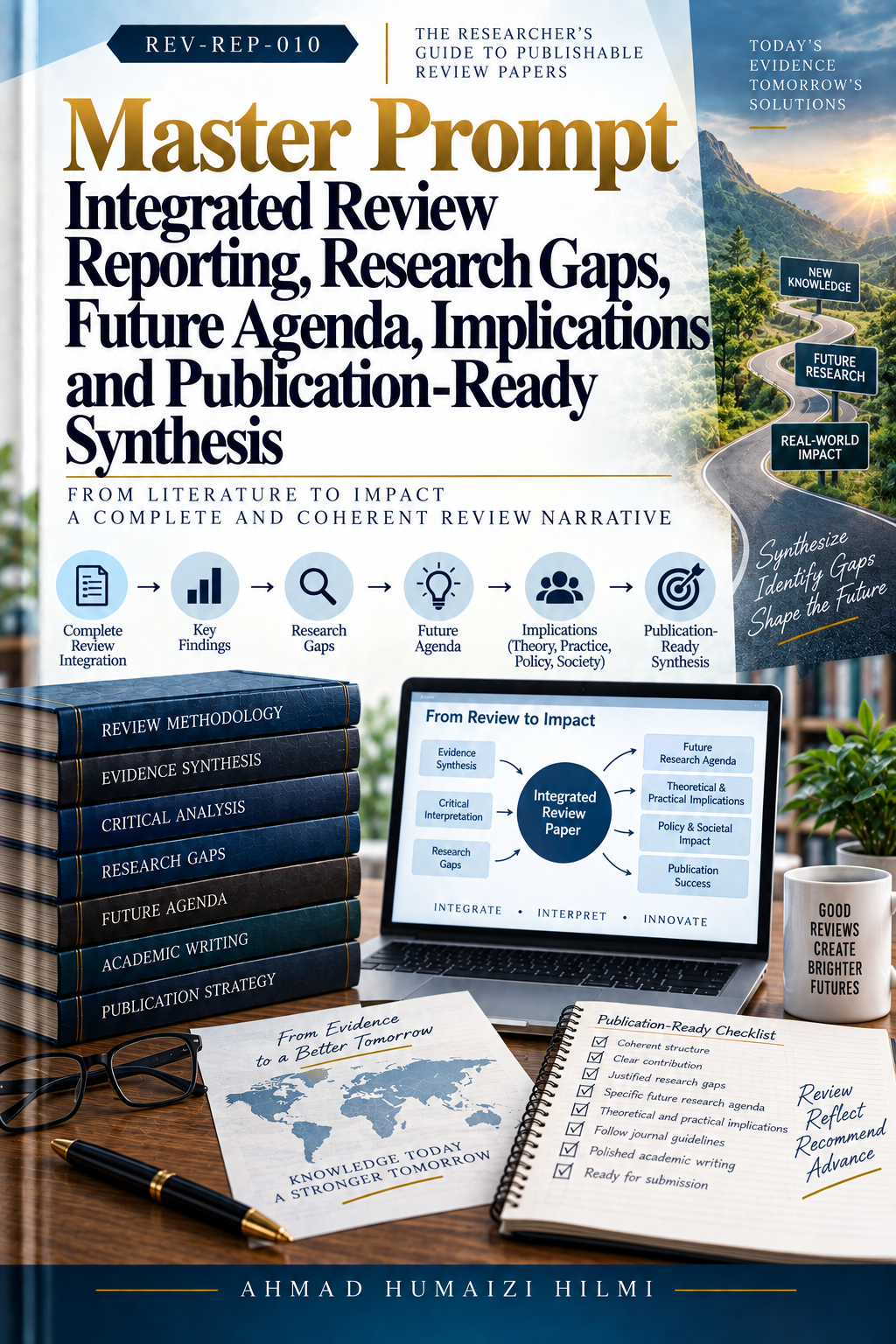
10. REV-REP-010 — Integrated Review Reporting, Research Gaps, Future Agenda, Implications and Publication-Ready Synthesis
Description
This Master Prompt focuses on transforming the complete review process into an integrated, transparent, evidence-traceable and publication-ready scholarly paper. It guides researchers in reconnecting the review problem, motivation, conceptual or theoretical foundation, review design, search strategy, eligibility and screening process, characteristics of included studies, methodological appraisal, evidence synthesis, critical interpretation, digital or AI-assisted procedures where used, principal findings, knowledge contribution, implications, limitations, research gaps, future research priorities and conclusion into a single coherent scholarly argument rather than presenting these components as disconnected sections. The final paper should demonstrate an explicit chain of reasoning from why the review was necessary to what evidence was identified, how that evidence was evaluated and synthesized, what can legitimately be concluded, and what remains unresolved. This emphasis is consistent with the uploaded literature showing that a usable review requires relevant scope, transparent reporting, appropriate searching, currency, critical appraisal and accessible study-level evidence rather than merely the existence of a published synthesis.
A major emphasis is placed on distinguishing a genuine research gap from a generic assertion that “more research is needed.” Every important gap should be demonstrably derived from the reviewed evidence and classified where appropriate as theoretical, conceptual, methodological, empirical, technological, population, geographical, contextual, measurement, data, validation, reproducibility, standardization, implementation, scalability, sustainability, policy, translational or commercialization related. An absence of studies should not automatically be described as a research gap without determining whether the absence is consequential to the review question. Likewise, contradictory evidence should not automatically be interpreted as a gap until plausible sources of disagreement have been examined. The uploaded collection demonstrates several forms of defensible gap identification: the HPV scoping review connects small samples, heterogeneity and lack of standardized protocols directly to the need for further validation; the integrated pulp-and-paper biorefinery review identifies limited treatment of environmental, economic and social sustainability; and the logic-model review identifies limited applied methodological guidance for incorporating frameworks into evidence synthesis.