





Trade Journaling Explained — Measured (PDF Guide)
You have been told to keep a journal and never told what it would take for the journal to answer a question. So it fills up with sentences, gets abandoned in a month, and the one month it did cover gets used to justify changing everything.
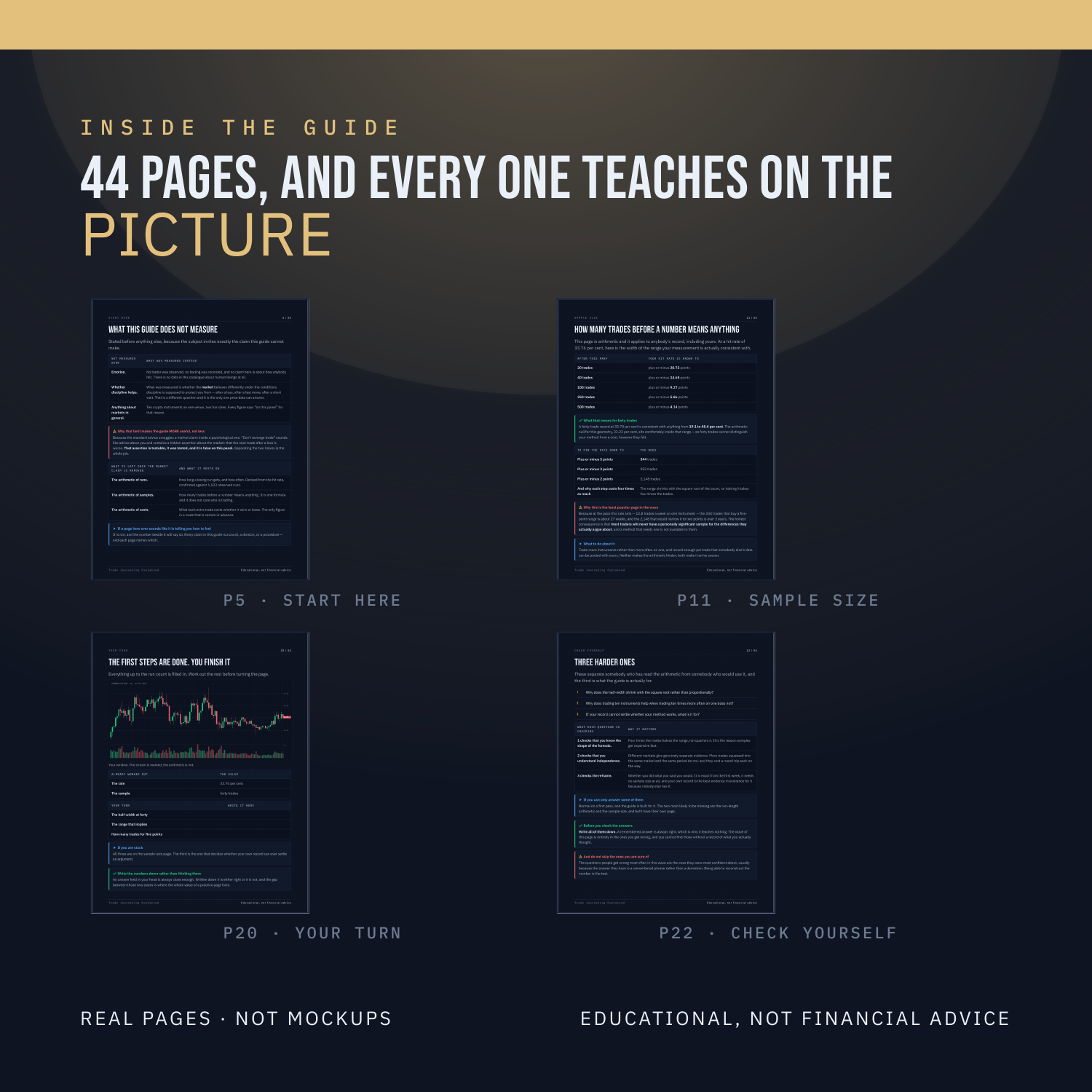
This guide does the arithmetic. It prints how wide the range around your hit rate is at twenty, forty, a hundred, two hundred and fifty and five hundred trades, and how many you would need to pin it down to five, three and two points. Every figure is one formula you can repeat. This is a 44-page PDF that teaches Trade Journaling from the first thing you see on the screen through to a written strategy with an entry, a stop and an explicit rule for when the trade is wrong.
Nothing is taught underneath a chart. Every label sits on the candle, the line or the level it is describing, on real BTC, ETH, SOL and LINK charts. There are three quizzes on real charts, each followed by the same chart re-shown annotated with the reasoning, plus faded practice pages where the first steps are filled in and you finish the rest.
WHAT'S INSIDE
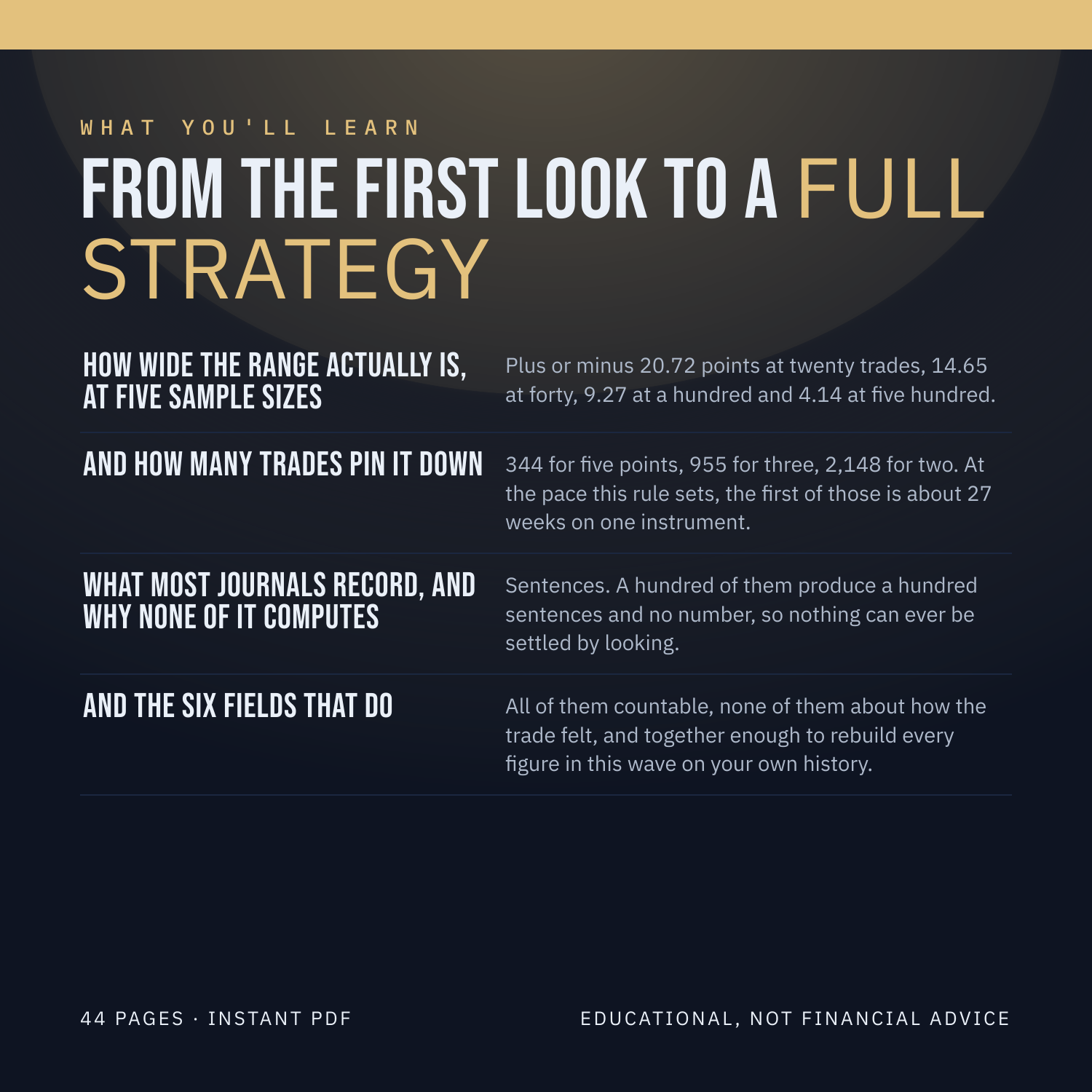
How wide the range actually is, at five sample sizes -- Plus or minus 20.72 points at twenty trades, 14.65 at forty, 9.27 at a hundred and 4.14 at five hundred.
And how many trades pin it down -- 344 for five points, 955 for three, 2,148 for two. At the pace this rule sets, the first of those is about 27 weeks on one instrument.
What most journals record, and why none of it computes -- Sentences. A hundred of them produce a hundred sentences and no number, so nothing can ever be settled by looking.
And the six fields that do -- All of them countable, none of them about how the trade felt, and together enough to rebuild every figure in this wave on your own history.
WHAT YOU'LL BE ABLE TO DO
State the error bar on your own hit rate in one formula.
Say how many trades a claim of yours would need.
Tell a field that computes from a field that only reads.
Get to a usable sample sooner without trading more often.
Refuse a conclusion drawn from a month of trades, politely.
AN HONEST NOTE
Trade Journaling is a clue, not a crystal ball. It describes what price has already done. This guide contains no win-rates, no backtest results and no promises about what you will make, because nobody can verify those and you should not trust anyone who prints them. What it hands you instead is a set of rules you can test yourself on TradingView in an afternoon. Educational, not financial advice.
Instant download. 44 pages, PDF.