
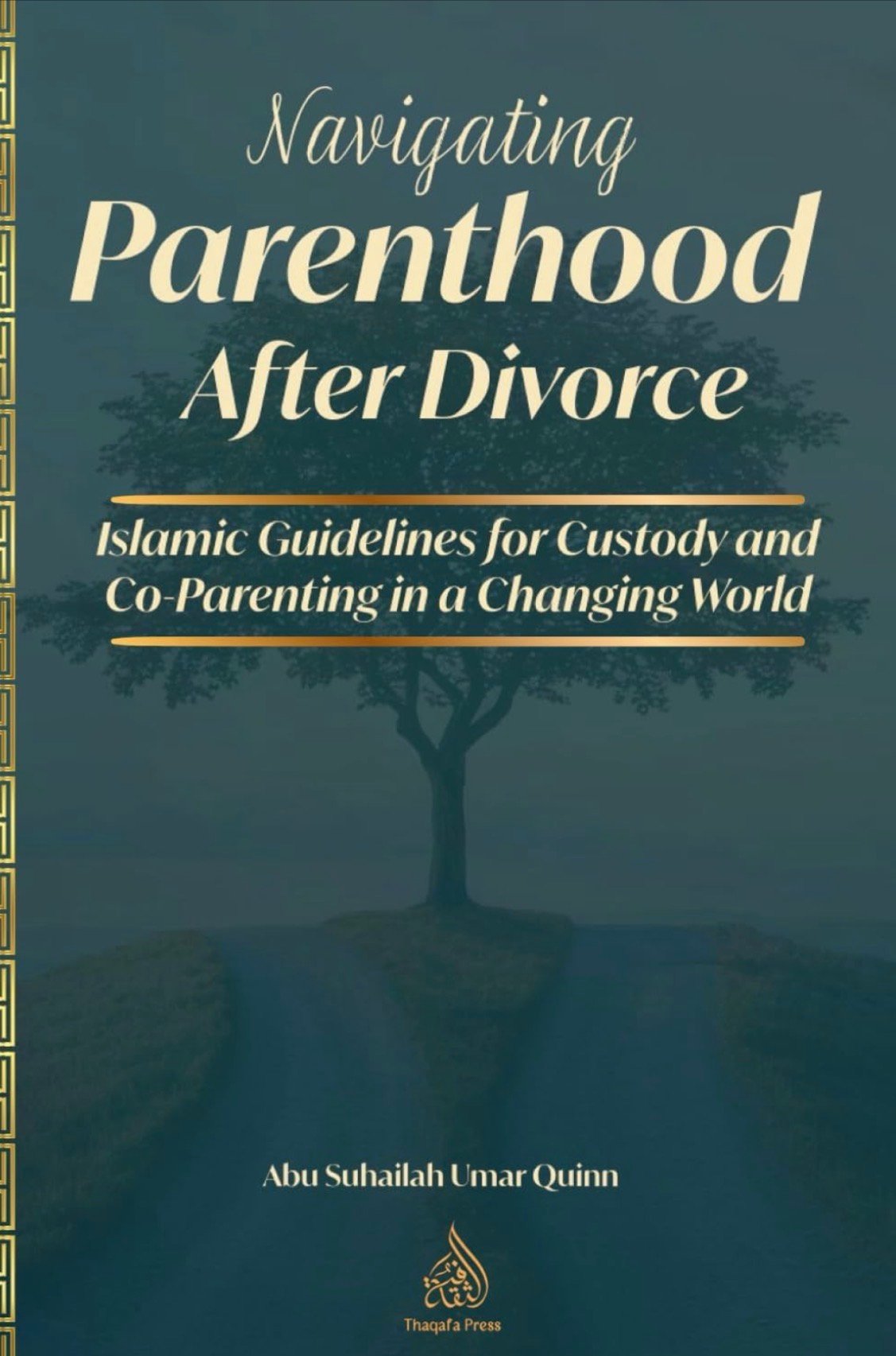
[EBOOK] Navigating Parenthood After Divorce: Islamic Guidelines for Custody and Co-parenting
Navigating Parenthood After Divorce Islamic Guidelines for Custody and Co-Parenting In a Changing World An In-Depth Exploration of the Advice & Rulings of Early & Contemporary Scholars
Custody is not an entitlement that follows automatically from being a parent. It is a form of guardianship, and Islamic law does not assign it by kinship alone. It assigns it to whoever is most capable of carrying the duty and most reliable in actually carrying it.
That principle governs everything in this book, and it cuts in directions people do not always expect.
Most Muslims navigating a divorce are working from a mix of half-remembered rulings, cultural assumptions, and whatever the community says. This book sets out what the jurists actually held, where they disagreed, and why — from the Qurʾān and Sunnah through the four schools to contemporary scholars addressing situations the classical manuals never faced.
Inside:
1. Stay Together in Kindness or Separate in Kindness. Why the family is a fortress, and why Iblīs targets it specifically. Giving reconciliation a real chance. Why divorce is nonetheless permitted as a last resort, and the obligation to forgive without forgetting the good that was shared. Cooperating afterward, and minimizing what the children absorb.
2. The Child's Welfare Always Takes Precedence. What ḥaḍānah actually means, and why the jurists placed it beside the chapter on maintenance. Why custody rulings exist to protect a child's body, mind, honor, and faith. How custom (ʿurf) enters where no explicit text governs, and what makes someone eligible in the first place: qudrah, the capability, and amānah, the trustworthiness.
3. The Default Responsibilities of the Mother & Father. The mother's prior right to custody, established from the Qurʾān, the Sunnah, and consensus. The father's financial duties, including the three categories of support owed during pregnancy and after birth, and why withholding them amounts to neglect. The three developmental stages that change the rules as a child grows. And the non-custodial parent's right of visitation, which the jurists agree on.
4A. Does relocation disqualify the mother? The well-known disagreement laid out school by school — Aḥmad, Mālik, al-Shāfiʿī, and Abū Ḥanīfah each held something different, and each had reasons.
4B. What if the stepfather agrees to the mother keeping custody? Including Ibn ʿUthaymīn on the women who stay unmarried for years because they fear losing their children.
Conclusion: Abusing Custody Rights. Obstructing visitation, manipulating financial obligations, weaponizing custody arrangements. Islamic law treats the misuse of a right as transgression, equivalent to a direct violation, because the harm is the same. This is the chapter most relevant to what actually happens in our communities, and the least discussed.
Throughout, the words of Ibn Taymiyyah, Ibn al-Qayyim, Ibn Qudāmah, al-Mardāwī, Ibn al-ʿArabī, Imām Mālik, al-Shawkānī, Ibn al-Humām, al-Bājī, Ibn ʿUthaymīn, Āl Bassām, and Imām al-Saʿdī, with the Arabic set alongside the English and every citation documented.
What you receive:
- EPUB for phones, tablets, and e-readers
- PDF at 6 × 9, matching the printed edition page for page
- Detailed study guide
The Arabic is fully vocalized and embedded, and displays correctly on any device.
Published by ThaqafaPress.