
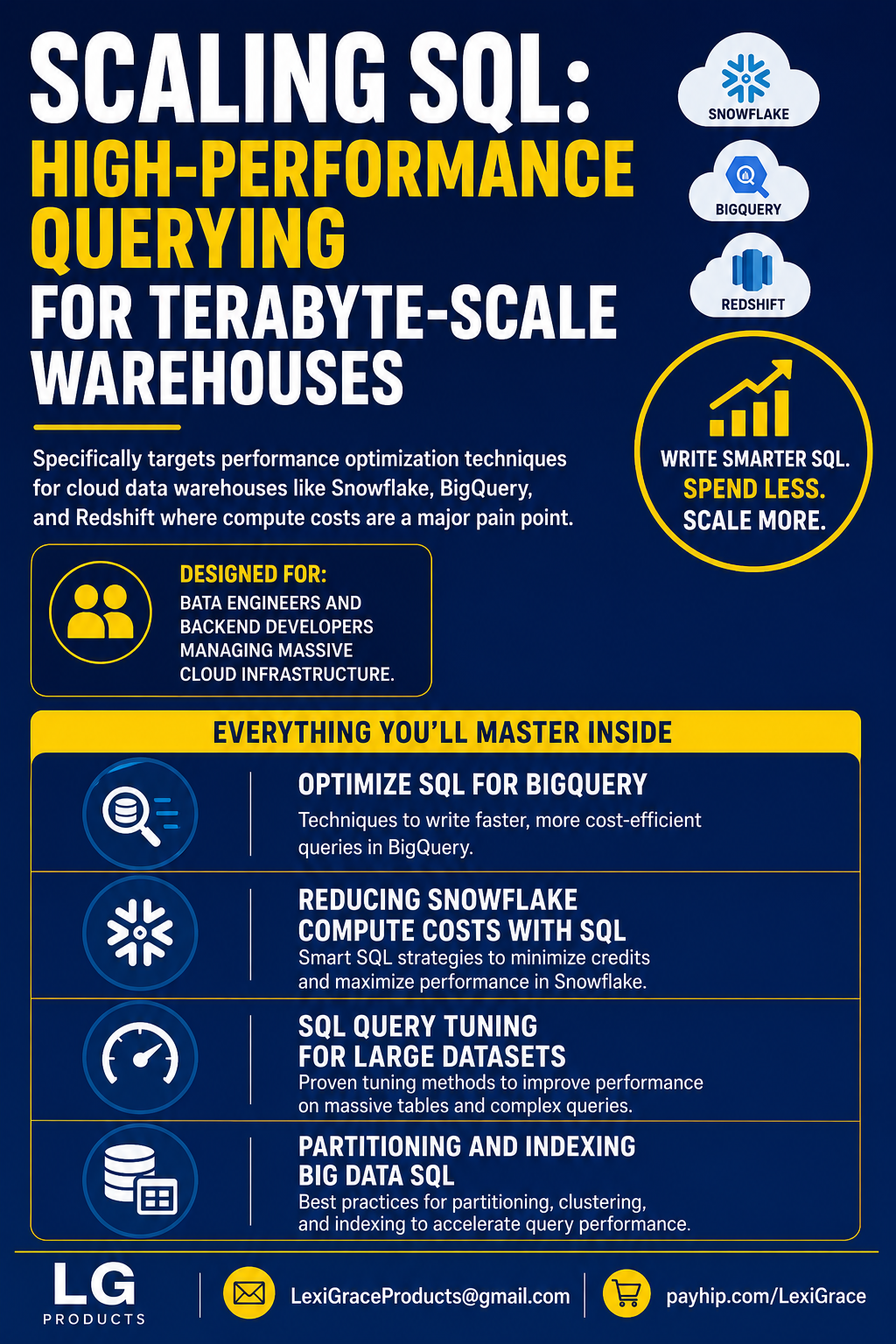
Scaling SQL: High-Performance Querying for Terabyte-Scale Warehouses — The Complete BigQuery, Snowflake and Redshift Optimization Guide
Your cloud SQL bill is not a data problem. It is a query problem. And this guide fixes it.
A single analyst running an unoptimized query on BigQuery can generate $25 in charges in one execution. If that query runs 50 times per day the monthly bill is $37,500 — for one query from one person. Snowflake charges by the second for active compute — a poorly written query that takes 10 minutes on a Large warehouse costs 13 times more than the same result achieved in 45 seconds on a Small warehouse. Redshift clusters running with low utilization waste money every hour on idle compute.
The performance difference between optimized and unoptimized SQL on these platforms is not marginal. It is typically 10x to 100x in both speed and cost. This guide teaches you to close that gap permanently.
Scaling SQL: High-Performance Querying for Terabyte-Scale Warehouses is the complete SQL optimization guide for data engineers and backend developers managing BigQuery, Snowflake, and Amazon Redshift — covering partitioning, clustering, materialized views, execution plan analysis, cost monitoring, and governance frameworks that prevent runaway bills before they happen.
Every optimization is shown with real SQL code. Every technique includes before-and-after cost comparisons. Every chapter covers all three platforms so you can apply the lessons immediately regardless of which warehouse you use.
What's Inside:
✅ Introduction — The cost of unoptimized SQL with a five-row platform comparison table showing unoptimized versus optimized query costs — including a real example where a single daily BigQuery query costs $37,500 per month unoptimized versus $375 optimized, a 99 percent reduction
✅ Chapter 1 — SQL query tuning for large datasets — five universal optimization principles that apply across all three platforms: eliminating SELECT * to reduce data scanned by 80 to 95 percent, pushing filters before joins for 22x runtime improvement, avoiding functions on WHERE columns to enable partition pruning, salting join keys to fix data skew, and using approximate functions that deliver 99.97 percent accuracy at 1 percent of the compute cost
✅ Chapter 2 — Optimize SQL for BigQuery — date column partitioning achieving 99.6 percent cost reduction on a single query, four-column clustering for secondary filter optimization reducing data scanned by 98.6 percent, materialized views that reduce a $45 query to $0.01 through automatic optimizer interception, dry run cost estimation before execution, and INFORMATION_SCHEMA monitoring queries for daily cost reports
✅ Chapter 3 — Reducing Snowflake compute costs with SQL — the complete warehouse size and credit cost reference table, automatic clustering and micro-partition pruning verification, Snowflake's three cache layers including the result cache that serves repeated dashboard queries at zero credits, smart AUTO_SUSPEND configuration to eliminate idle billing, and separate warehouse strategy for ETL versus BI workloads
✅ Chapter 4 — Amazon Redshift performance tuning — the four distribution styles explained with a complete decision table, optimized table creation with KEY distribution and compound sort keys, EXPLAIN plan reading guide identifying DS_BCAST_INNER and DS_DIST_BOTH as expensive redistribution operations, WLM queue configuration for workload isolation, and the critical VACUUM and ANALYZE commands that restore performance after bulk data loads
✅ Chapter 5 — Partitioning and indexing big data SQL — partitioning philosophy explained for all three platforms including BigQuery physical file partitioning, Snowflake micro-partition clustering, and Redshift zone map sort keys, a five-row query pattern to partitioning strategy decision matrix covering date filters, category filters, point lookups, analytical joins, and rolling window queries, and partition pruning verification queries for each platform
✅ Chapter 6 — Window functions and CTEs — running totals, 7-day moving averages, LAG and LEAD for period comparison, and month-over-month growth rate in a single query pass, efficient CTE patterns that scan tables once instead of five times, BigQuery UNNEST optimization reducing array scan cost, and the QUALIFY clause replacing expensive nested subqueries for row filtering and deduplication
✅ Chapter 7 — Query profiling and execution plans — BigQuery INFORMATION_SCHEMA analysis identifying high bytes-to-result ratio queries, Snowflake QUERY_HISTORY analysis detecting spill to local and remote storage as a warehouse sizing signal, Redshift STL_QUERY diagnostics for slow query identification, filter selectivity analysis, and lock wait detection for concurrency issues
✅ Chapter 8 — Cost monitoring and governance — BigQuery real-time cost monitoring view with daily user-level spend alerts, Snowflake RESOURCE MONITOR configuration with automatic warehouse suspension at budget thresholds, and a complete eight-policy governance framework covering no-SELECT-* enforcement, partition filter requirements, pre-production cost estimate gates, query tagging, and dev/prod warehouse separation
✅ Bonus — Complete SQL Reference — a 12-item pre-production optimization checklist, a 12-row platform feature quick reference comparing BigQuery, Snowflake, and Redshift across billing model, partitioning, clustering, query cache, cost estimation, and materialized views, and the Top 10 Most Expensive SQL Anti-Patterns table with cost impact and fix for each one
This guide is perfect for:
- Data engineers who manage BigQuery, Snowflake, or Redshift and receive monthly cloud bills that feel too high
- Backend developers writing analytical queries against cloud data warehouses who want to understand why their queries are slow and expensive
- Analytics engineers building dbt models who want to ensure every model is cost-optimized before production deployment
- Data platform leads building governance frameworks to prevent runaway costs from analyst queries
- Anyone who has received a surprising cloud data warehouse bill and wants to understand exactly what happened and how to prevent it
The queries exist. The data exists. The bill arrives every month.
The only question is whether your SQL is reading 5TB when it should be reading 50GB. Whether your joins are shuffling data across nodes when they should be collocated. Whether your dashboards are recomputing aggregations that should be materialized. Whether your analysts have any guardrails preventing a full table scan on a 10TB table.
This guide answers every one of those questions — with SQL you can run today.
Write Smarter SQL. Spend Less. Scale More.
Instant digital download. Start optimizing your cloud SQL costs today.
Note: SQL examples and cost figures use BigQuery on-demand pricing ($5/TB), Snowflake standard pricing ($3/credit), and Redshift on-demand pricing. Actual costs vary by region, contract, and usage patterns. Always verify current pricing at each platform's official website.
© 2026 Lexi Grace Products | LexiGraceProducts@gmail.com | payhip.com/LexiGrace