
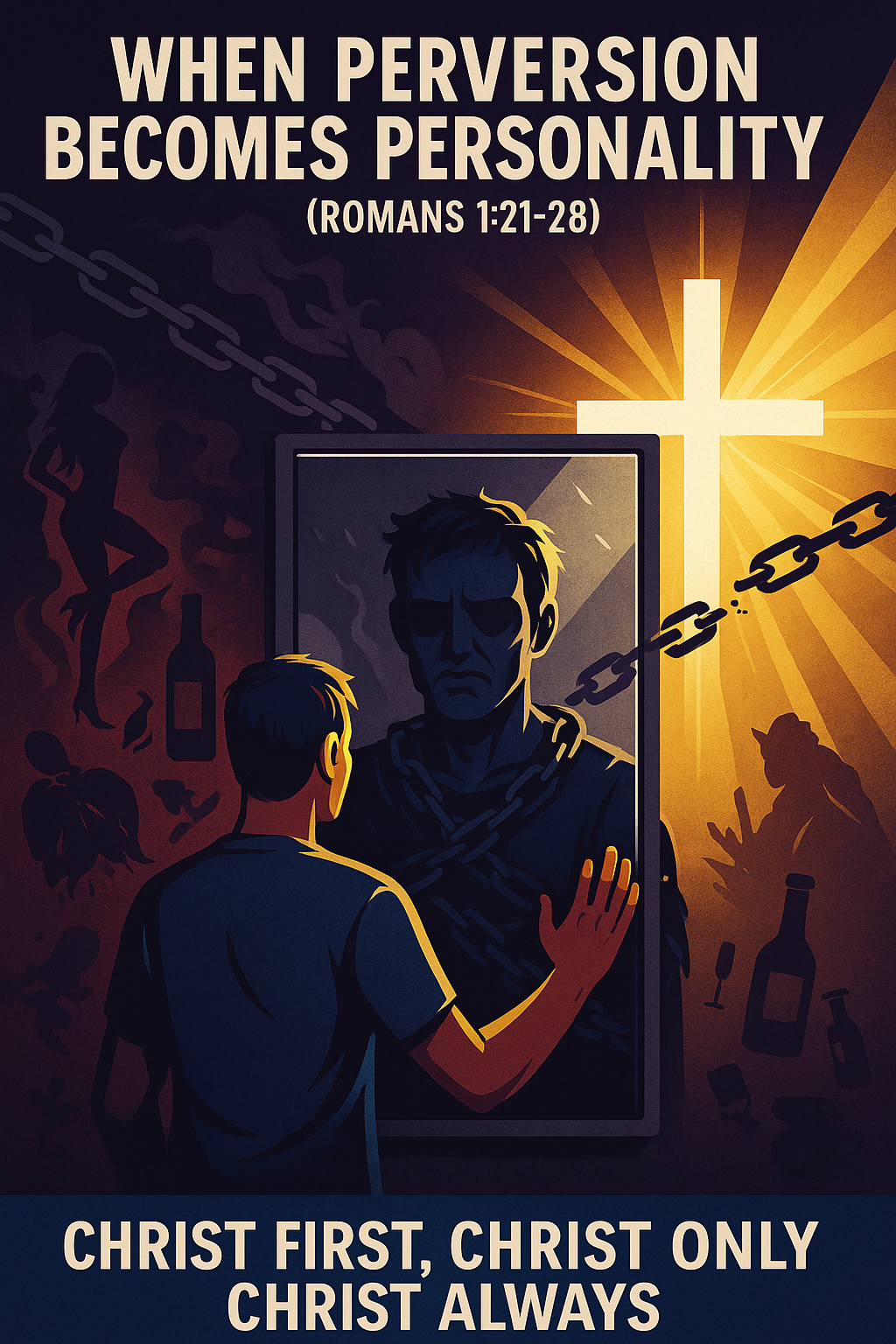
“When Perversion Becomes Personality” (Romans 1:21–28)
“When Perversion Becomes Personality” (Romans 1:21-28)
Everyone has a “secret” or private life, including our children and grandchildren. And it is the truth of Scripture that what we practice most in our private life or what we even fantasize about the most in our private life, over time, becomes a predominant part of our personality (James 1:14-15).
Many people that we meet are walking, talking personifications of their private and sometimes public perversions. This is the mother who is always high when she drops her children off for school.
This is the man who must have a drink every single day of his life. When their inhibitions are lowered, so are their sexual standards. Some things you have to be drunk or high to do the first few times. These acts all begin with someone’s private, yet perverted thoughts and fantasies.
For example, the LGBTQ community is an outgrowth of the sexual fantasies and private practices of everyday people like you and me. Men and women would go to special cinemas, sexual stores, and even patronize mail order catalogues to keep their predilections private, while still practicing them.
These practices are what God calls perversions. Some of the more specific practices that God calls perversions are homosexuality/lesbianism (Romans 1:26-27); bestiality (Leviticus 18:23); incest (Leviticus 18:6-18); and adultery (Leviticus 18:20; Proverbs 6:32). The words “perversion” or “perverted” are used in Scripture to mean that it is a corruption of what God designed to be good.
Following closely on these sexual perversions are the perversions associated with alcohol and drugs. Drunkenness, even in the privacy of your own home is a perversion (Proverbs 20:1; Ephesians 5:18, Galatians 5:19-21).
Drug use that enslaves the body and mind is called “sorcery” from the Greek word from which we get our English word “pharmacy” (Galatians 5:20; Revelation 9:21; 21:8). Drug and alcohol abuse are dangerous, scripturally because they open the mind to destructive and even demonic influences.
Sadly, within this age of depression and high anxiety, so many have allowed what was initially a private perversion, to become one of the cornerstones of their personality. What we practice, we become addicted to. What we become addicted to shapes our personality.
The perversion itself becomes our outward identity, influencing how we see the world and how we treat others. This is one of the reasons why liquor stores were considered essential businesses during the 2020 pandemic and marijuana usage is not treated as a criminal offense. This is also the reason why men and women who are with multiple partners no longer see it as a public stigma.
Even in Christian settings, it is no longer shameful to have openly gay musicians or sexual predators in leadership who groom the children of the church or help single mothers pay bills.
While the text under our consideration speaks primarily to sexual perversions, the progression of these initially private, sinful acts is common among all perversions and addictions. Consider the following four points.
1. Private thoughts birth perversions.
a. We are called upon to guard our hearts because from it flow the issues of life (Proverbs 4:23). We are also told that as a man thinketh in his heart, so is he (Proverbs 23:7).
b. Pornography is a perversion because it stimulates the mind with images that are ungodly. From the recessions of our dark minds, these images not only separate us from God, they control us (Ephesians 4:18).
i. This is precisely why women are commanded to dress modestly, because of the private thoughts of both men and women that have birthed perversions (1st Timothy 2:9-10; 1st Peter 3:3-4).
ii. This is also why men should wear clothing appropriate for men and conducive to masculinity; likewise for the women (Deuteronomy 22:5).
c. When we get our pleasures from darkness, we resist the light that is Christ (John 3:19-20).
2. Emptiness, chaos and confusion crave addiction.
a. The word employed by Paul in Romans 1:21 is “vain” and it means empty.
b. When there is no meaningful home life from which a child learns peace and contentment, emptiness and confusion reigns. James wrote that “where envying and strife is, there is confusion and every evil work” (James 3:16).
3. As the perversion grows, there is no room for anything else.
a. The once private perversion that began early in life grows publicly until it overtakes or it’s intertwined with our personality (James 1:13-15). James argues that it will not be finished with us until there is nothing else left to take.
b. Satan destroys anything that remotely looks like Christ – including what remains of His image in us (John 10:10; 1st Peter 5:8; Genesis 3:1-5).
c. Paul says three times (in Romans 1:24, 26, 28) that God has turned them over to what seeks to destroy them.
4. Christ can break the power of the perversion.
a. We should desire to be a child of God so He does not reject us (Matthew 7:23).
b. God (through Christ) will bring us out of the darkness of perversion (1st Peter 2:9).
“Christ First, Christ Only, Christ Always”