






Doji Explained — Read the pause (PDF Guide)
You learned that a doji means indecision and a reversal is coming. So you started marking them, and there were far more than you expected, and most of them preceded nothing at all. You assumed you were marking them wrong. You were not - at the usual setting there is one roughly every 18 bars, and no book ever told you what the setting was.
A doji is a candle whose body is a small fraction of its range. How small is a threshold you choose, and this guide states it, keeps it, and shows what it costs: 1,017 doji at two per cent against 7,915 at twenty, on the same 35,944 bars. Then it measures the two variants that claim a direction - and prints the reason neither one survived. This is a 42-page PDF that teaches Doji from the first thing you see on the screen through to a written strategy with an entry, a stop and an explicit rule for when the trade is wrong.
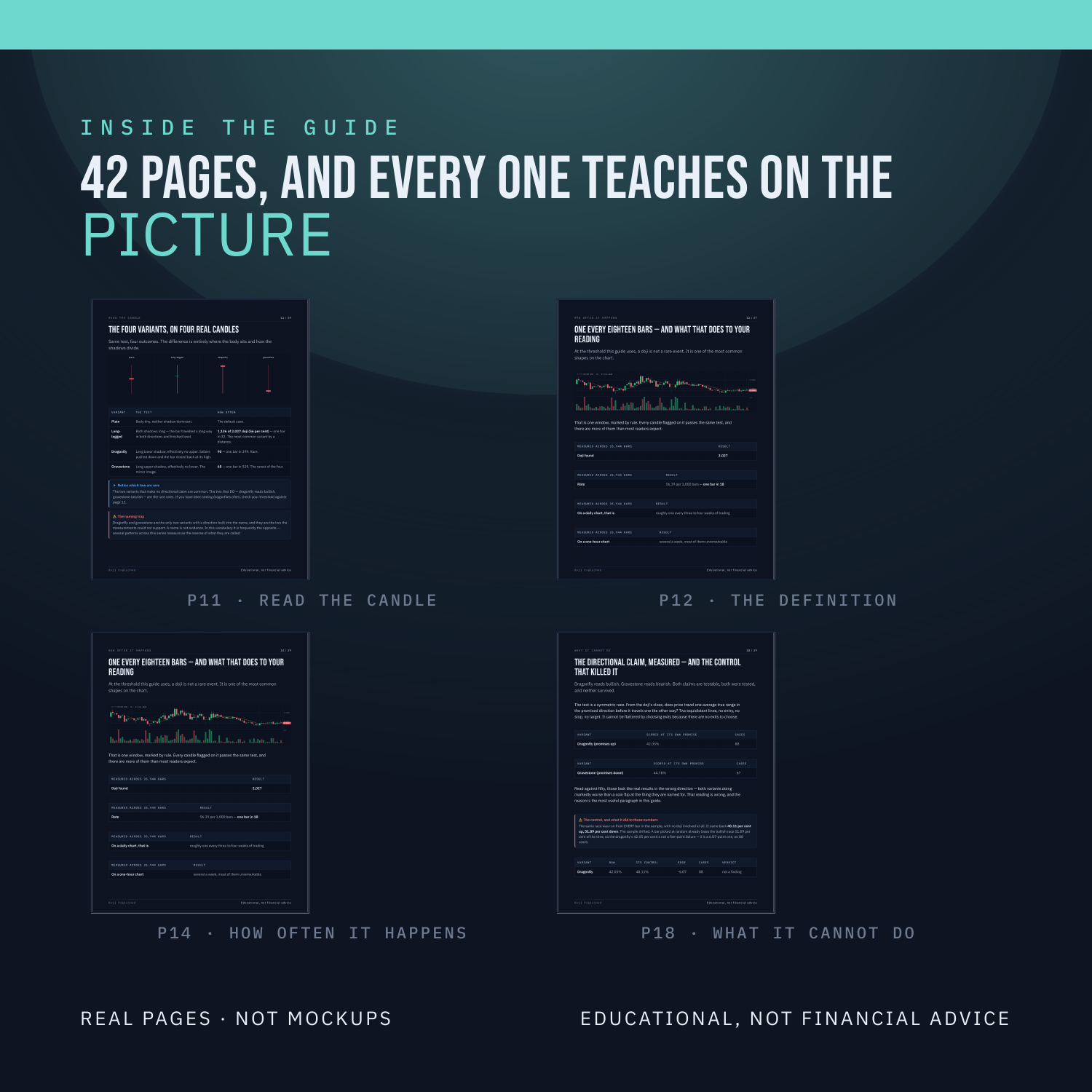
Nothing is taught underneath a chart. Every label sits on the candle, the line or the level it is describing, on real BTC, ETH, SOL and LINK charts, with the measured ratios printed on the candles. There are three quizzes on real charts, each followed by the same chart re-shown annotated with the reasoning, plus faded practice pages where the first steps are filled in and you finish the rest.
WHAT'S INSIDE
- The number the textbooks leave out — The threshold is a choice. Across 35,944 bars the count runs from 1,017 to 7,915 depending on which book you read.
- - How common it really is — 2,027 doji in 35,944 bars - one bar in 18. Most of them are not telling you anything, and that is the expected result.
- - The four variants, and which two are rare — Long-legged is 56 per cent of them. Dragonfly and gravestone - the only two with a direction in the name - are one bar in 399 and one bar in 529.
- - The control that killed two findings — Dragonfly scored 42.05 per cent and gravestone 44.78 at their own promise. Both are noise once measured against a random bar, and the guide shows the working.
- - What it is genuinely for — Locating. A flat close at a level you marked first is evidence. The same candle in open space is a bar that closed flat.
WHAT YOU'LL BE ABLE TO DO
- State the threshold you use, and say what changing it costs you.
- - Tell the four variants apart mechanically, in two numbers off the chart.
- - Say how often a doji should appear, before you count them.
- - Ask any candlestick claim the two questions it usually cannot answer: compared with what, and on how many?
- - Use the candle for location instead of direction, with a written invalidation.
AN HONEST NOTE
Doji is a clue, not a crystal ball. It describes what price has already done. This guide contains no win-rates, no backtest results and no promises about what you will make, because nobody can verify those and you should not trust anyone who prints them. What it hands you instead is a set of rules you can test yourself on TradingView in an afternoon. Educational, not financial advice.
Instant download. 42 pages, PDF.