
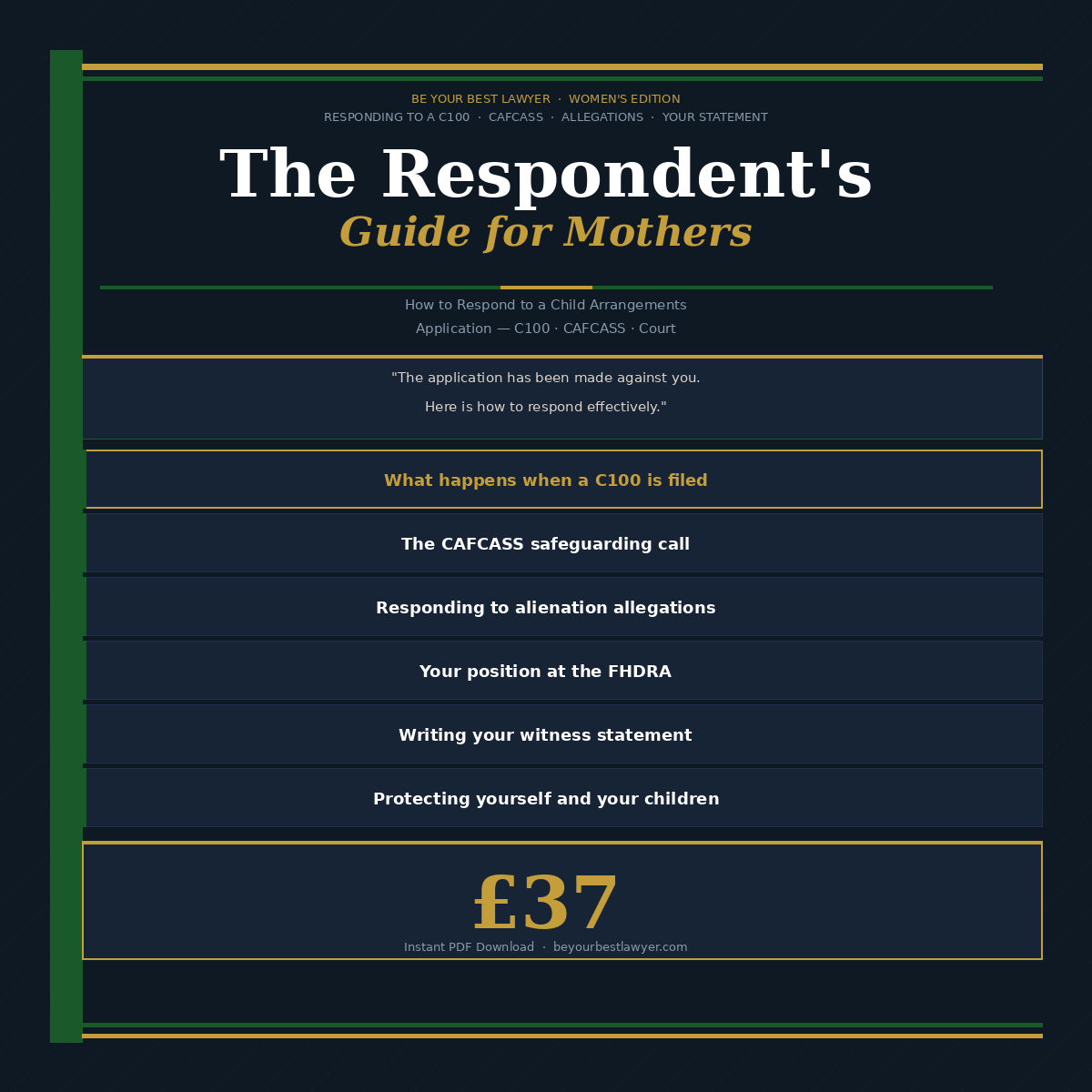
The Respondent's Guide — How to Respond to a Child Arrangements Application
The application has been made against you.
Here is how to respond effectively.
Your child's father has filed a C100 application. You
have been served with court papers. The court is being
asked to make an order about your children that you
did not initiate.
This guide is written specifically for respondent
mothers — because the respondent's experience of
family court is genuinely different from the applicant's,
and that difference matters.
WHAT THIS GUIDE COVERS:
PART 1 — WHAT HAPPENS WHEN A C100 IS FILED
The C7 Acknowledgment of Service — what to say and
what not to say. The CAFCASS safeguarding call —
when it will happen and what to expect. The FHDRA —
what it is and how long you have to prepare.
PART 2 — THE CAFCASS SAFEGUARDING CALL
The call that matters most in the early stages — and
the one most mothers approach without preparation.
What CAFCASS is actually listening for. How to present
genuine welfare concerns clearly and credibly. What
not to say — and why.
PART 3 — IF YOU ARE FACING ALLEGATIONS
The allegation of parental alienation — what it means,
how seriously courts take it, and how to respond. The
most powerful response is a consistent record of having
supported the relationship. This section tells you how
to build and present that record.
PART 4 — YOUR POSITION AT THE FHDRA
How to approach the first hearing with a positive
proposal — not just opposition. What the court expects
from a respondent. When welfare concerns justify
resisting contact, and how to present them effectively.
PART 5 — WRITING YOUR WITNESS STATEMENT
Structure, content and tone. What to include — and
what to leave out. The version you write at midnight
is not the version that should go to court.
PART 6 — PROTECTING YOURSELF AND YOUR CHILDREN
If there is a history of domestic abuse — what to
disclose, when and how. The children's voice —
what courts do with it and what you must never do.
The single rule that covers everything.
WHAT YOU GET:
✓ Complete respondent's guide — 6 parts
✓ Covers C7, CAFCASS, FHDRA, witness statement
✓ Specific guidance on alienation allegations
✓ Written by a qualified solicitor (non-practising)
✓ PDF — instant download, lifetime access
No deposit. No hourly rate. Just the knowledge
you need to respond effectively.
For educational purposes only. Not legal advice.
Eugene Pienaar is a non-practising Solicitor of the
Supreme Court of England and Wales.