




Liquidity Grabs Explained — See stop hunts (PDF Guide)
You put your stop just above the obvious high, the way you were taught. Price spiked through it by a hair, took you out, and reversed without you. It felt personal. It was not personal, it was structural, and it is measurable to within a fraction of a per cent.
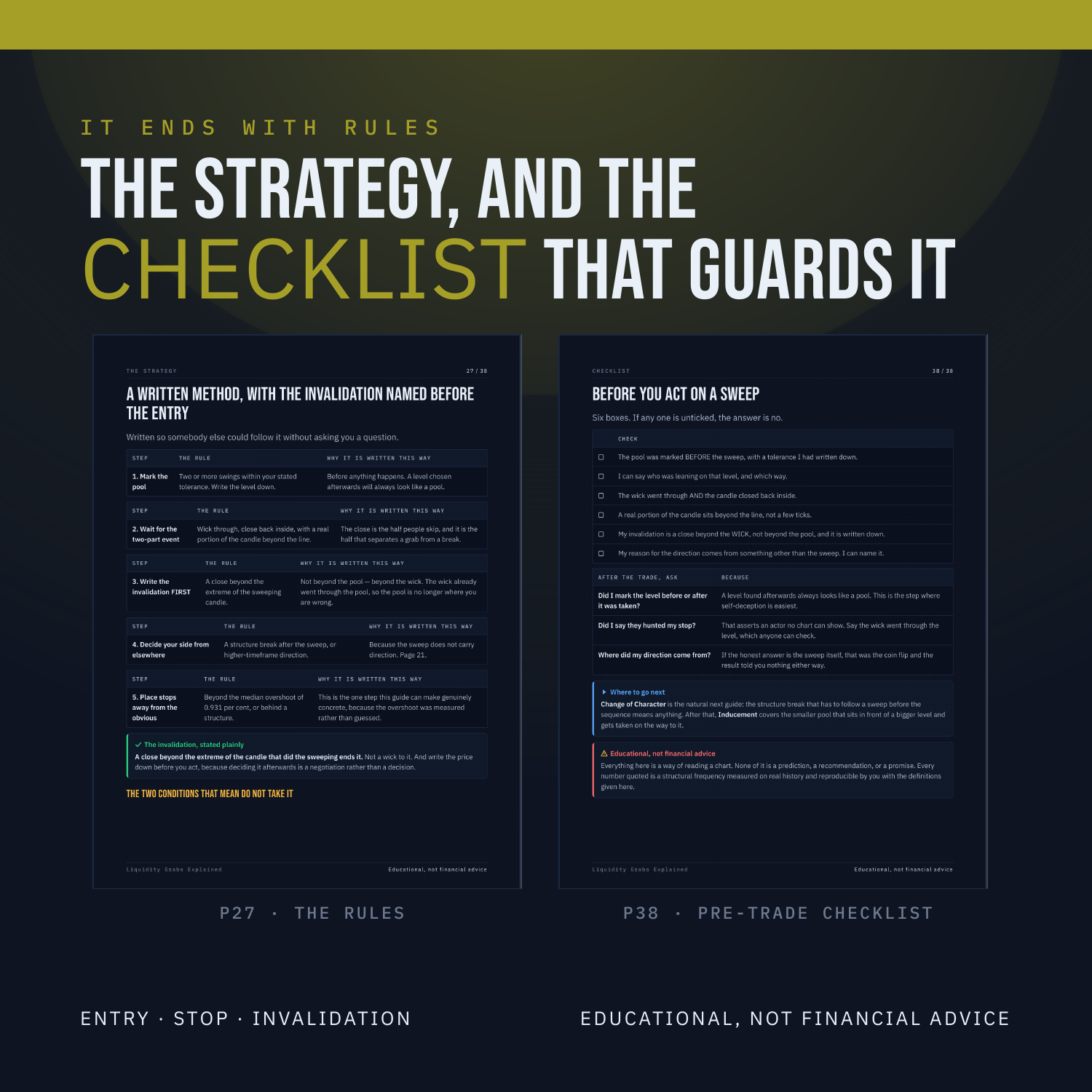
A liquidity grab is a two-part event with an exact test: the wick goes THROUGH a level where stops cluster, and the candle closes back INSIDE. Measured across 1,247 equal-high and equal-low pools on 35,944 bars of real history, 72.41% were taken that way against 10.26% that broke cleanly, and the median grab reached 0.931% beyond the level. That last figure is the practical one: it tells you how far past an obvious level stops actually get taken. This is a 38-page PDF that teaches Liquidity Grabs from the first thing you see on the screen through to a written strategy with an entry, a stop and an explicit rule for when the trade is wrong.
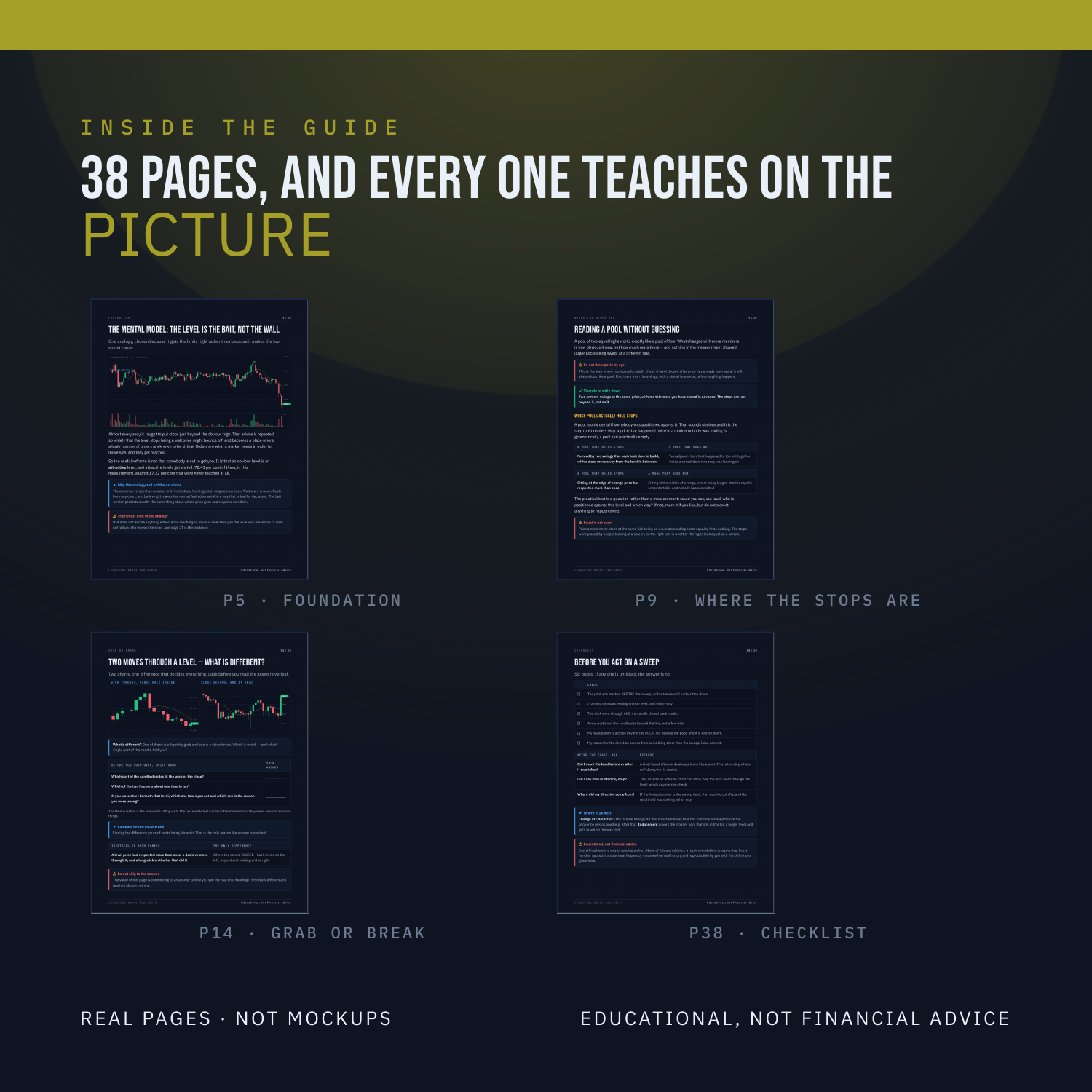
Nothing is taught underneath a chart. Every label sits on the candle, the line or the level it is describing, on real market data. There are three quizzes on real charts, each followed by the same chart re-shown annotated with the reasoning, plus faded practice pages where the first steps are filled in and you finish the rest.
WHAT'S INSIDE
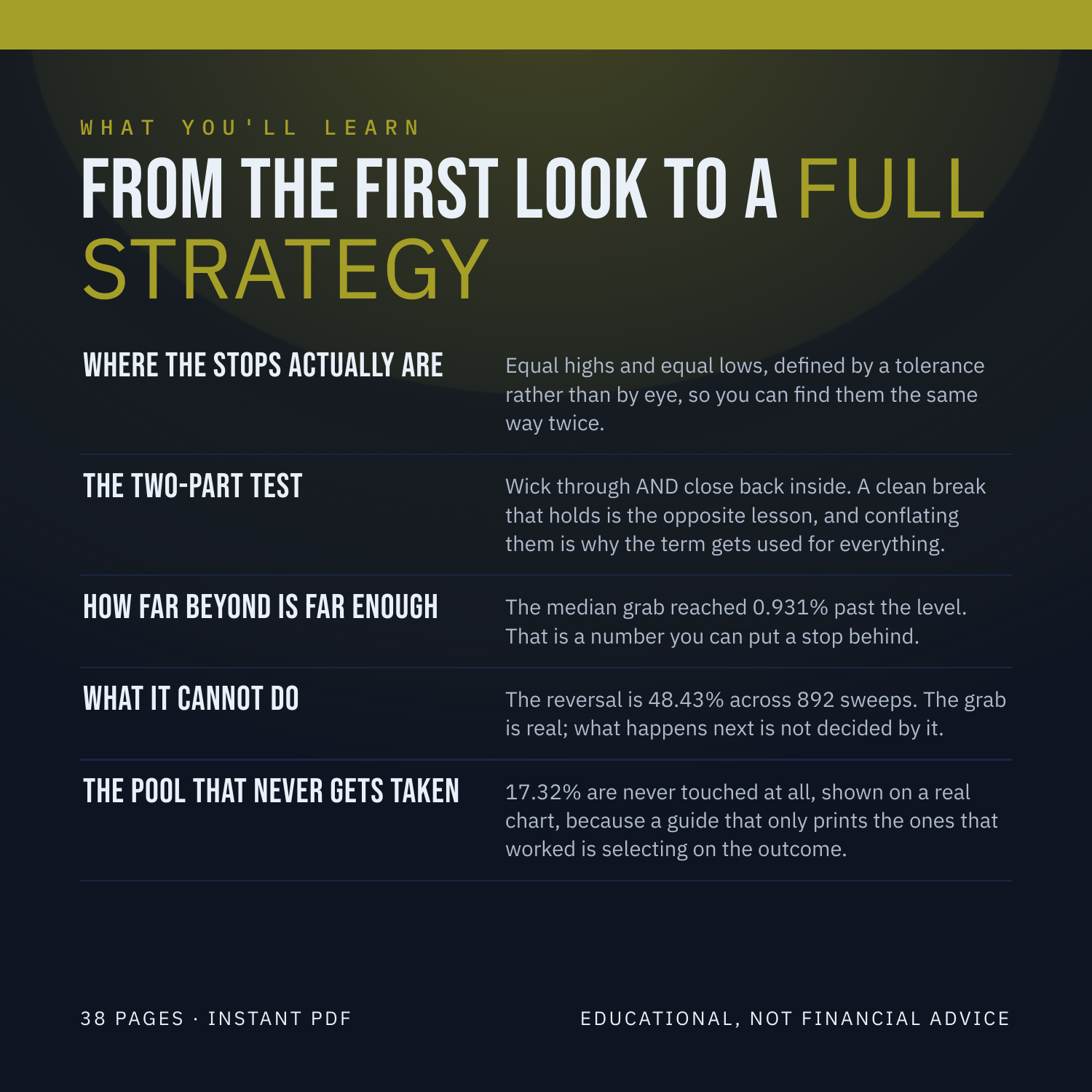
- Where the stops actually are — Equal highs and equal lows, defined by a tolerance rather than by eye, so you can find them the same way twice.
- The two-part test — Wick through AND close back inside. A clean break that holds is the opposite lesson, and conflating them is why the term gets used for everything.
- How far beyond is far enough — The median grab reached 0.931% past the level. That is a number you can put a stop behind.
- What it cannot do — The reversal is 48.43% across 892 sweeps. The grab is real; what happens next is not decided by it.
- The pool that never gets taken — 17.32% are never touched at all, shown on a real chart, because a guide that only prints the ones that worked is selecting on the outcome.
WHAT YOU'LL BE ABLE TO DO
- Find where stops cluster, by rule rather than by eye.
- Tell a liquidity grab from a clean break, with a two-part test.
- Say how far beyond a level a grab typically reaches.
- Place a stop somewhere less obvious, and explain why.
- Say what a sweep does and does not tell you, with the numbers.
AN HONEST NOTE
Liquidity Grabs is a clue, not a crystal ball. It describes what price has already done. This guide contains no win-rates, no backtest results and no promises about what you will make, because nobody can verify those and you should not trust anyone who prints them. What it hands you instead is a set of rules you can test yourself on TradingView in an afternoon. Educational, not financial advice.
Instant download. 38 pages, PDF.