
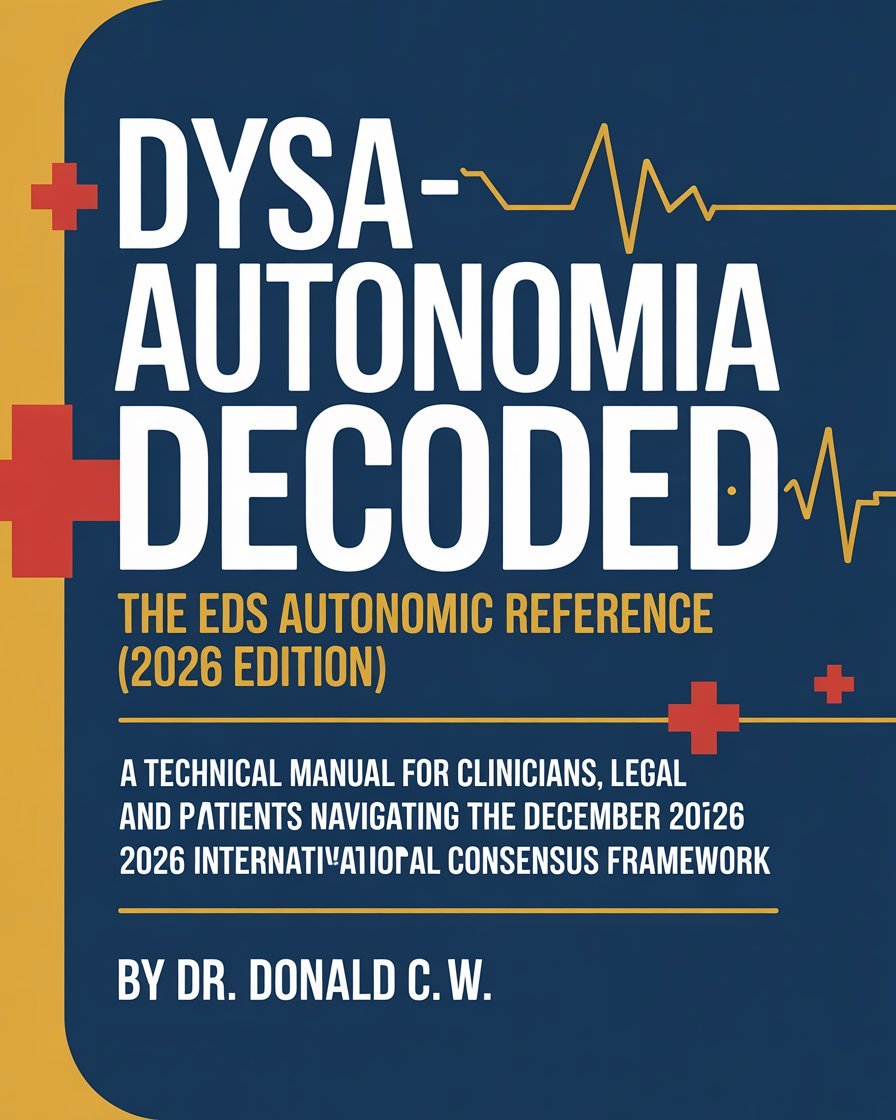
DYSAUTONOMIA DECODED The EDS Autonomic Reference (2026 Edition)
DYSAUTONOMIA DECODED: The EDS Autonomic Reference (2026 Edition) is a book about navigating the complex intersection of Ehlers-Danlos Syndromes, autonomic dysfunction, and mast cell disorders for patients, clinicians, and legal advocates who need authoritative, actionable guidance grounded in the December 2026 International Consortium Global Diagnostic Update.
This book is for the high-literacy patient who has spent years searching for answers that internet forums and outdated medical textbooks cannot provide. It is for the physician who wants to practice at the cutting edge of connective tissue medicine but needs precise clinical language, billing codes, and documentation templates to justify care to insurance companies. It is for the disability attorney who must establish medical necessity and functional limitation before an administrative law judge.
If you have been told your symptoms are anxiety, if you have been dismissed as a difficult patient, if you have been diagnosed with a dozen separate conditions while the underlying connective tissue disorder that unites them remained invisible, this book will give you the tools to change that.
The December 2026 Consensus has transformed the diagnostic landscape, formally recognizing that EDS is not merely a structural collagen disorder but a systemic condition affecting autonomic regulation, mast cell stability, and neurodevelopment through shared extracellular matrix signaling pathways.
Inside these pages, you will find the 2026 diagnostic criteria explained in granular detail, the four-tier autonomic severity grading system, the integrated Trifecta Stabilization Protocol for managing POTS, MCAS, and EDS simultaneously, surgical pre-operative checklists designed to prevent catastrophic complications, pediatric autonomic assessment tools for children and adolescents, documentation of the neuro-connective link between EDS and autism/ADHD, and a complete Patient Advocacy Toolkit containing physician referral letters, functional capacity evaluations, disability support templates, and insurance appeal blueprints.
This is a technical manual, not a memoir or wellness guide. The information is dense because the subject is complex. Every chapter provides templates that readers can take directly to their medical appointments, insurance companies, and legal representatives. The ICD-11 and CPT billing codes are here. The medical necessity documentation language is here. The strategies for preventing insurance denials are here.
What you will gain from this book is the clinical vocabulary and documentation infrastructure to transform subjective complaints into objective, medicolegally defensible evidence of impairment. You will understand why your blood vessels fail to constrict properly upon standing, why mast cell stabilizers can improve your autonomic function, and why addressing one component of the Trifecta without the others leads to treatment failure.
You will be able to speak with your physicians in the precise terminology of the 2026 Consensus, and you will have the templates to ensure that your medical record reflects the specificity required for appropriate care, disability benefits, and insurance coverage.
This is a book for taking control of a medical journey that has felt out of control. It is for transforming confusion into clarity and dismissal into validation. With the 2026 Framework as its foundation, this book provides the roadmap for navigating life with EDS-related dysautonomia with expertise, confidence, and hope.