
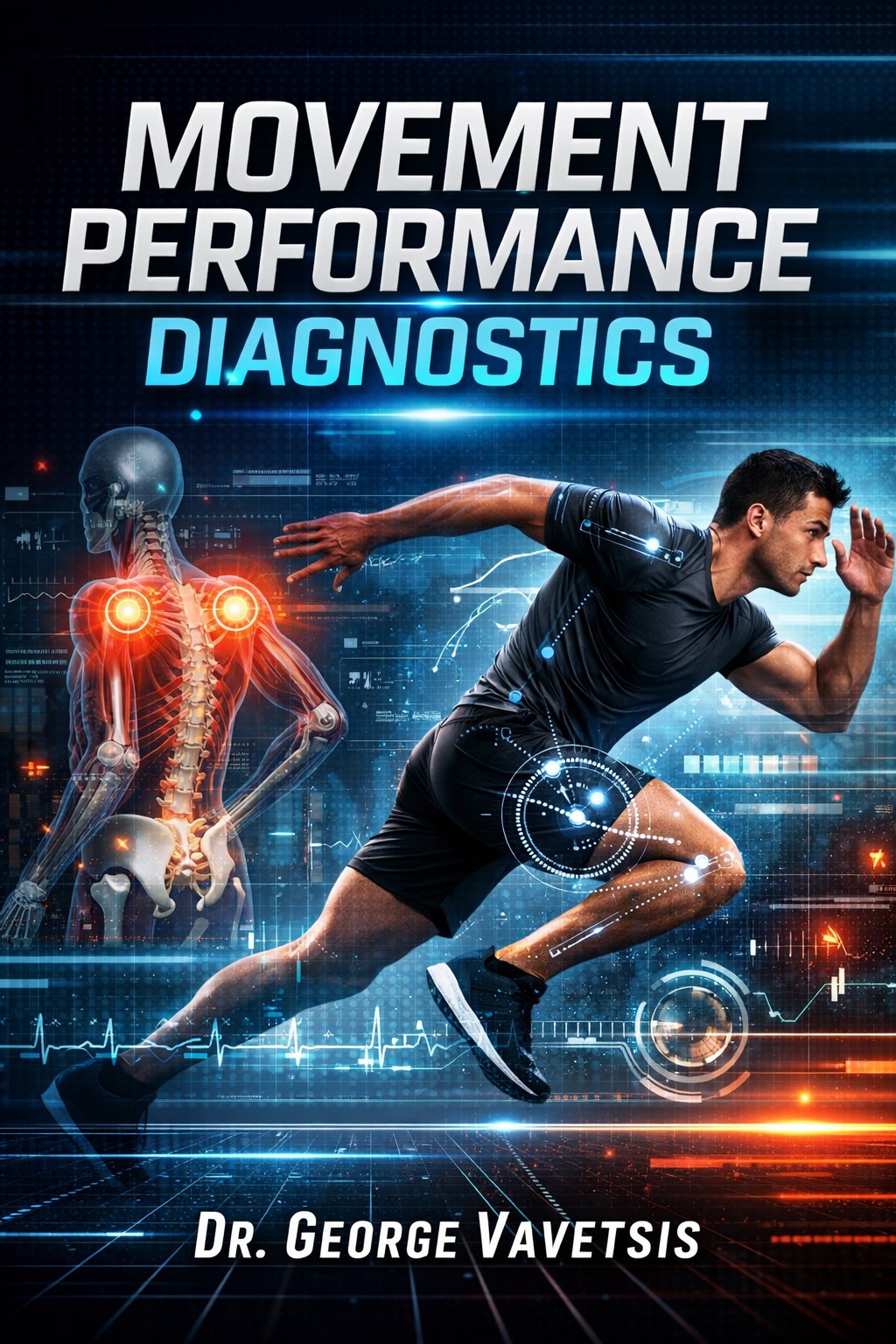
Movement Performance Diagnostics
Pages: 3847
In the evolving landscape of human performance science, the precise evaluation of movement capacity stands as a cornerstone of both clinical practice and high-performance training. The integration of goniometry and manual muscle testing (MMT) represents far more than a set of measurement techniques—it constitutes a unified language through which the neuromusculoskeletal system can be interpreted, quantified, and ultimately optimized. This book, Movement Performance Diagnostics, emerges from the necessity to bridge the gap between traditional assessment methodologies and the demands of modern, data-driven performance environments.
At its core, movement is not merely the displacement of segments in space; it is the expression of a highly coordinated interaction between neural drive, muscular force production, joint mechanics, and connective tissue behavior. The evaluation of range of motion (ROM) and muscular strength provides an entry point into this complex system. Yet, as highlighted throughout this work, isolated measurements of ROM or strength offer only a fragmented understanding unless interpreted within a broader biomechanical and functional context.
The classical distinction between Active Range of Motion (AROM), Passive Range of Motion (PROM), and Active-Assisted Range of Motion (AAROM) serves as a foundational diagnostic triad. These measures are not simply quantitative outputs but reflect distinct physiological processes—volitional neuromuscular activation, passive tissue extensibility, and assisted motor capacity. The normative relationship where PROM is equal to or exceeds AROM provides a powerful clinical heuristic, allowing practitioners to differentiate between muscular weakness, joint restriction, and neuromotor inhibition.
However, modern performance diagnostics demand a deeper level of interpretation. The clinician or strength and conditioning specialist must move beyond surface-level measurements and consider the underlying mechanics that govern movement. The distinction between osteokinematic motion—the gross angular displacement measured by a goniometer—and arthrokinematic motion—the subtle roll, glide, and spin occurring at joint surfaces—represents a critical conceptual shift. Without adequate accessory motion, even seemingly normal ROM may fail to translate into efficient or pain-free functional performance.
This book is written with the conviction that assessment must evolve from static measurement to dynamic interpretation. Movement is inherently task-dependent, and therefore, the concept of functional ROM becomes paramount. Anatomical capacity alone does not define performance; rather, it is the ability to express sufficient, coordinated motion within the constraints of a specific task that determines success. As such, this text emphasizes the comparison between anatomical ROM and functional requirements, highlighting that optimal performance often requires less than maximal available motion but demands superior control, timing, and integration.
In high-performance sport, these principles take on even greater significance. Athletes operate at the limits of their physiological capacity, where small deficits in mobility or strength can translate into substantial performance decrements or increased injury risk. The ability to detect asymmetries, interpret end-feel characteristics, and identify compensatory movement strategies becomes a decisive factor in training design and injury prevention. Goniometry and MMT, when applied with scientific rigor, transform from basic clinical tools into sophisticated instruments of performance analytics.
Equally important is the recognition that movement quality cannot be divorced from neuromuscular control. Strength, in this context, is not merely the ability to produce force but the capacity to generate, modulate, and sustain force across a functional range of motion. Manual muscle testing, therefore, must be interpreted not only in terms of maximal output but also in relation to coordination, endurance, and resistance to fatigue. The interplay between agonist and antagonist muscle groups, the influence of the length–tension relationship, and the role of central nervous system drive all contribute to the observed performance during testing.
Another critical dimension explored in this book is the role of end-feel assessment in clinical reasoning. The qualitative perception of resistance at the end range of motion provides invaluable insight into the nature of tissue limitation—whether it is muscular, capsular, ligamentous, or pathological. This tactile feedback, when combined with quantitative ROM data, enhances diagnostic accuracy and informs targeted intervention strategies.
Furthermore, the integration of biomechanical principles—planes of motion, axes of rotation, and kinetic chain dynamics—allows for a more comprehensive understanding of how local impairments influence global movement patterns. The human body functions as an interconnected system, where dysfunction in one region often manifests as compensation in another. Effective assessment, therefore, requires a systems-based perspective that accounts for regional interdependence and movement variability.
This work is designed not only for clinicians but also for strength and conditioning coaches, sports scientists, and performance analysts who seek to elevate their assessment capabilities to an elite level. It provides a structured yet flexible framework for evaluating movement, combining scientific theory with practical application. Each concept is presented with the intention of enabling the reader to translate assessment findings into actionable strategies for performance enhancement, rehabilitation, and injury prevention.
Ultimately, Movement Performance Diagnostics is a call to reimagine assessment as a dynamic, integrative process. It challenges the reader to move beyond routine measurement and to engage in a deeper analysis of movement as a complex, adaptive system. By mastering the principles outlined in this book, practitioners will be equipped not only to identify dysfunction but to understand its origins, predict its consequences, and design interventions that restore optimal function.
In an era where marginal gains define success, precision in assessment is no longer optional—it is essential.