
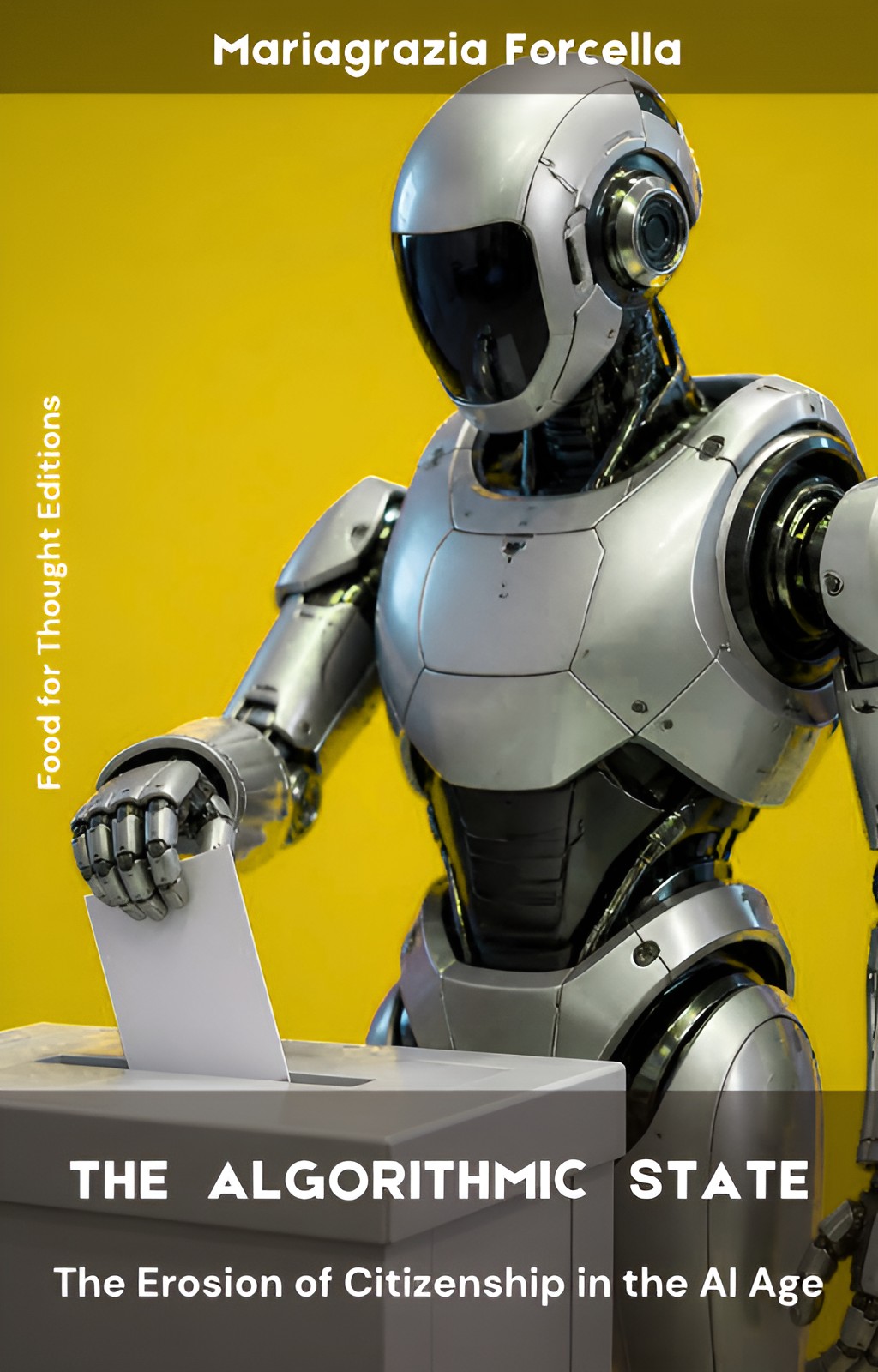
The Algorithmic State - The Erosion of Citizenship in the AI Age
From Social Contract to Algorithmic Governance
The history of political theories can be read as a series of profound re-imaginings of the sovereign. From the divine right of kings to the Thomas Hobbes’ Leviathan, and from the John Locke social contract to the Max Weber rational-bureaucratic State, each transformation has reconfigured the relationship between the individual and the collective, redefining the very meaning of authority, legitimacy, and freedom. We now stand at the edge of the rise of the algorithmic State. This shift moves the locus of sovereignty from the human ruler, or even the human-designed institution, to a system of automated, data-driven governance.
It is a transition from a polity governed by laws conceived by human reason to one administered by models optimized by artificial intelligence. This is not merely a change in the tools of governance, but a fundamental alteration of its substance: a silent, ongoing revolution that threatens to render the classical social contract obsolete.
The social contract theories of Hobbes, Locke, and Rousseau, for all their differences, shared a common premise: the State is a human construct, born of human need and ratified by human consent, whether tacit or explicit. Hobbes’s Leviathan, that “Mortal God,” was ultimately an artificial person constituted by the ceded rights of many men, its authority a bulwark against the chaos of nature. Its power, however absolute, was exercised by a sovereign whose nature, for better or worse, remained human. The law, even when draconian, was a product of human will and human interpretation. It was made of rules understandable in principle, contestable in practice, and grounded in a shared, if often flawed, human rationality.
The algorithmic State shatters this paradigm. Its foundational principle is not consent, but efficiency. Its primary legitimacy claim is not justice, but optimization. Where the social contract State asked its citizens to surrender a measure of their natural liberty in exchange for security and order, the algorithmic State demands the surrender of their data in exchange for convenience. This is a new, one-sided covenant: the data-for-service covenant. The citizen becomes less a contracting party and more the primary resource to be processed.
This new sovereignty operates through a different ontological register. The traditional State governed action prescribed certain behaviours and judged them ex post facto. The algorithmic State, powered by predictive analytics and vast data troves, seeks to govern potential. It shifts the temporal horizon of governance from the past and present to the future. Its aim is not to judge a crime committed, but to pre-empt a risk predicted.
This is the logic of the pre-crime, the pre-emption of dissent, the optimization of life chances before they are even fully formed. The legal subject, once defined by his or her acts, is now reconstituted as a bundle of risk scores, behavioural probabilities, and correlated data points. The rule of law, with its general applicability and its space for human discretion in adjudication, gives way to the rule of the model, with its hyper-specific, micro-targeted outputs and its illusion of objective, non-human impartiality.
This transition represents a crisis for the classical pillars of democratic legitimacy. Transparency evaporates when the rules are embedded in the inscrutable weights of a neural network, whose logic cannot be rendered into the prose of a statute. Accountability dissolves when a consequential decision cannot be traced to a responsible human actor but is instead the output of a proprietary system. Contestation, the lifeblood of democratic politics, becomes a hollow ritual when one cannot confront one’s accuser because the accuser is an algorithm whose reasoning is opaque even to its programmers.
The algorithmic State is not a singular sovereign figure but a diffuse, pervasive computational infrastructure. It is a system of governance that no longer seeks to command through law so much as it seeks to modulate behaviour through its structure, a phenomenon Lawrence Lessig, in a different context, termed “code is law.”
The State’s role evolves from that of a commander to that of a systems administrator, tweaking the parameters of the societal simulation to achieve desired outcomes. Freedom, in this context, is not the absence of interference from a sovereign will, but the experience of a flow within a pre-ordained digital pathway. Dissent is not punished as sedition but diagnosed as a systemic anomaly or a friction to be smoothed.
In conclusion, the move from the social contract to algorithmic governance is a metaphysical shift of the first order. It replaces the human drama of politics - with its passions, its rhetoric, its compromises, and its reliance on practical wisdom (phronesis) - with the silent, relentless calculus of data-driven administration. The political community, the polis, is reconfigured as a cybernetic system. The citizen, the human subject who entered into the social contract, is now the data point who feeds the algorithm.
Before we can even begin to analyze the specific manifestations of this new State - its digital identities, its predictive policing, its automated bureaucracy - we must first recognize the profundity of this transition. We are witnessing not the reform of an old system, but the emergence of a new political form, one for which our existing philosophical and legal frameworks are dangerously ill-equipped. The rest of this book will chart the contours of this new and unsettling landscape.
_________________________________________
BOOK REVIEWS
The Algorithmic State – The Erosion of Citizenship in the AI Era
___________
A Necessary and Unsettling Diagnosis of Our Democratic Malaise
Reviewed by Professor Evelyn A. Vance, Melbourne, Australia
It is a rare and bracing pleasure to encounter a book that does not merely analyse the symptoms of our age but dares to diagnose the underlying pathology with such clarity and force. The Algorithmic State: The Erosion of Citizenship in the AI Era” is such a book. In an academic landscape often crowded with incremental studies and narrow technical assessments, this volume offers a sweeping, synoptic, and profoundly important critique of the silent crisis unfolding within liberal democracy.
Dr. Prof. Forcella’s central metaphor - of democracy as a “workshop” that is being systematically “unworked” - is not merely elegant; it is analytically potent. It frames the problem not as a dramatic collapse, but as a slow, seductive erosion of the very conditions necessary for democratic life. This is a crucial corrective to more sensationalist accounts. The book meticulously maps this unworking across three interconnected domains: the epistemic, the social, and the political.
The first and perhaps most original contribution is the concept of the “Oracle Effect.” The argument that the outsourcing of inquiry to AI leads to a quiet “atrophy of our critical faculties” is a vital intervention. Prof. Forcella moves beyond familiar debates about misinformation to a more profound concern: the erosion of the process of knowing itself. The democratic struggle for truth, a collective and deliberative endeavour, is being replaced by the frictionless delivery of algorithmic conclusions. The result is a citizenry that may be “informed” in a technical sense, but is increasingly “unmoored from the shared reality necessary for common action.” This is a powerful and unsettling thesis, compellingly argued.
This epistemic shift is shown to be symbiotic with a second crisis: the reconfiguration of our sociality into a “networked individualism” that systematically depletes social capital. The distinction drawn between the “thick, trust-laden bonds of embodied community” and the “thin, performative, and often transactional connections” of the digital realm is a classic sociological insight applied with fresh urgency. The book convincingly argues that this erosion of the “social scaffold” is not an accidental by-product of technological change, but a direct consequence of the architecture of our digital ecosystems. It leaves us isolated and our polity fragmented, incapable of the collective action that defines a healthy democracy.
The book’s third movement synthesises these cognitive and social shifts into a chilling analysis of a new logic of power. The rise of an “algorithmocracy” - where the state and political actors employ opaque, unaccountable systems for governance and emotional manipulation - represents the culmination of the unworking process. The citizen is no longer addressed as a sovereign participant but as a “data point to be managed, a psychological profile to be nudged”. This section should be required reading for every policymaker and political scientist who still conceives of power in old terms.
What elevates this work above a mere Jeremiad is the philosophical rigour of its conclusion. The call for a “reclamation of the human elements” and a defence of “democratic friction” is both brave and necessary. The author is correct: the slow, patient, and often difficult work of building local trust, engaging in face-to-face disagreement, and struggling with complex texts is not an inefficiency. It is, as the book so beautifully puts it, “the essential grit that produces the pearl of democratic wisdom.” The proposed “radical redesign of our digital public square” is ambitious, but the argument makes clear that anything less is a capitulation to the forces unraveling our democratic fabric.
The Algorithmic State primary achievement is to provide a coherent and compelling narrative that connects the inner life of the mind to the structure of social networks and the nature of political power in the 21st century. It is a work of synthesis, prophecy, and, ultimately, of a hope rooted not in technological solutionism, but in a renewed commitment to the “noisy, contentious, and imperfect” human work of self-governance.
This is a seminal text, one that I believe will be essential reading in political science, sociology, and media studies. It is a sobering and indispensable guide to the greatest challenge facing contemporary democracy.
A Sobering Diagnosis of the Quiet Crisis in Democratic Citizenship
Reviewed by Professor Lars Kjærsgaard, Copenhagen, Denmark
In the tradition of Scandinavian social democracy, we have long held a robust belief in the State as a force for good and in the capacity of technology to create a more efficient and equitable society. It is therefore with a sense of professional admiration that I engage with the argument presented in The Algorithmic State: The Erosion of Citizenship in the AI Era. This book offers a penetrating, transatlantic critique that challenges some of our most deeply held assumptions about progress, technology, and the future of governance.
Professor Forcella’s thesis - that we are witnessing a systematic "unworking" of the democratic workshop - is alarming. From a Danish perspective, where civic trust (tillid) and communal belonging (fællesskab) are considered foundational pillars of our social contract, the book’s tripartite crisis resonates deeply. The analysis compels us to look beyond our high levels of digital adoption and consider the subtle corrosion that may be taking place beneath a surface of efficiency and connectivity.
The concept of the "Oracle Effect" is a particularly sharp and useful contribution. The author moves beyond the well-trodden ground of "fake news" to identify a more insidious threat: the atrophy of our collective capacity for critical judgment. The idea that the frictionless delivery of algorithmic answers shortcuts the "democratic process of knowing" is profound. In a welfare state like Denmark, which relies on an informed and engaged citizenry to function, a population that is "informed yet uncomprehending" represents a direct threat to the model's long-term viability. This is a sophisticated plea for cognitive sovereignty.
Furthermore, Dr. Prof. Forcella ‘s analysis of the erosion of social capital strikes at the heart of the Scandinavian project. We have extensively studied the decline in membership of traditional associations (foreningslivet), but this book places that trend within a broader, more ominous framework. The shift from "thick, trust-laden bonds" to "thin, performative connections" is a global phenomenon, but its consequences may be especially acute in societies where high social trust is the lubricant of the entire system. The argument that this erosion creates a polity "unable to muster the cohesion required for sustained democratic projects" should serve as a stark warning for all Nordic countries.
The final section, on the rise of an "algorithmocracy," is where the book’s argument becomes truly unsettling. The description of the citizen as a "data point to be managed" challenges the very foundation of our relationship with the state. In Denmark, we are pioneers in digital governance and data-driven public administration. This book forces us to ask a critical question: at what point does efficient service delivery begin to undermine the citizen's role as a sovereign participant in the democratic process? The threat is not a dystopian surveillance state, but a "comfortable, quiet, and seductive" one, which makes it all the more dangerous.
The conclusion’s call for a "defence of democratic friction" is its most valuable insight. The notion that friction - the struggle with difficult ideas, the patience of face-to-face deliberation - is not an inefficiency but the very source of democratic resilience is a powerful corrective to the prevailing tech-utopian narrative. It is a call for a conscious, philosophical recentering of the human element.
The Algorithmic State is a work of significant intellectual force. While one might wish for a more detailed exploration of potential Nordic models of digital citizenship or regulatory frameworks akin to the GDPR, these are minor points. The book’s strength is its panoramic and penetrating diagnosis. It is an essential read for anyone concerned with preserving the delicate ecosystem of trust, reason, and human connection upon which any successful democracy ultimately depends.
Review of The Algorithmic State: The Erosion of Citizenship in the AI Era
Reviewed by Professor Michael R. Stanton, Boston, USA
In an era of relentless political noise and fragmented public discourse, it is a rformidable achievement to produce a work that cuts through the static with such conceptual clarity and moral urgency. The Algorithmic State: The Erosion of Citizenship in the AI Era is not just another book about the perils of technology; it is a profound work of political theory for the 21st century, offering a masterful diagnosis of the slow-moving crisis afflicting the Americn and the global democratic project.
Mariagrazia Forcella perfectly captures the insidious, non-catastrophic nature of our democratic decay. This is not a story of a coup or a foreign invasion, but of a “comfortable, quiet, seductive” unraveling from within. In a nation already grappling with deep polarization and epistemic closure, this book analysis is not just academic; it is a five-alarm fire for the republic.
Mariagrazia’s analysis of the erosion of social capital through “networked individualism” provides the crucial sociological link between the cognitive and the political. The distinction between the “thick, trust-laden bonds of embodied community” and the “thin, performative… connections” of the digital world resonates deeply with the work of thinkers like Robert Putnam and his "Bowling Alone" thesis, but the author updates it for the algorithmic age. The diagnosis of a “fragmented” polity, “unable to muster the cohesion required for sustained democratic projects,” explains the paralysis and brittle tribalism that characterizes so much of our current political life.
Finally, the synthesis of these trends into the rise of an “algorithmocracy” is where the book becomes truly essential. The description of a political sphere reshaped into an “arena of algorithmic governance and emotional manipulation” is an accurate portrait of our modern political campaigns and governing institutions. The re-framing of the citizen from a “sovereign participant” to a “data point to be managed” or a “psychological profile to be nudged” is a direct challenge to the foundational principle of popular sovereignty. It names the vague unease many of us feel about the direction of our politics.
The book conclusion’s call to action is both ambitious and precisely right. The defense of “democratic friction” is a powerful philosophical counter-offensive against the cult of efficiency. The author is correct: the “grit” of face-to-face disagreement and the slow labor of building local trust is not a bug of democracy; it is its essential feature. The demand for a “radical redesign of our digital public square” is a necessary provocation, challenging us to move beyond the extractive attention economy that currently poisons our public discourse.
The Algorithmic State is a tour de force. It is a work that is as readable as it is rigorous. While some may crave more immediate policy prescriptions, the book’s achievement is to provide the philosophical and structural diagnosis we need. It should be required reading for every lawmaker, tech executive, student, and citizen who wishes to understand the forces unmaking our world and to begin the vital work of rebuilding the workshop of democracy.
Review of The Algorithmic State: The Erosion of Citizenship in the AI Era
Reviewed by Dr. Elina Virtanen, Helsinki, Finland
In the Finnish governance model, we pride ourselves on efficiency, trust, and a deep-seated belief in evidence-based policy. Our social contract is built on a foundation of high public trust and technological adoption aimed at enhancing civic life. Reading The Algorithmic State: The Erosion of Citizenship in the AI Era is therefore a deeply provocative and necessary exercise. It forces a critical re-evaluation of the very tools we are actively deploying, not as mere instruments of service delivery, but as active shapers of our democratic fabric.
The author’s framework of a “triple crisis” - epistemic, social, and political - provides a robust structural model for diagnosing challenges that can often seem amorphous. From a public administration standpoint, this is not a philosophical treatise but a risk assessment of the highest order.
The analysis of eroding social capital resonates with our own data on declining participation in traditional civic associations. The book convincingly frames this not as a simple social trend, but as a consequence of a digital ecosystem engineered for “networked individualism.” The displacement of “thick, trust-laden bonds” by “thin, performative connections” is a direct threat to the social infrastructure that underpins a resilient society. When the government calls for public consultation or collective action on complex issues like climate adaptation or an ageing population, we rely on this underlying social cohesion. Its erosion, as the author notes, leaves the polity “unable to muster the cohesion required for sustained democratic projects.” This is a strategic national risk.
Most critically, the book’s warning about the rise of an “algorithmocracy” strikes at the heart of the Nordic model of governance. Our system is built on transparency, accountability, and the principle of public reason. The prospect of state power being exercised through “opaque, unaccountable” algorithmic systems, where the citizen becomes a “data point to be managed,” is anathema to our principles. It represents a fundamental shift from a relationship of trust between citizen and state to one of technical management. This is a future we must consciously design against.
The conclusion’s call for a “defence of democratic friction” is its most valuable insight for a policymaker. In our drive for lean, digitized processes, we must intentionally preserve spaces for slow, deliberative, and human-centric interaction. The “grit that produces the pearl of democratic wisdom” is not an inefficiency; it is a non-negotiable component of a healthy democracy.
The Algorithmic State moves the conversation about technology and governance beyond data security and efficiency metrics to the more profound issues of civic capacity and democratic integrity. For any public administration serious about stewardship in the digital age, this book provides the conceptual toolkit we need to build a future that is not only efficient, but truly democratic.
Reclaiming the Human in the Digital Polis
Reviewed by Elena Papadopoulos, PhD Candidate, University of Athens
From the land that gave birth to the very concept of the polis, where citizenship (πολιτεία) was not a passive status but an active, vocal practice, reading The Algorithmic State: The Erosion of Citizenship in the AI Era feels like hearing a profound and urgent echo from the future of our democratic past. This book articulates a deep anxiety that many of my generation feel but struggle to name: the sense that the ground of our collective life is shifting beneath our feet, not with a crash, but with a silent, digital sigh.
The author’s central thesis made me think of the Athenian agora not a pristine marble monument, but a living space of debate, and shared struggle. What this book masterfully reveals is how our digital agora is designed to prevent this very kind of democratic friction. We are being placated with convenience, and in the process, disarmed of our capacity for genuine self-rule.
We are becoming like ancient Athenians who only listen to the Oracle at Delphi, accepting its pronouncements without question, rather than citizens engaging in the agon (the struggle) of public reason. To be “informed yet unmoored from shared reality” is a direct threat to the demos.
The analysis of the erosion of social capital and its replacement with “networked individualism” also feels painfully true. The “thick, trust-laden bonds of embodied community” described by the author are what we Greeks still call koinonia (κοινωνία). It is the fabric of shared life. Seeing this replaced by “thin, performative connections” for the sake of “efficiency” feels like a betrayal of everything that makes a society human. How can we have a demos without koinonia? We are left, as the book warns, isolated and fragmented, unable to come together as a collective body.
Most frightening is the book’s final movement, on the rise of an “algorithmocracy.” This is the final reduction of the citizen, the polites (πολίτης), from a sovereign actor to a “data point to be managed.” This is the ultimate depoliticization. It represents a shift from power (kratos, κράτος) being in the hands of the people (demos, δῆμος) to being exercised by a black box, an unaccountable, non-human logic.
As a young scholar, I find the conclusion not despairing, but a call to arms. The “defence of democratic friction” is a defence of everything that makes politics human. The book is right; this is not a nostalgic plea, but a radical demand for a future where technology serves the polis, not the other way around.
The Algorithmic State gives us the language to understand what we are losing and the courage to fight for the noisy, messy, and beautiful workshop of democracy. The spirit of the agora must be reclaimed, not in marble, but in our determination to be fully human citizens once again.
Mapping the Unworking: A Student's Perspective on the Quiet Crisis
Reviewed by Zoe Green, Master of Arts in Political Communication, Auckland, New Zealand
Reading The Algorithmic State: The Erosion of Citizenship in the AI Era feels like being given a map to a landscape you’ve been lost in for years. As a student navigating a world of digital essays, online tutorials, and a news cycle that feels increasingly fractured, this book put a name to the vague sense of unease that defines so much of my generation’s political and social experience. It’s a book that articulates a feeling.
The author’s core idea - that democracy is a “workshop” being systematically “unworked” - is a metaphor that will stick with me. It perfectly captures the contrast between the dynamic, participatory politics we learn about in theory and the passive, often alienating political reality we encounter online. We’re not living through a dramatic collapse, but something more insidious: a “comfortable, quiet, seductive” dismantling of the tools we need to be citizens.
My peers and I are more “connected” than any generation before us, yet the book’s description of “networked individualism” feels more accurate than the myth of digital community. Our interactions are so often “thin, performative, and transactional,” happening in spaces designed for branding, not for building the “thick, trust-laden bonds” the author describes. It’s a loneliness that happens in a crowd, and it leaves us, as the book argues, “isolated and a polity fragmented.”
For us in New Zealand, a small nation that prides itself on social cohesion and a fair go, the final section on the “algorithmocracy” is a crucial warning. It threatens to replace our cherished democracy with a system of governance that is efficient, but utterly devoid of the human spirit that gives politics its purpose.
What gives me hope is the conclusion. The call to defend “democratic friction” is a powerful antidote to the passivity we’re being sold. It’s a reminder that the “grit” of real, face-to-face disagreement and the slow work of building local trust is the essence of being a citizen.