
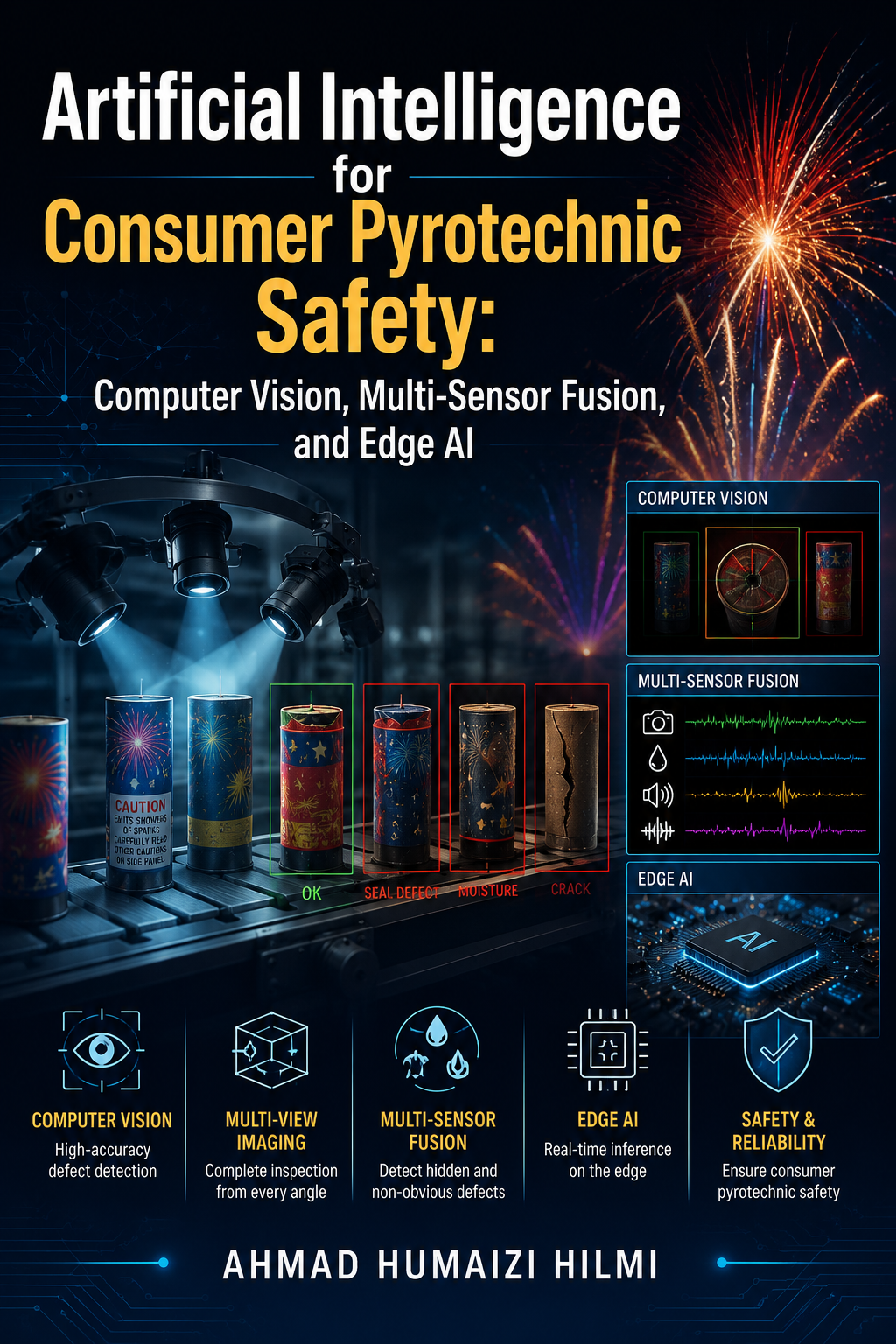
Artificial Intelligence for Consumer Pyrotechnic Safety: Computer Vision, Multi-Sensor Fusion, and Edge AI
This review synthesises evidence on safety hazards in consumer pyrotechnic products and evaluates artificial intelligence approaches that may support automated inspection and regulatory‑grade auditability. It first maps common defect classes and failure modes—voids, misfills, seal and crimp defects, fuse misplacement, moisture ingress—to measurable imaging and sensor signals, identifying where visible‑light imaging, structured light, radiography, acoustic and moisture sensors can complement each other. It then surveys AI methods used in industrial and medical inspection, including convolutional and transformer backbones, YOLO and Mask R-CNN detectors, U-Net segmentation, multi‑view fusion, and multi‑sensor architectures, and reviews edge‑AI practices such as quantization, pruning, distillation and quantization‑aware training. Explainable AI techniques (Grad‑CAM, SHAP, LIME and counterfactuals) are examined as mechanisms to produce auditable evidence for human adjudication. Cross‑domain precedents suggest that transfer learning, robust data augmentation, deployment‑aware compression and human‑in‑the‑loop workflows can produce deployable pipelines, but the literature also highlights gaps: scarce domain‑specific labeled datasets, limited empirical evidence that multi‑sensor fusion reliably exposes internal anomalies, and weak standardisation of XAI evaluation and statistical validation. The review therefore recommends targeted dataset development, multi‑sensor riging, robustness‑aware edge optimisation and auditable XAI evaluation to advance production‑ready pyrotechnic inspection systems.