

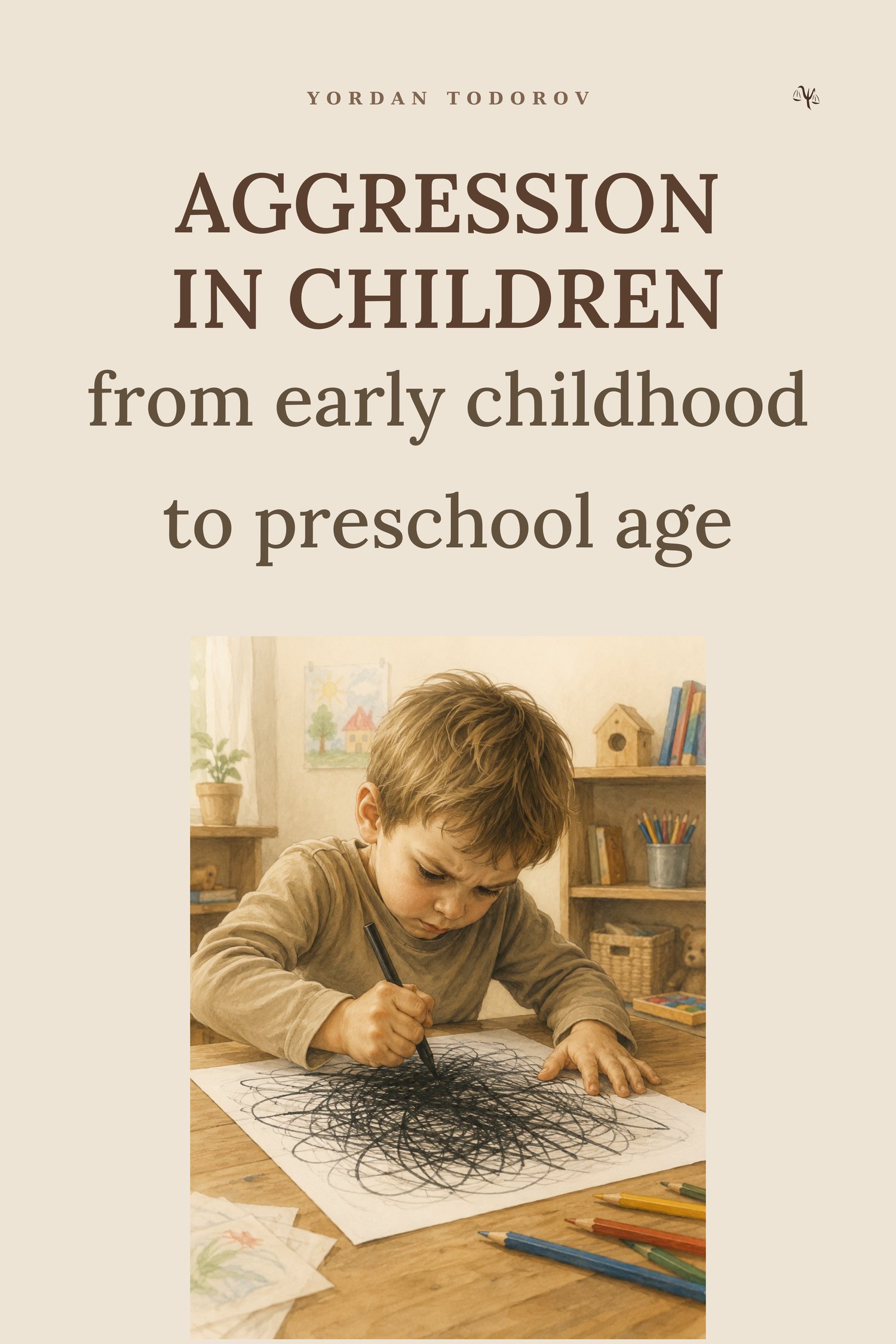
Aggression in children from early to preschool age
“Aggression in children from early to preschool age” is a psychological study by Yordan Todorov devoted to aggressiveness in early and preschool childhood and to the psychological, family, and social factors associated with its emergence and manifestation.
One of the main lines of the study is the role of the environment in which the child is raised and develops, and the comparison between the family and institutional models of child-rearing. The importance of the family for early child development, parent–child relationships, models of upbringing, and the social environment are analysed, as well as their influence on manifestations of aggressive behaviour.
The theoretical part examines major psychological concepts of aggression and frustration, including the views of Sigmund Freud, Konrad Lorenz, Albert Bandura, Dollard, Miller, and other authors. Different forms and mechanisms of aggression, frustrating experiences in childhood, the influence of the family, interaction with peers, and other social factors are explored.
Particular attention is devoted to the family as an environment for the socialisation and development of the child, to different types of family upbringing, and to the circumstances in which family relationships may be associated with manifestations of aggressiveness. Alongside this, the work examines the institutional upbringing of children and its comparison with the family model within the framework of the author's study.
The independent empirical part covers 20 children of early and preschool age, divided into two age groups of 10 children each. A questionnaire and interviews with parents, direct observation, discussions with kindergarten staff, and a questionnaire completed by an educator were used. The research instruments for parents and educators each contain 24 items.
The data obtained are analysed in relation to the family environment, family structure, the manner of upbringing, and manifestations of aggressive behaviour. The analysis distinguishes different groups of children and traces the characteristics of their behaviour depending on the environment and relationships in which they develop.
The work also examines parental alienation, different types of family upbringing and their relationship to aggressive behaviour, as well as models for the control and limitation of aggressive manifestations.
The publication combines a theoretical psychological review and the author's own empirical study, placing childhood aggressiveness within the broader context of the relationships between the child, the family, the educational environment, and institutional upbringing.
It is suitable for psychologists, educators, professionals working with children and families, students, parents, and readers with a professional or academic interest in child development, aggressive behaviour, and the influence of the environment on the child.