
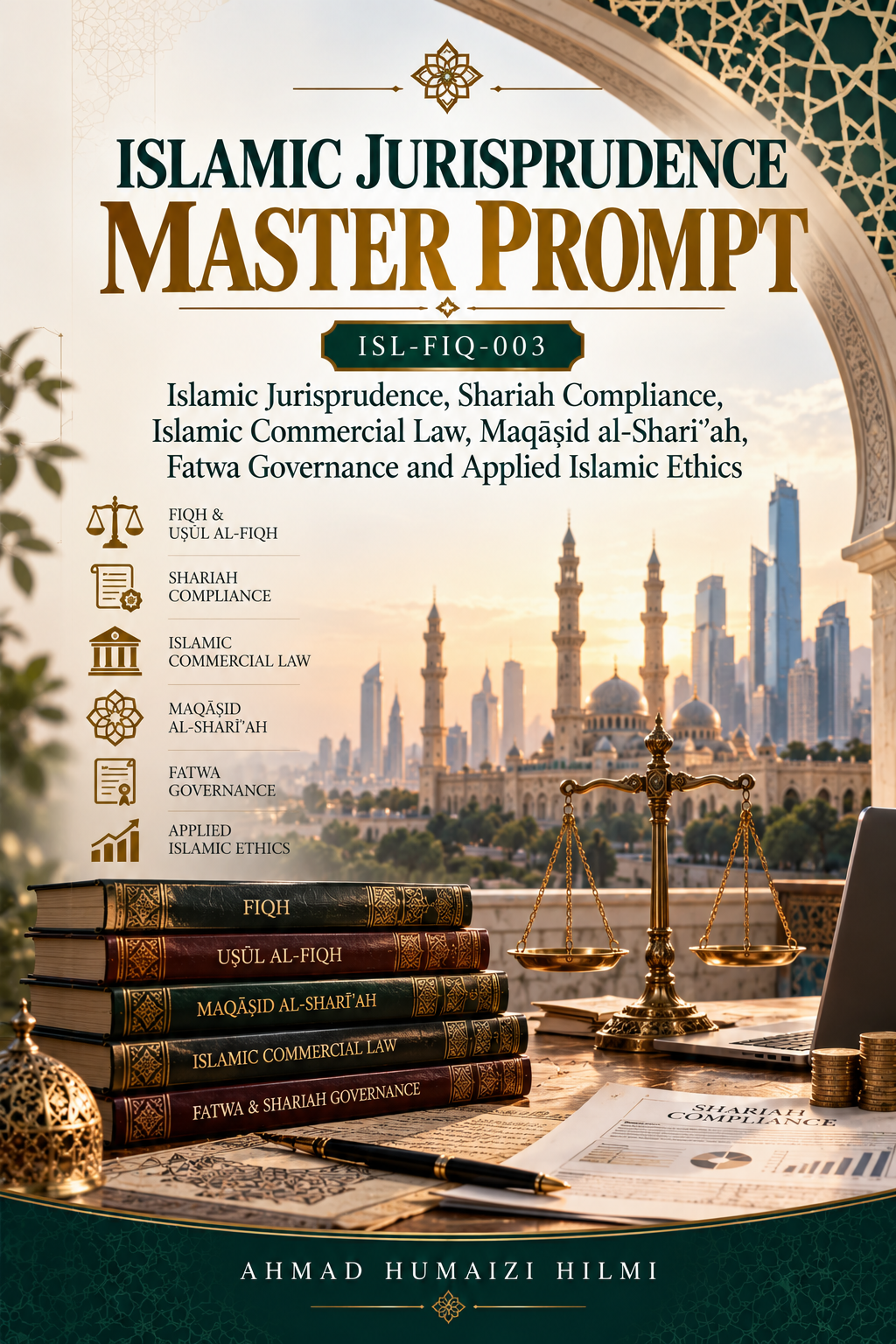
3. ISL-FIQ-003 — Islamic Jurisprudence, Shariah Compliance, Islamic Commercial Law, Maqāṣid al-Sharīʿah, Fatwa Governance and Applied Islamic Ethics
Description
This Master Prompt provides a comprehensive, systematic, interdisciplinary, and academically rigorous framework for conducting advanced research in Islamic jurisprudence (fiqh), principles of Islamic jurisprudence (uṣūl al-fiqh), Shariah compliance, Islamic commercial law (fiqh al-muʿāmalāt), objectives of Islamic law (maqāṣid al-Sharīʿah), Islamic legal maxims (qawāʿid fiqhiyyah), fatwa governance, and applied Islamic ethics. It encompasses the primary and supplementary sources of Islamic legal reasoning, including the Qur'an, Sunnah, consensus (ijmāʿ), analogical reasoning (qiyās), public interest (maṣlaḥah), juristic preference (istiḥsān), customary practice (ʿurf), independent legal reasoning (ijtihād), and juristic disagreement (ikhtilāf), while recognising differences in their acceptance and application across Islamic legal schools. Particular attention is given to the development of Islamic legal doctrines, comparative madhhab analysis, contemporary fatwa institutions, Shariah Supervisory Boards, regulatory harmonisation, and the application of Islamic legal principles within banking, finance, takaful, sukuk, investment, Islamic FinTech, halal industries, corporate governance, healthcare, bioethics, and emerging technologies. The Master Prompt integrates doctrinal legal research, comparative jurisprudence, historical analysis, qualitative and quantitative methods, regulatory assessment, institutional case studies, and interdisciplinary research approaches. Researchers are guided through the complete scholarly process, including research problem identification, literature synthesis, legal source authentication, theoretical and conceptual framework development, research methodology, compliance evaluation, empirical analysis, model validation, critical discussion, and evidence-based policy formulation. Emphasis is placed on distinguishing Shariah principles from particular juristic interpretations, ensuring authentic and traceable legal evidence, respecting legitimate scholarly disagreement, maintaining methodological transparency, evaluating regulatory and institutional contexts, and developing original, ethically responsible, academically defensible contributions to Islamic jurisprudence and contemporary Shariah governance.