
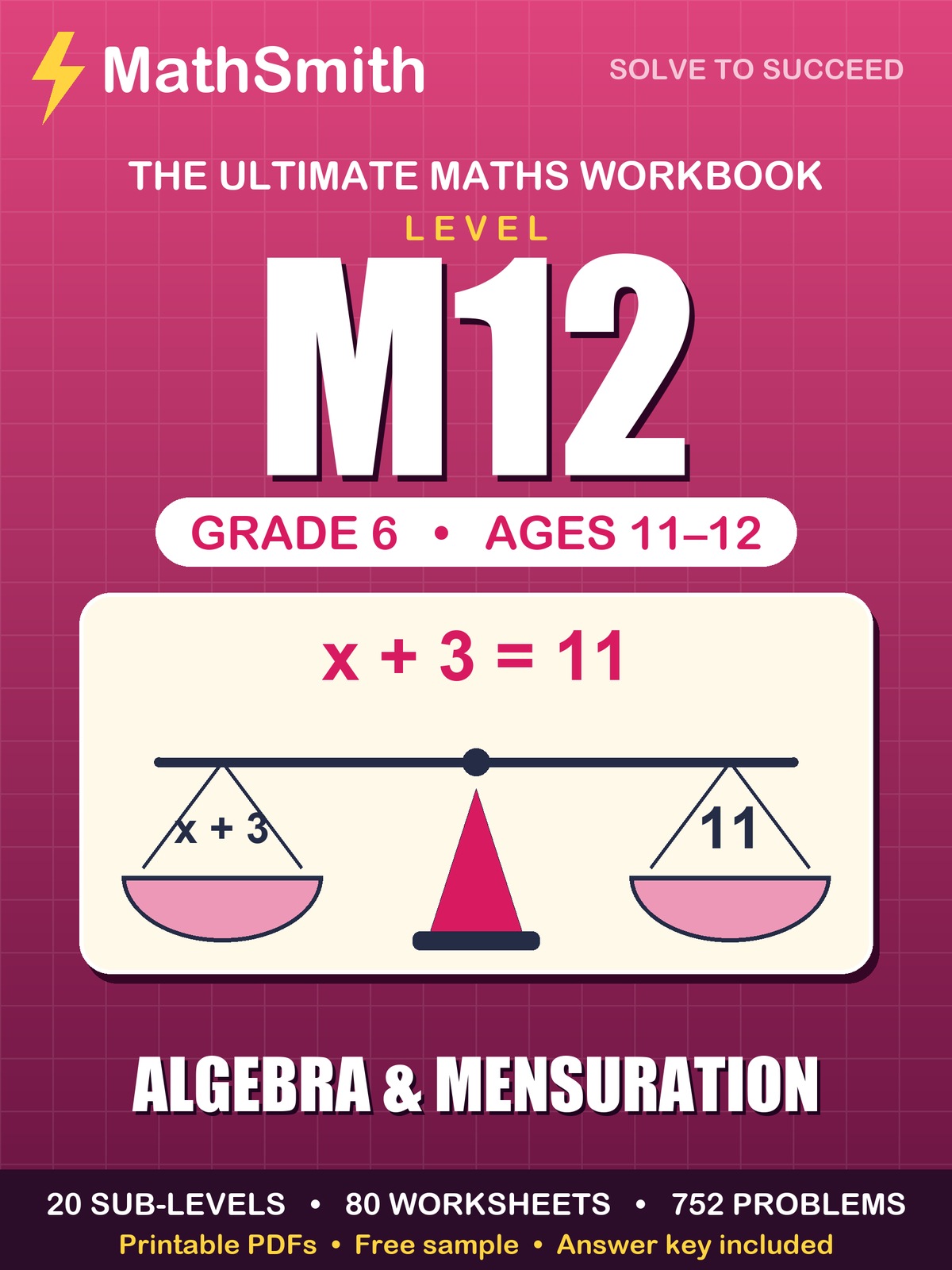
Gr 6 Maths Worksheets (Ages 11-12) | Level M12: Algebra & Mensuration
🎓 Launch offer: 80% OFF every MathSmith workbook with code LAUNCH80 (first 1000 orders). Click Add to Cart, then enter LAUNCH80 in the discount box before you pay.
Not sure which level your child needs? Take the free 40-question placement test: https://ebooks.thecodecrafters.net/placement
See free sample pages first: https://ebooks.thecodecrafters.net/
Help your child build absolute confidence and mastery in mathematics. This comprehensive workbook from MathSmith takes a highly structured, "one-rung-at-a-time" approach to Algebra and Mensuration, ensuring students fully understand concepts before moving forward.
Instead of overwhelming learners with random equations, this workbook uses a carefully scaffolded, predictable learning ladder. It is perfect for homework, structured independent study, or mastery practice.
📊 What Is Included?
1 Complete Level (Level M12)
20 Structured Sub-levels for gradual progression
80 Printable Worksheets
752 Total Problems for thorough practice
Full Answer Key online, unlocked by the order ID on your Payhip receipt, for quick, stress-free marking
🗺️ Curriculum Breakdown
This collection focuses deeply on mastering Algebra and Mensuration through a carefully curated system:
A letter standing for a number (2 Sub-levels): The hardest two rungs in the level, and neither of them has anything to work out. A child who has spent five levels being asked for an answer is being asked for a way of writing one down, so every story is about a container nobody has opened - and the matchstick pattern that follows does not introduce the letter at all. It arrives at it: count three shapes, notice that each new one costs the same as the last, and the rule you write down is an expression before anybody has said the word.
Writing an expression, and finding what it is worth (3 Sub-levels): Words into algebra, one instruction and then two. Subtraction gets both of its wordings on every sheet, because five less than y and five take away y are different numbers and a child reading left to right gets one of them wrong every time. Brackets arrive here carrying meaning rather than tidiness: multiply then add needs none, add then multiply cannot be written without them.
A rule about a shape, written with letters (1 Sub-level): The hinge of the level, and the reason its two halves are one book. A formula is not a new kind of thing - it is an expression that happens to be true about every shape of one sort, which is exactly why it is worth writing down once. Everything before this rung makes expressions out of stories; everything after it makes them out of shapes.
What an equation says, and how to check one (2 Sub-levels): Half of these are not equations at all, because a child who cannot tell a rule from a claim will try to solve 3x + 5. Checking a value comes before solving for it and is not a lesser skill: it is the definition of a solution, and it is the only thing that says whether an answer got by any method at all is right.
Solving it: by trying, and then by moving (3 Sub-levels): Trial first, because it always works and a child is never stuck - and because it is slow enough to make the next rung welcome. Then the level's new notation: the equation stack, a column of whole equations aligned on the equals sign, each one the last with the same move made on both sides. The sheet prints the equals column and rules both sides of it, so the one wrong answer these rungs exist to prevent - taking the number off one side only - is the one thing the frame will not let a child write tidily.
Making an equation out of a situation (1 Sub-level): Nobody is ever handed an equation. They are handed a situation with a number missing from it, and this is the rung the last one in the level comes back to: a rectangle whose perimeter is known and whose width is not is a situation with a number missing from it.
The distance round a shape (3 Sub-levels): Class 5 walked round these shapes on squared paper (M9.10 and M9.11, which are the revision here). The step is that the shape now arrives in words, so it has to be pictured before it can be measured and the rule is the only thing left to work with - and that the rule is not always a rectangle's. A shape with no two sides the same is added up side by side; a shape with every side the same is one multiplication.
How much a shape covers (4 Sub-levels): Counting the squares comes first and is not a warm-up: a rectangle is counted AND multiplied in the same question, and the two agree, which is the only argument there is for the shortcut. Then the two cases a drawing cannot show - a rectangle quoted in two different units, and a shape that has to be cut into rectangles before any rule applies to it at all.
Stories with a rule in them (1 Sub-level): Where the two halves are put back together. A perimeter of 38 metres with one side of 12 is not a measuring question any more: it is 2(12 + b) = 38, which is an equation the child solved eight rungs ago.
🎯 Who Is This For?
Parents looking to provide structured math support at home.
Homeschoolers searching for a sequential curriculum to guarantee zero gaps in math skills.
Teachers & Tutors looking for bite-sized, scaffolded printables for classroom morning work or targeted intervention.
📖 How To Use This Workbook
Print the workbook, read each rung's method page, and let your child work inside the printed frame. Then check the answers your way: in the printable answer-key PDF included in this download, or online, one page at a time, with the order ID on your Payhip receipt (valid for six months). Please keep the answer key for the adult marking the work and do not share it with your child: the workbook only works if they have worked each answer out for themselves.
Step-by-step manual and video guide: https://ebooks.thecodecrafters.net/manual/
Check the answers: https://ebooks.thecodecrafters.net/answers
⚙️ Digital Delivery Details
Format: four instant-download PDFs (free sample, sample answers, workbook, full answer key). The answer key is also available online.
Print Ready: Easily printable on home or school printers.
Usage: Licensed for individual family or single-classroom use.