
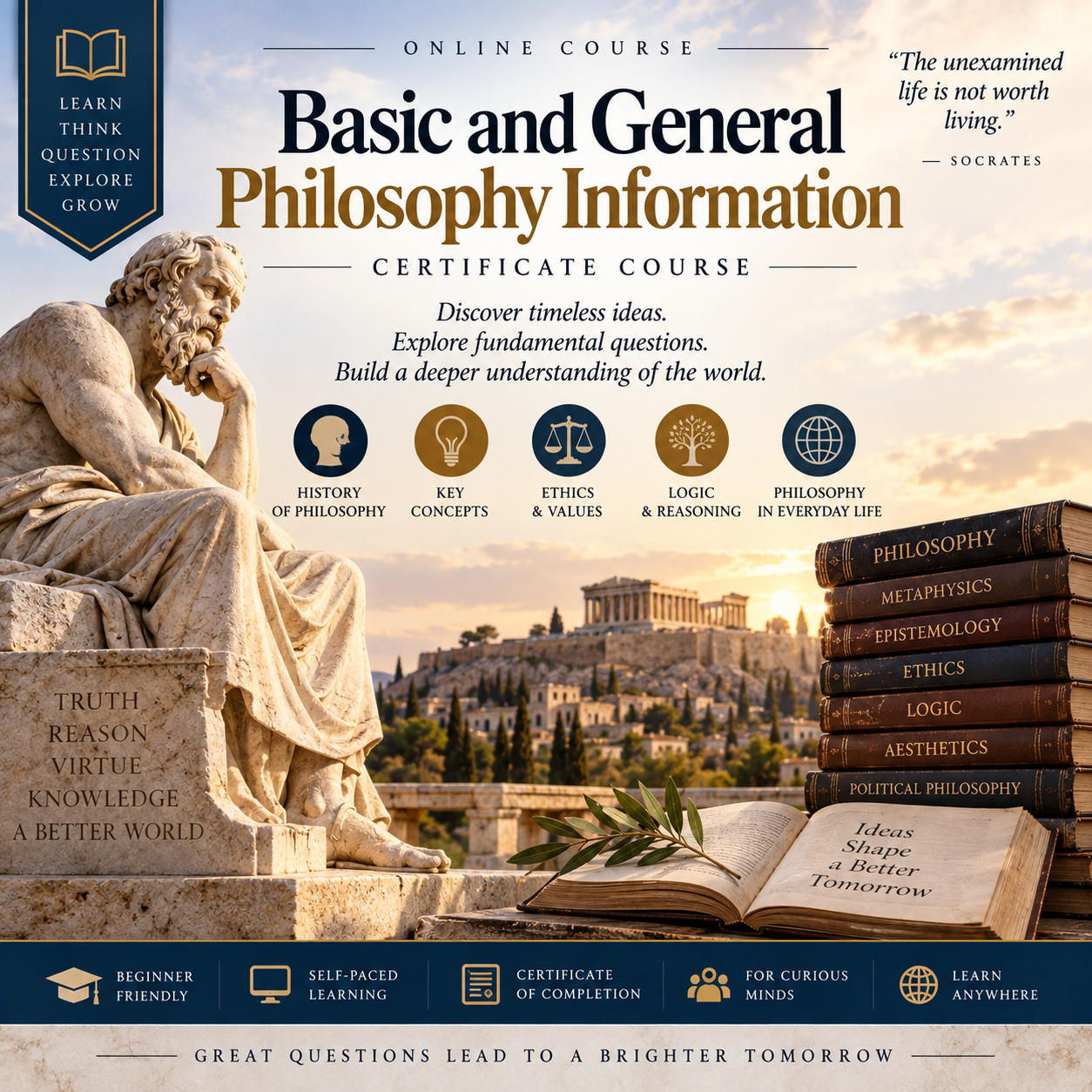
Basic and General Philosophy Information Certificate Course
Basic and General Philosophy Information Certificate Course
Learn to Think More Deeply, Question More Clearly, and Understand the World from a Broader Perspective
Philosophy begins with questions.
What is truth?
What can we really know?
What makes an action right or wrong?
What is justice?
What is the meaning of life?
What makes a good society?
What does it mean to be free?
How should human beings live?
The Basic and General Philosophy Information Certificate Course offers an accessible introduction to these questions and to the major ideas, thinkers, traditions, and branches that have shaped philosophical thought across centuries.
Designed for beginners, independent learners, students, educators, professionals, and anyone interested in understanding ideas more deeply, this course provides a structured introduction to philosophy without requiring previous academic study.
You do not need to be a philosophy student to begin.
You only need curiosity and a willingness to think.
What Is Philosophy?
The word “philosophy” is traditionally associated with the love of wisdom.
But philosophy is much more than a collection of old theories.
It is a way of asking questions, examining assumptions, evaluating arguments, and trying to understand ourselves and the world around us.
Philosophy deals with fundamental questions about:
- Reality
- Knowledge
- Truth
- Morality
- Justice
- Society
- Human nature
- Freedom
- Consciousness
- Reason
- Beauty
- Meaning
- Religion
- Politics
- Science
- Language
Throughout history, philosophers have attempted to explore these questions using reasoned argument, dialogue, observation, criticism, and reflection.
This course introduces you to that tradition.
What You Will Learn
The course provides a broad overview of philosophy and introduces learners to some of its most important subjects.
You will explore:
- The meaning and purpose of philosophy
- The history of philosophical thought
- Major philosophers and philosophical traditions
- Logic and reasoning
- Ethics and moral philosophy
- Metaphysics
- Epistemology
- Political philosophy
- Philosophy of mind
- Philosophy of religion
- Aesthetics
- Human nature
- Freedom and responsibility
- Truth and knowledge
- Philosophy in everyday life
The aim is to provide a strong general foundation that can support further study.
Introduction to Philosophical Thinking
Philosophy often begins when we stop accepting assumptions automatically.
A philosopher asks:
Why do I believe this?
What evidence supports this idea?
Could there be another explanation?
Is this argument logically consistent?
What assumptions are hidden behind this conclusion?
What would happen if everyone followed this principle?
Philosophical thinking encourages us to move beyond quick opinions and examine ideas carefully.
Throughout the course, you will develop a greater awareness of how arguments are constructed and how ideas can be analysed.
History of Philosophy
One of the major parts of this course is an introduction to the historical development of philosophical thought.
You will encounter philosophical traditions associated with different periods and cultures.
Topics may include:
- Ancient philosophy
- Classical Greek philosophy
- Hellenistic philosophy
- Medieval philosophy
- Renaissance thought
- Enlightenment philosophy
- Modern philosophy
- Contemporary philosophy
You will also become familiar with the historical context in which important philosophical ideas developed.
Ancient Greek Philosophy
Ancient Greek philosophy had an enormous influence on Western intellectual history.
The course introduces learners to major figures such as:
- Socrates
- Plato
- Aristotle
You will explore questions concerning:
- Virtue
- Knowledge
- Justice
- Politics
- Reality
- Education
- Ethics
- Human flourishing
The methods and ideas developed by ancient philosophers continue to influence philosophy, politics, science, education, and ethics today.
Socrates and the Art of Questioning
Socrates is one of the most influential figures in the history of philosophy.
Rather than simply giving people answers, Socrates became famous for questioning assumptions.
His method encouraged people to examine their beliefs carefully.
This approach remains highly relevant today.
Learning to ask better questions can help us:
- Identify weak arguments
- Challenge assumptions
- Clarify ideas
- Recognise contradictions
- Develop stronger reasoning
- Make more informed decisions
The Socratic tradition reminds us that intellectual growth often begins by admitting that there is more to learn.
Plato
Plato explored some of the most enduring questions in philosophy.
His works address subjects such as:
- Justice
- Knowledge
- Reality
- Education
- Politics
- Leadership
- Virtue
- The nature of the ideal society
The course introduces learners to selected ideas associated with Plato and explains why his philosophy remains influential.
Aristotle
Aristotle made major contributions to many areas of human knowledge.
His work influenced:
- Logic
- Ethics
- Politics
- Biology
- Metaphysics
- Rhetoric
- Psychology
- Education
Learners will explore selected Aristotelian ideas and consider how his approach to reasoning helped shape later intellectual traditions.
Logic and Critical Thinking
Logic is one of the foundations of philosophy.
It helps us distinguish strong reasoning from weak reasoning.
The course introduces basic ideas such as:
- Arguments
- Premises
- Conclusions
- Validity
- Consistency
- Contradictions
- Deductive reasoning
- Inductive reasoning
- Common logical errors
- Fallacies
Learning basic logic can help you analyse information more carefully and communicate your own ideas more clearly.
Recognising Logical Fallacies
People often make arguments that appear persuasive but contain reasoning errors.
The course introduces common logical fallacies such as:
- Ad hominem arguments
- False dilemmas
- Circular reasoning
- Hasty generalisations
- Appeals to authority
- Slippery slope arguments
- Straw man arguments
- Emotional reasoning
Understanding these errors can be useful far beyond philosophy.
They appear in:
- Advertising
- Politics
- Social media
- Journalism
- Workplace communication
- Public debates
- Everyday conversations
Critical thinking helps us evaluate such claims more carefully.
Ethics and Moral Philosophy
Ethics asks questions about how people should behave.
Some of the central questions include:
What makes an action right?
What makes an action wrong?
Do moral rules apply universally?
Does intention matter more than consequence?
What does it mean to live a good life?
The course introduces major approaches to ethical thinking.
These may include:
- Virtue ethics
- Deontological ethics
- Consequentialism
- Utilitarianism
- Moral relativism
- Duty
- Responsibility
- Justice
These ideas can help learners analyse moral dilemmas with greater clarity.
Metaphysics
Metaphysics explores some of philosophy’s deepest questions about reality.
Topics may include:
- What is reality?
- What does it mean for something to exist?
- What is time?
- What is identity?
- Do humans possess free will?
- What is causation?
- What is the relationship between mind and body?
Metaphysical questions have influenced philosophy, religion, science, and culture for centuries.
Epistemology – The Study of Knowledge
Epistemology asks:
What does it mean to know something?
How can we distinguish knowledge from belief?
Can we trust our senses?
What counts as evidence?
Can absolute certainty ever be achieved?
These questions are especially relevant in an age of enormous information availability.
Learners will explore concepts involving:
- Knowledge
- Belief
- Evidence
- Doubt
- Skepticism
- Reason
- Experience
- Truth
Truth and Belief
One of philosophy’s central concerns is the relationship between truth and belief.
People can strongly believe something that turns out to be false.
This raises important questions:
How do we evaluate claims?
How should evidence influence belief?
Can truth be objective?
Does perspective change our understanding of reality?
Philosophical thinking helps learners approach these questions systematically.
Political Philosophy
Political philosophy investigates how societies should be organised.
Important topics include:
- Justice
- Government
- Authority
- Liberty
- Equality
- Rights
- Law
- Democracy
- Responsibility
- Citizenship
- Power
Throughout history, philosophers have proposed different answers to questions about how society should function.
Understanding these ideas can help learners analyse modern political and social debates more carefully.
Philosophy of Mind
What is consciousness?
What is the mind?
How are thoughts related to the brain?
Can machines think?
What creates personal identity?
These are some of the questions explored in the philosophy of mind.
The subject connects philosophy with psychology, neuroscience, cognitive science, and artificial intelligence.
Philosophy of Religion
Philosophy of religion examines religious ideas using philosophical reasoning.
Topics may include:
- Faith and reason
- Arguments concerning the existence of God
- Religious experience
- Free will
- The problem of evil
- Morality and religion
- Religious knowledge
The course approaches these subjects academically and encourages respectful examination of different viewpoints.
Aesthetics – Philosophy of Art and Beauty
Why do people find certain things beautiful?
What is art?
Does art need to have meaning?
Can artistic value be objective?
Aesthetics explores questions concerning:
- Beauty
- Art
- Creativity
- Taste
- Interpretation
- Cultural values
This area of philosophy can deepen the way we think about literature, music, painting, architecture, cinema, and creative expression.
Freedom and Responsibility
Are human beings truly free?
If our decisions are influenced by biology, environment, education, and culture, how free are we?
And if people are not completely free, how should responsibility be understood?
These questions have major implications for:
- Ethics
- Law
- Psychology
- Religion
- Politics
- Education
The course provides an introduction to philosophical debates concerning freedom and responsibility.
Philosophy and Everyday Life
Philosophy is not limited to universities or ancient books.
Philosophical ideas appear in everyday decisions.
For example:
Should you always tell the truth?
What makes a fair decision?
What obligations do we have toward other people?
How should we respond to disagreement?
What is more important: freedom or security?
What makes life meaningful?
How should we use technology responsibly?
Learning philosophy can help us think about such questions more systematically.
Philosophy and Personal Development
Studying philosophy can also contribute to personal growth.
It may encourage:
- Self-reflection
- Intellectual curiosity
- Better questioning
- Clearer reasoning
- Greater tolerance of different viewpoints
- More thoughtful decision-making
- Better communication
- Greater awareness of values and assumptions
Philosophy does not necessarily tell us what to think.
Instead, it teaches us how to think more carefully.
Critical Thinking Skills
One of the most practical benefits of philosophy is the development of critical thinking.
Critical thinking involves:
- Identifying assumptions
- Evaluating evidence
- Comparing arguments
- Recognising bias
- Distinguishing facts from opinions
- Examining alternative explanations
- Reaching reasoned conclusions
These skills can be useful in education, business, research, journalism, management, politics, law, communication, and everyday life.
Who Is This Course For?
The course is suitable for:
- Complete beginners
- Students
- Teachers
- Researchers
- Writers
- Educators
- Managers
- Business professionals
- Psychology students
- Sociology students
- Political science students
- Theology students
- History enthusiasts
- Personal development learners
- Lifelong learners
- Anyone interested in philosophy and human thought
No previous philosophy education is required.
Beginner Friendly
You do not need to understand complicated philosophical terminology before starting.
The course introduces important concepts gradually.
The focus is on helping learners understand the meaning behind philosophical ideas rather than simply memorising definitions.
You can begin with no previous academic background in philosophy.
Study at Your Own Pace
This is a flexible learning course.
You can study according to your own schedule and revisit material when necessary.
This format may be particularly convenient for:
- Working professionals
- University students
- International learners
- Independent researchers
- Busy learners
- Lifelong learners
You decide how quickly you progress.
What You Can Gain from This Course
By completing the course, you can develop a broader understanding of:
- Philosophical thinking
- Major branches of philosophy
- Important philosophical questions
- Major philosophers
- Logic
- Critical thinking
- Ethics
- Metaphysics
- Epistemology
- Political philosophy
- Philosophy of mind
- Philosophy of religion
- Aesthetics
- Human freedom
- Knowledge and truth
- Philosophy in everyday life
You can also develop analytical and reflective skills useful in many other areas of study.
A Foundation for Further Study
This introductory course can provide a foundation for more advanced learning in subjects such as:
- Ethics
- Logic
- Metaphysics
- Epistemology
- Political philosophy
- Ancient philosophy
- Philosophy of science
- Philosophy of religion
- Philosophy of mind
- Existentialism
- Phenomenology
- Eastern philosophy
- Contemporary philosophy
It can also complement studies in psychology, sociology, law, politics, history, theology, literature, and education.
Certificate of Completion
Learners who successfully complete the applicable course requirements may receive a Certificate of Completion for the:
Basic and General Philosophy Information Certificate Course
The certificate may be useful for:
- CVs and résumés
- LinkedIn profiles
- Personal development portfolios
- Continuing education records
- Academic portfolios
- Professional development documentation
- Demonstrating additional learning
Course Type: Online Certificate Course
Level: Beginner / Introductory
Study Method: Self-Paced
Subject: Philosophy
Certificate: Available upon successful completion of the applicable course requirements
Why Choose This Course?
Broad Introduction
Explore several major areas of philosophy within one structured program.
Beginner Friendly
No previous philosophy education is required.
Critical Thinking
Develop stronger analytical and reasoning skills.
Practical Relevance
Connect philosophical questions with everyday life.
Flexible Learning
Study online according to your own schedule.
Historical Perspective
Discover how philosophical ideas evolved through different periods.
Personal Development
Explore questions relating to values, purpose, knowledge, responsibility, and human life.
Certificate of Completion
Receive evidence of your learning after completing the applicable course requirements.
Great Questions Can Change the Way We See the World
Philosophy reminds us that some of humanity’s most important discoveries began with a question.
Why?
How do we know?
What if we are wrong?
What is fair?
What should we do?
What makes life meaningful?
Learning philosophy gives us the opportunity to examine these questions with greater clarity.
It teaches us to question assumptions without automatically rejecting them.
It teaches us to disagree without abandoning reason.
It teaches us to examine both our own beliefs and the beliefs of others.
And it reminds us that learning is not only about collecting information.
It is also about developing wisdom.
Begin Your Philosophy Journey Today
From Socrates, Plato, and Aristotle to modern questions about society, consciousness, technology, justice, and human existence, philosophy continues to influence the way we understand our world.
The Basic and General Philosophy Information Certificate Course offers an accessible starting point for anyone who wants to explore these ideas.
Learn to analyse.
Learn to question.
Learn to reason.
Learn to see familiar problems from new perspectives.
Think More Deeply.
Question More Clearly.
Understand More Broadly.
Keep Learning.
Start your philosophy journey today.