
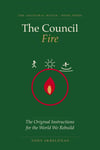
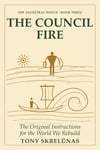
The Council Fire — The Original Instructions for a Breaking World
THE COUNCIL FIRE The Original Instructions for a Breaking World By Tony Skrelūnas · The Ancestral Watch, Book Three · A novel ·
A governance architect has written a novel about the end of the world — and a roadmap for healing our way out of it. It is also the most useful book on the shelf.
Tony Skrelūnas is an economic futurist and a governance systems architect — which is to say his profession is designing how societies decide things, count things, and hold together. For thirty years he has done that work inside real institutions, at real scale, on four continents. He founded and led a decade of gatherings that drew Indigenous elders from across two continents. He advises technology companies on community-centered AI and robotics. He is a college trustee, faculty at 1440 Multiversity, and a doctoral candidate formalizing all of it into a dissertation. He is not, by training, a novelist.
He is also not, by origin, any of the above. He was raised by his great-grandmother in an eight-sided log cabin, far from any city, among sheepherders whose way of living had not meaningfully changed in centuries. He learned the old knowing the way it has always been handed over — beside her, with the animals, in the weather. And he learned to read at an oak table by the light of a kerosene lamp.
Hold that image, because the book returns it to you. Some distance into The Council Fire, after the collapse has come and the keepers are dead, their grandchildren keep the knowing alive by reading at night by lamplight. It is the novel's central picture of survival — the small lit room, the child, the flame, the words getting through. It is also, precisely, the author's childhood. The argument and the biography are the same object seen from two sides.
That turns out to be the point.
The Council Fire is the third book of his Ancestral Watch series and by some distance the most ambitious: a beautifully told story of humanity's honorable survival that is simultaneously a working blueprint for it — assembled entirely from the tools our ancestors used to ensure we would have any thoughts or stories at all.
On the form. Skrelūnas writes as a metamodernist — the term is his own, drawn from doctoral work on ancestral wellness as applied metamodernism — and the book's boldest move is one most readers will only recognize on the second pass. This is a novel that carries its own appendices, its own glossary of the old words, its own prophecies. It contains functioning frameworks — an economic ledger, a governance architecture, a hundred-year healing path — sitting inside a narrative without apology, as though the border between story and instrument were a recent invention rather than a permanent law. Which it is.
Then the deeper move. Inside the story, the twelve keepers deliberately encode signs into the stories they leave behind, so that great-grandchildren they will never meet can read those stories and know when the world has returned. The book does exactly this to its own reader. The form enacts the argument. It is a story that knows it is a transmission device — which is the metamodern move exactly: sincerity that has passed all the way through irony and come out the far side still willing to mean something. A postmodern novel could not end with the coyote acting like himself again. This one does, and earns it.
On the story. Twelve keepers, twelve peoples, one fire. It opens on a cold Friday in Germany with seven men riding a steel cage up out of the dark carrying the last lump of coal ever cut in that country, and it ends, a hundred years on, with the morning the coyote finally acts like himself again. In between: a Lithuanian song-keeper, a Japanese grandmother who has run her neighborhood assembly for forty years, an Andean seed-holder, a Maasai herder, a Diné shepherd. The collapse arrives. The keepers die, one by one. Their children carry the fire; their grandchildren read by lamplight and learn the songs.
Nobody is a guest in this book — no tradition is positioned as the exotic visitor in another's story. The Diné and the Lithuanian and the Swiss commons and the Balinese terraces stand at exactly the same height, which sounds like a courtesy and is in fact the entire thesis: every people on earth was once indigenous somewhere.
On the argument. The novel's center of gravity is a chapter called "The Far Messengers," and it is the best writing here. Its claim is disarmingly simple. Everything you know reached you because somebody carried it. They crossed the largest sand desert on earth on foot. They sailed a month of open ocean with no map, lying in the hull of a canoe at night, reading the swells through the wood with their own bodies. A people's soul grows deep only when its knowing is given away far.
And the skill we are losing, Skrelūnas argues, is not the stories. It is the carrying. The calm heart that crosses the killing ground. The eye that reads a changing sky in time to move.
He then does something a lesser book would not risk: he asks how such a person is made. His answer is that you cannot make one in the panic — the crossing was always made beforehand, in the quiet days, because out on the sand you do not manufacture calm, you retrieve it. And that no messenger ever stood alone. Each one sat at the top of a whole civilization organized around the raising of honored people: the weather-reader, the seed-keeper, the one who knew which root fed you and which lied, the song-holder carrying a people's entire library inside his own memory. In that world, he writes, you rose by mastering something and serving the people with it. Your rising was not a threat. Your rising was your family's glory. Anyone who has lived inside a community that pulls its risers back down will feel that sentence land like a diagnosis.
On the wound. Here the book does something its shelf-mates do not. Having argued that the coming world will demand messengers, Skrelūnas turns and asks the question that makes the whole project honest: what if the people who would have to become them have already been broken?
The chapter is called "The Fire That Turned Inward," and it names three kinds of person the dying world damaged nearly to death — the messenger with the calm heart, who carries the thread; the one called to serve, surrounded with honor, who makes the change; and the watcher, who reads the world across a lifetime and shapes what he sees into a story that outlasts him. No seed, no solar array, no council chamber would matter at all if these three could not be made again.
And they cannot be made in a season, he writes, or trained in a workshop, or legislated into being. What has to be rebuilt is not a skill. It is a people. And a people is rebuilt the way it was broken — slowly, from the inside, one child and one family at a time. He gives it a hundred years. Three generations, maybe four.
This is the book's roadmap for healing generational trauma, and it is unsentimental about the order of operations. You do not get the story first. You get the story last. The watcher — the one who will shape the Fifth World story, the story a people needs to survive the next stretch — cannot be grown while the fear is still in the body. Get the tiger out of the room. Then turn the fire back outward, at what is actually breaking the world, instead of inward at your own. Then rebuild the honor, so that a rising child is a family's glory instead of a target. Only then can a people make the story that carries it. Reverse that sequence and nothing holds — which is, Skrelūnas suggests, precisely what has been attempted for four hundred years.
On the honesty. The book declines to promise rescue. It says plainly that the visions in it may not come true, that parts may, that some will come slower than hoped and some faster than feared. What it offers instead is a harder proposition: that a people can become whole even while the world is still healing; that some places will be spared and become the seeds of what returns. This is a grown-up hope, and it is rarer in this territory than it should be.
On where it sits. There are two shelves in this genre that almost never touch. On one, the Indigenous-wisdom books — deep on values and story, each speaking from a single tradition, none engaging the hard mechanics of governance and economy. On the other, the climate books — fluent in collapse and rebuilding, treating spiritual and cultural knowledge as, at most, a grace note. The Council Fire is the first to put the nervous-system healing and the four-capital ledger between the same two covers, as one continuous argument, on the grounds that the inner regulation is the floor the governance stands on.
The verdict. The keepers are invented. The frameworks are not — every one has been tested in legislation that passed, in enterprises that exist, in communities under real pressure. That is an unusual sentence to write about a novel, and it is the reason this one matters. Skrelūnas has written a book meant to be read by firelight seven generations from now and still be true, and the remarkable thing is that the claim doesn't read as vanity.
Read it as a story. Then read it again as a manual. It was built to survive both.
A word from Käthe
One of the twelve keepers carries the eternity debt. Her people cut coal out of the ground under Germany for a hundred and fifty years, and when the last cage came up they found out what the ground had been holding down the whole time. She is the bluntest of them. This is what she says to the ones still deciding.
You want me to tell you it will be fine. I will not.
Here is what I know, and my people learned it the expensive way. Six hundred meters under the green hills of Bottrop, the water is always trying to rise. The moment we stopped digging, it started climbing — and if it climbs all the way, the poison meets the clean water half the region drinks, and we have done a thing to our grandchildren that cannot be undone.
So the pumps run. Forever. There is no later date when someone gets to switch them off. Our engineers have a word for it. Ewigkeitsaufgabe. The eternity task. A bill with no final payment. We now spend more electricity keeping a dead mine from drowning the living than we ever got out of the coal.
That is what my grandfather understood, sitting at the kitchen table the night he came up for the last time, turning his own last lump of coal over in his fingers. Forty-one years underground. I asked him what he would do now. He thought a long time. I will look after the water, he said.
You took? Then you owe. Forever. That is my teaching. It is not a mood. It is an accounting.
Now look at what was put in your hands.
Every story you know. Every song, every remedy, every way of doing a thing right. Somebody carried that to you across a desert. Across an ocean. Across four hundred years of people who were told to forget and refused. You did not earn it. It was handed to you.
You took. So you owe.
And there is exactly one way that bill gets paid. Forward. To people you will never meet, who will need it more than you ever did.
So. Twenty-five.
This is thirty years of work. Legislation that passed. Institutions that still run. Gatherings that pulled elders across two continents. Frameworks tested against real communities under real pressure — not talked about. Tested.
Here is the honest arithmetic. If you lead anything — a company, a village, a classroom, a family — you need one thing in here to work. One. Not all of it.
And if nothing lands, you are out twenty-five and you read a good story. I have made worse bets before breakfast.
But do not tell me afterward that you did not know about the debt.
Take it. Read it. Carry it.
Glück auf. Good luck coming back up.
What's inside
● The story of the founding — twelve keepers, one fire, a hundred-year arc
● The Far Messengers — how the quiet ones crossed the whole earth, and why we are about to need them again
● The Fire That Turned Inward — why wounded peoples tear down their own risers, and how that stops
● Governance without campaigns — how leaders are recognized instead of elected
● The Sacred Veto — the covenant with the seventh generation
● The Four Capitals — financial, relational, cultural, natural
● Honor Attracts Honor — the trade system that replaces extraction
● The Seventh Generation Company — a new design for business
● The Community Circle and the Regional Council — how the fire scales from one household to a hemisphere
● Humble rituals from many traditions — belonging to no one, usable by all
● A hundred-year path of healing
● The signs written into the story on purpose, for the great-grandchildren to recognize when the world returns
Who it's for
The ones feeling the weight.
The ones carrying grief they haven't named yet — for the fires that keep coming, for the seasons that no longer arrive when they used to. For the salmon whose rivers are too warm. For the forests dying standing up. For the sacred sites drying, the medicine plants moving beyond reach, the ceremonies that now come at the wrong time of year.
Parents lying awake trying to find a future to describe to their kids that doesn't sound like a lie.
The ones who sit in their community and feel something being asked of them — some kind of guidance, some kind of holding — with no map for what that looks like.
Anyone who has spent years working on the individual and is starting to understand that individual healing alone will not save us. We need the container too.
Anyone who read Stone Breath and is ready for the bigger picture.
About Tony
Tony Skrelūnas is a governance systems architect and economic futurist who works at the seam where the oldest human wisdom meets the newest human tools — on the question that will define this century: how do we rebuild our societies to grow in the honorable way our ancestors intended?
Lithuanian and Diné, he is himself the braid this book describes — living proof that every people was once indigenous to somewhere, and once knew how to live in a body, and belong to a community, without wrecking either. He led the governance restructuring of a still-deeply-cultural nation, returning power to local communities and rebuilding representation on the ancient patterns of nomination and honor. For a decade he convened indigenous elders from across the Americas in the old way — through ceremony and story and song — to keep that knowledge alive. Today he carries it to the frontier, advising technology companies and communities on every continent on how to measure wealth in four kinds instead of one, and grow without breaking the world.
He is a PhD candidate at Prescott College — home to North America's first doctoral program in sustainability education, with field campuses from Mexico to Kenya — studying how the wisdom of our ancestors heals modern lives. He teaches at 1440 Multiversity and other venues around the world, and is the only person of Native American and Lithuanian descent inducted into Northern Arizona University's College of Business Hall of Fame.
He failed out of college, came back, finished at the top of his class — and has spent his life proving these tools work.
He writes to help you remember who you are.
The offer
The Council Fire — $25. Instant EPUB download. Yours to keep, on every device, forever. If it moves you, pay more. Either way, you're carrying the work forward.
Stone Breath was the beginning. This is the founding. The Ancestral Watch is four books, and each one stands on its own.
We are the far messengers now. The circle holds.