
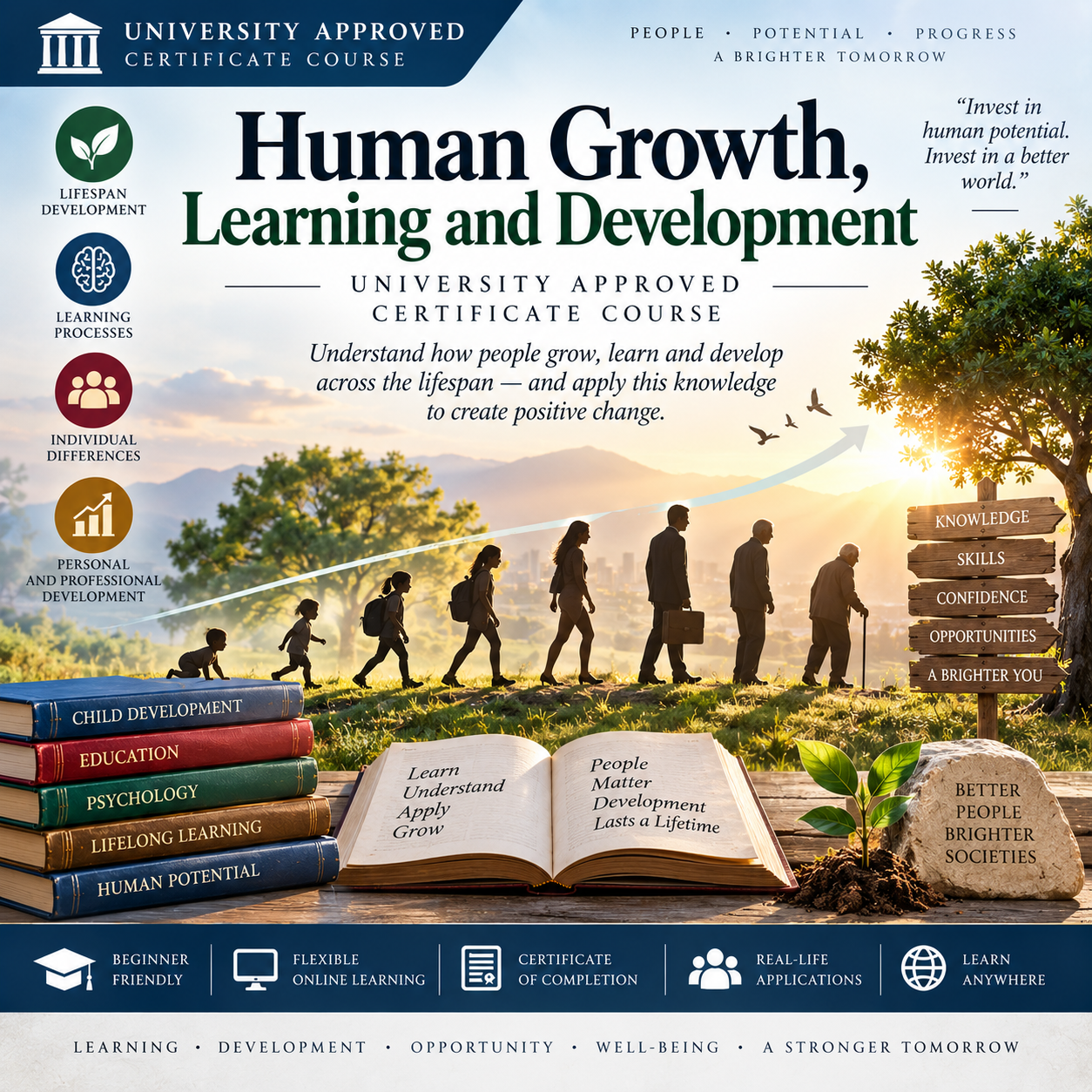
Human Growth Learning and Development University Approved C
Human Growth, Learning and Development – University Approved Certificate Course
Understand How People Grow, Learn, Change, and Develop Across the Lifespan
Human development is a lifelong process.
From infancy and childhood to adolescence, adulthood, and later life, people continuously change physically, cognitively, emotionally, socially, and psychologically.
The Human Growth, Learning and Development – University Approved Certificate Course provides a structured and accessible introduction to the key principles that help explain how people develop, how they learn, why individuals differ, and how education, relationships, environment, biology, experience, and society can influence human growth.
This course is suitable for complete beginners as well as learners interested in psychology, education, counselling, teaching, coaching, social sciences, childcare, personal development, human resources, health-related studies, and lifelong learning.
No previous specialist knowledge is required.
Whether you are studying for personal interest, professional development, continuing education, or as preparation for further academic study, this course offers a valuable foundation.
What Is Human Growth and Development?
Human growth and development refers to the changes that occur throughout the human lifespan.
These changes may involve:
- Physical development
- Cognitive development
- Emotional development
- Social development
- Language development
- Personality development
- Moral development
- Learning
- Relationships
- Identity
- Independence
- Adaptation
- Ageing
Development does not occur in exactly the same way for every individual.
Each person develops within a unique combination of biological, psychological, family, educational, cultural, economic, and social influences.
Understanding these influences can help us better understand both ourselves and other people.
What You Will Learn
Throughout this course, you will explore topics such as:
- Human growth and development
- Lifespan development
- Major developmental theories
- Learning processes
- Cognitive development
- Emotional development
- Social development
- Language development
- Personality
- Individual differences
- Motivation
- Intelligence
- Childhood development
- Adolescence
- Adulthood
- Ageing
- Learning environments
- Family and social influences
- Education and development
- Personal and professional growth
- Lifelong learning
The course is designed to provide a broad foundation without requiring prior academic training.
Understanding Lifespan Development
Human development does not stop when childhood ends.
People continue changing throughout their lives.
This course examines development across the lifespan, including:
- Infancy
- Early childhood
- Middle childhood
- Adolescence
- Early adulthood
- Middle adulthood
- Later adulthood
Each stage brings different opportunities, challenges, responsibilities, relationships, and developmental experiences.
Learners will explore how development can continue across physical, cognitive, emotional, and social dimensions throughout life.
Major Theories of Human Development
Developmental psychology includes several influential theories that attempt to explain how and why people change.
The course introduces learners to important theoretical perspectives associated with areas such as:
- Cognitive development
- Psychosocial development
- Behavioural learning
- Social learning
- Attachment
- Moral development
- Humanistic development
Understanding different theories helps learners appreciate that human development can be examined from several perspectives.
No single theory explains every aspect of human development.
Instead, different approaches provide different insights.
Physical Growth and Development
Physical development is one of the most visible aspects of human growth.
Learners will explore general concepts involving:
- Growth
- Motor development
- Brain development
- Physical maturation
- Puberty
- Age-related change
- Health and development
- Environmental influences
The course provides an educational overview and does not replace medical or clinical training.
Cognitive Development
Cognitive development concerns the way people think, understand, remember, solve problems, and process information.
Topics may include:
- Thinking
- Memory
- Attention
- Problem-solving
- Reasoning
- Decision-making
- Language
- Intelligence
- Learning strategies
Understanding cognitive development is particularly useful for people working in education, teaching, childcare, training, coaching, and learning support.
Learning and How People Learn
Learning is a central part of human development.
People learn through many different processes, including:
- Experience
- Observation
- Practice
- Reinforcement
- Repetition
- Feedback
- Social interaction
- Formal education
- Informal learning
- Self-directed learning
The course explores how learning can be influenced by motivation, environment, attention, memory, confidence, prior knowledge, and individual differences.
Behavioural Approaches to Learning
Learners will be introduced to basic behavioural concepts related to learning.
Topics may include:
- Classical conditioning
- Operant conditioning
- Reinforcement
- Consequences
- Behaviour modification
- Habit formation
These principles have influenced education, psychology, parenting, training, and organisational behaviour.
The goal is to understand how environmental consequences can influence behaviour.
Social Learning
People do not learn only through direct experience.
We also learn by observing others.
This course introduces the idea of social learning and explores how:
- Parents
- Teachers
- Friends
- Colleagues
- Media
- Society
- Role models
can influence behaviour and attitudes.
This is particularly relevant when studying children and adolescents, but social learning continues throughout adulthood.
Emotional Development
Emotional development is an important part of human growth.
People gradually learn to:
- Recognise emotions
- Express emotions
- Understand emotional experiences
- Regulate emotional responses
- Develop empathy
- Manage frustration
- Respond to stress
The course explores how emotional development can be influenced by relationships, experience, temperament, family, culture, and environment.
Social Development
Human beings develop within relationships.
Social development involves learning how to interact with other people and participate in families, groups, schools, workplaces, and communities.
Topics may include:
- Attachment
- Friendship
- Family relationships
- Cooperation
- Conflict
- Social skills
- Peer influence
- Communication
- Social identity
- Belonging
Understanding social development can be useful in education, counselling, management, coaching, social work, and many other people-focused professions.
Language Development
Language plays a major role in communication, learning, social interaction, and cognitive development.
The course introduces learners to general concepts relating to:
- Early communication
- Vocabulary development
- Language learning
- Social interaction
- Communication skills
- Language and thought
Language development can be influenced by both biological and environmental factors.
Childhood Development
Childhood is a period of rapid development.
Learners will explore areas such as:
- Physical growth
- Motor development
- Cognitive development
- Language
- Emotional regulation
- Family relationships
- Play
- Friendship
- School experiences
- Learning
Understanding childhood development can be particularly valuable for parents, educators, childcare workers, coaches, and people working with children.
Adolescence
Adolescence involves major physical, emotional, cognitive, and social changes.
The course explores topics including:
- Puberty
- Identity
- Independence
- Peer relationships
- Decision-making
- Emotional development
- Family relationships
- Education
- Motivation
- Risk awareness
Adolescence is not simply a transition from childhood to adulthood.
It is an important developmental stage in its own right.
Adulthood
Development continues throughout adulthood.
Learners will explore themes relating to:
- Work
- Relationships
- Family
- Identity
- Responsibility
- Personal goals
- Life transitions
- Learning
- Career development
- Well-being
Adults continue to adapt, learn, and develop in response to new experiences and changing circumstances.
Ageing and Later Life
Later adulthood can involve both challenges and opportunities.
The course introduces learners to topics relating to:
- Physical ageing
- Cognitive changes
- Social relationships
- Retirement
- Lifelong learning
- Adaptation
- Independence
- Well-being
- Social participation
The course encourages a balanced approach to ageing that recognises individual differences and continued human potential.
Individual Differences
People develop differently.
Two individuals of the same age can differ substantially in:
- Personality
- Interests
- Motivation
- Learning style
- Ability
- Confidence
- Emotional responses
- Social experiences
- Culture
- Family background
Understanding individual differences is essential for effective teaching, communication, management, coaching, and support.
Personality Development
Personality refers to relatively consistent patterns of thought, emotion, and behaviour.
Learners will explore general ideas relating to:
- Personality traits
- Temperament
- Experience
- Family influences
- Social environment
- Identity
- Individual differences
Personality develops through complex interactions between biological and environmental influences.
Motivation and Development
Motivation affects learning, achievement, behaviour, and personal development.
The course explores factors such as:
- Goals
- Rewards
- Personal interests
- Expectations
- Confidence
- Self-belief
- Internal motivation
- External motivation
Understanding motivation can be valuable in education, workplace management, coaching, parenting, and personal development.
Intelligence and Learning
The concept of intelligence has been examined from many different perspectives.
Learners will be introduced to general questions concerning:
- What intelligence means
- Different forms of ability
- Learning
- Problem-solving
- Creativity
- Individual strengths
- Environmental influences
The course encourages learners to avoid overly simplistic interpretations of human ability.
Family and Development
Families can play a major role in human development.
The course explores how development may be influenced by:
- Parenting
- Communication
- Support
- Relationships
- Expectations
- Cultural values
- Stability
- Conflict
- Education
Family influence is only one part of development, but it can be highly significant.
Education and Human Development
Education can shape cognitive, social, emotional, and professional development.
Learners will explore:
- Learning environments
- Teacher influence
- Motivation
- Assessment
- Feedback
- Individual learning needs
- Formal education
- Informal education
- Lifelong learning
The course encourages learners to think about education as more than simply passing examinations.
Education can influence confidence, opportunity, identity, and participation in society.
Learning Environments
People often learn more effectively when environments support:
- Safety
- Motivation
- Participation
- Curiosity
- Feedback
- Respect
- Clear expectations
- Active engagement
Understanding learning environments can help teachers, trainers, managers, and coaches create more effective educational experiences.
Development in Society
Human development occurs within social and cultural environments.
People are influenced by:
- Culture
- Community
- Media
- Education
- Economics
- Technology
- Social expectations
- Institutions
The course helps learners understand that development cannot always be separated from the society in which a person lives.
Lifelong Learning
Learning does not end with school or university.
People continue to learn throughout life.
Lifelong learning may include:
- Professional development
- Career changes
- Personal interests
- New technologies
- Language learning
- Academic study
- Skills training
- Self-directed learning
A lifelong learning approach can support adaptability, confidence, and personal growth.
Personal Development
Understanding human development can also help individuals understand their own growth.
The course encourages reflection on:
- Personal strengths
- Habits
- Goals
- Motivation
- Relationships
- Learning preferences
- Life transitions
- Future development
Self-awareness can support more intentional personal and professional choices.
Professional Development
Knowledge of human growth, learning, and development can be relevant to many professional fields.
These include:
- Education
- Teaching
- Childcare
- Psychology
- Counselling
- Coaching
- Human resources
- Management
- Training
- Social services
- Community work
- Healthcare support
- Youth work
- Personal development
The course can therefore provide useful background knowledge for a wide range of learners.
Real-Life Applications
The concepts studied in this course can be applied to everyday situations.
They may help you better understand:
- Why children learn differently
- Why motivation changes
- Why people respond differently to stress
- Why relationships influence development
- Why individuals develop at different rates
- How learning environments affect performance
- How life transitions influence identity
- How people continue learning throughout adulthood
This practical relevance makes human development an especially valuable field of study.
Who Is This Course For?
This course may be suitable for:
- Complete beginners
- Psychology students
- Education students
- Teachers
- Teaching assistants
- Parents
- Childcare workers
- Counselling students
- Coaches
- Human resources professionals
- Managers
- Trainers
- Social care workers
- Youth workers
- Personal development learners
- Lifelong learners
- Anyone interested in understanding human development
No previous qualification is required to begin.
Beginner Friendly
The course introduces concepts gradually and uses accessible explanations.
You do not need previous knowledge of developmental psychology or education.
The objective is to help learners build a strong foundation before moving into more specialised areas.
Flexible Online Learning
Study online according to your own schedule.
The self-paced format makes the course suitable for people balancing education with:
- Work
- Family responsibilities
- University study
- Professional commitments
- Other training
You can revisit material whenever necessary and progress at a pace that suits you.
What You Can Gain from This Course
By completing the course, you can develop a broader understanding of:
- Lifespan development
- Human growth
- Learning processes
- Cognitive development
- Emotional development
- Social development
- Language development
- Childhood
- Adolescence
- Adulthood
- Ageing
- Personality
- Individual differences
- Motivation
- Education
- Social and family influences
- Lifelong learning
- Personal development
You can also develop a stronger foundation for further academic or professional study.
A Foundation for Further Study
This course may provide useful preparation for further learning in subjects such as:
- Developmental psychology
- Educational psychology
- Child psychology
- Counselling
- Education
- Teaching
- Social psychology
- Human resources
- Coaching
- Learning sciences
- Special education
- Social work
- Behavioural science
It can also complement broader studies in psychology and human development.
Certificate of Completion
Learners who successfully complete the applicable course requirements may receive a Certificate of Completion for:
Human Growth, Learning and Development – University Approved Certificate Course
The certificate may be useful for:
- Your CV or résumé
- LinkedIn profile
- Personal development portfolio
- Continuing education records
- Academic portfolio
- Professional development documentation
- Demonstrating additional learning
Course Format: Online
Level: Beginner / Introductory
Study Method: Self-Paced
Subject: Human Growth, Learning and Development
Certificate: Available upon successful completion of applicable course requirements
Why Choose This Course?
Lifespan Perspective
Explore development from infancy through later adulthood.
Beginner Friendly
No previous specialist knowledge is required.
Broad Curriculum
Study physical, cognitive, emotional, social, and educational development.
Practical Applications
Connect theory with everyday life, education, relationships, and professional settings.
Flexible Online Learning
Study according to your own schedule.
Personal Development
Gain greater awareness of learning, motivation, behaviour, and individual differences.
Professional Relevance
Develop knowledge useful across education, psychology, training, management, coaching, and support roles.
Certificate of Completion
Receive documentation of your learning after successfully completing the applicable requirements.
Understand People. Support Growth. Create Positive Change.
Human development is one of the most fascinating areas of study because it concerns every person.
We all grow.
We all learn.
We all adapt.
We all experience change.
Understanding these processes can help us become better learners, educators, colleagues, parents, leaders, and members of society.
The Human Growth, Learning and Development – University Approved Certificate Course provides an accessible opportunity to explore these ideas in a structured way.
Learn how people develop.
Understand how people learn.
Explore individual differences.
Apply developmental knowledge to real life.
Build a stronger foundation for future learning.
People. Potential. Progress.
Begin your learning journey today.
Important Professional Notice
This course is intended for educational and personal/professional development purposes.
Completion of the course does not qualify a learner as a psychologist, psychotherapist, counsellor, teacher, physician, or other regulated professional unless additional qualifications and licensing requirements applicable in the learner’s jurisdiction have been satisfied.
The course should not be used as a substitute for professional psychological, educational, medical, or developmental assessment where such services are required.