
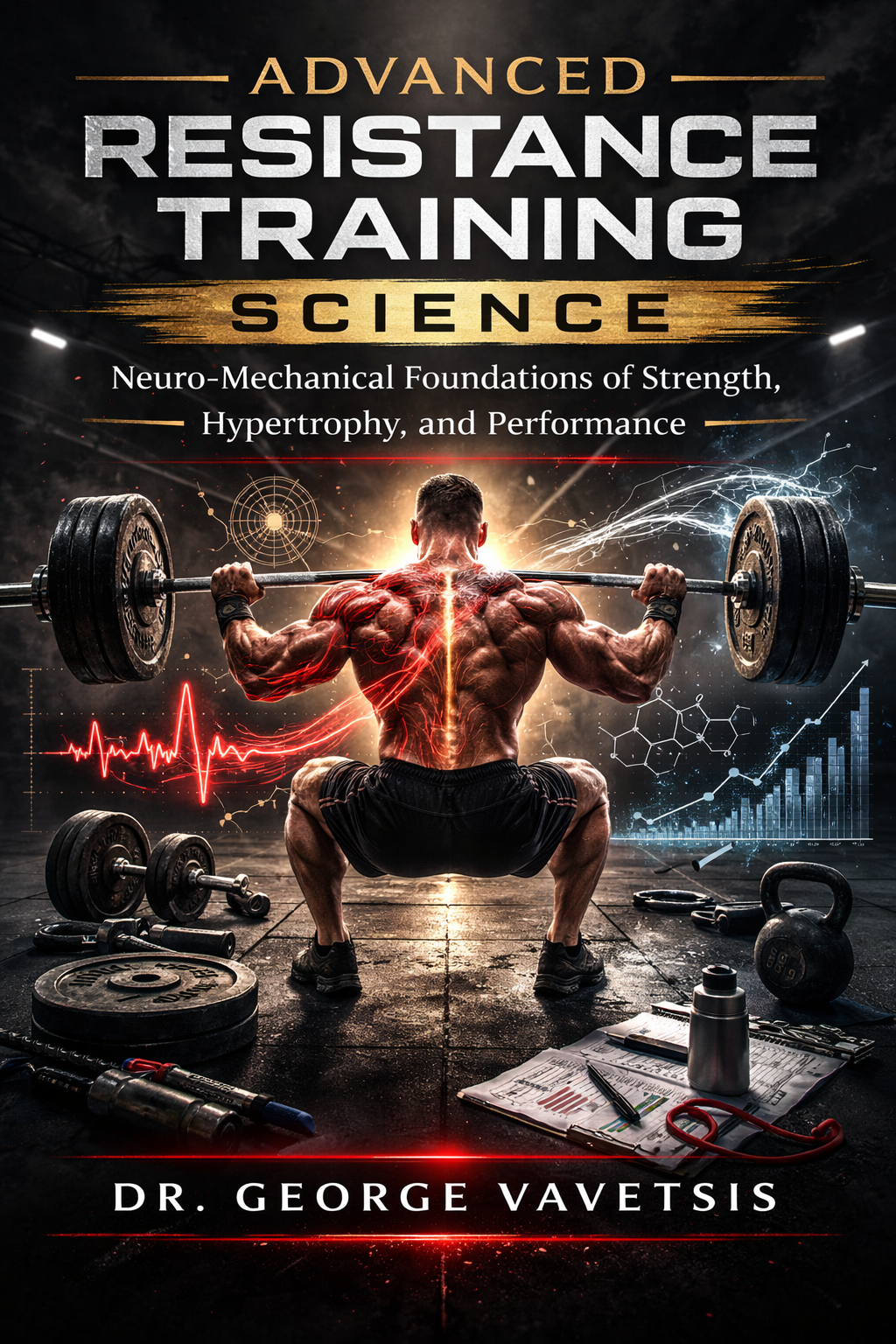
Advanced Resistance Training Science
Pages: 1010
Resistance training is no longer a simple practice of lifting external loads in pursuit of strength or muscle size. It has evolved into a sophisticated, multidimensional science that integrates biomechanics, neurophysiology, bioenergetics, and adaptive systems theory to optimize human performance. At the highest level of sport and performance preparation, resistance training is not merely about moving weight—it is about manipulating internal load, neural drive, force–time characteristics, and structural adaptation in a precisely engineered manner. This book emerges from that advanced paradigm.
Modern strength and conditioning operates within a neuro-mechanical framework. Mechanical tension, internal physiological strain, and force–time behavior form the primary drivers of adaptation, not simply the magnitude of external load. Hypertrophy, neural efficiency, rate of force development, and mechanical power are outcomes of complex internal processes involving motor unit recruitment, mechanotransduction, and fatigue modulation. The architecture of training must therefore be constructed around internal stress signals rather than superficial metrics alone.
The central thesis of this work is that resistance training should be understood as a system of load prescription architecture—an organized framework that governs how mechanical, neural, and metabolic stimuli are applied over time to induce specific adaptations. In elite environments, training decisions are no longer based solely on tradition or generalized guidelines. Instead, they rely on measurable constructs such as impulse, velocity loss, neural activation patterns, and fatigue signatures. The integration of monitoring technologies and performance analytics allows coaches to move from intuition-driven practice to evidence-guided precision.
A key theme explored throughout this book is the distinction between external and internal load. External load describes the physical work performed—sets, repetitions, and resistance—while internal load reflects the physiological and neural cost imposed on the athlete. Adaptation occurs primarily in response to internal strain. Two athletes performing identical external workloads may experience vastly different internal responses, leading to divergent adaptations, fatigue patterns, and injury risk. Understanding and controlling this divergence is fundamental to modern resistance training methodology.
Another foundational concept is the force–time integral, or impulse, as a determinant of structural adaptation. The body does not respond solely to peak force; it responds to the cumulative exposure to tension over time. Impulse governs the stimulus for muscle remodeling, neural drive adaptation, and fatigue accumulation. By manipulating impulse through load, tempo, and contraction duration, coaches can engineer highly specific training effects ranging from maximal strength to explosive power and neuromuscular resilience.
Neural factors occupy an equally critical role. Maximum voluntary contraction, rate of force development, and neural drive define the ceiling and speed of force production. Elite performance depends not only on how much force can be produced but how rapidly it can be expressed. The nervous system orchestrates motor unit recruitment, synchronization, and firing frequency, shaping both strength and power capabilities. Resistance training, therefore, becomes a process of neural optimization as much as muscular development.
This book also addresses the dynamic nature of fatigue and recovery. Neuromechanical fatigue and metabolic fatigue represent distinct yet interacting pathways. Effective programming requires understanding how these fatigue domains evolve across sessions and cycles, and how they influence performance readiness, adaptation, and injury susceptibility. Modern load prescription must balance stimulus and recovery through precise manipulation of intensity, volume, and density.
The evolution of velocity-based training and autoregulatory models marks another shift in contemporary practice. Traditional percentage-based systems assume stable relationships between load and performance, yet fatigue, readiness, and neuromuscular state constantly fluctuate. Velocity loss, movement speed, and perceived effort provide real-time insight into internal load and adaptive state, enabling individualized training regulation. Such methods transform resistance training into a responsive, adaptive system rather than a rigid prescription.
Equally important is the structural dimension of adaptation. Resistance training shapes not only muscle fibers but also connective tissue, tendon stiffness, joint stability, and kinetic chain coordination. The interaction between passive and active tension, muscle-tendon elasticity, and joint torque distribution determines movement efficiency and resilience under load. A well-constructed program develops the entire neuromusculoskeletal system as an integrated performance unit.
Throughout this book, resistance training is approached as a continuum—from neural efficiency and coordination to maximal force production and structural hypertrophy. Different training strategies emphasize different adaptive pathways, yet all must be harmonized within a coherent periodization model. The objective is not simply to increase strength, but to produce transferable performance: faster acceleration, greater power output, improved stability, and reduced injury risk.
For the advanced strength and conditioning professional, this text offers a deep exploration of the principles governing load prescription and adaptation science. It aims to bridge theory and application, translating complex physiological and mechanical concepts into actionable frameworks for programming. The emphasis is on precision, individualization, and systemic thinking—hallmarks of elite performance preparation.
Ultimately, resistance training represents an adaptive dialogue between stimulus and organism. The coach designs the stimulus; the athlete’s neuromechanical system interprets and responds to it. Mastery lies in understanding this dialogue—how force, time, neural drive, and recovery interact to shape performance capacity. This book is dedicated to advancing that understanding and providing the conceptual and practical tools necessary to engineer human performance at the highest level.