
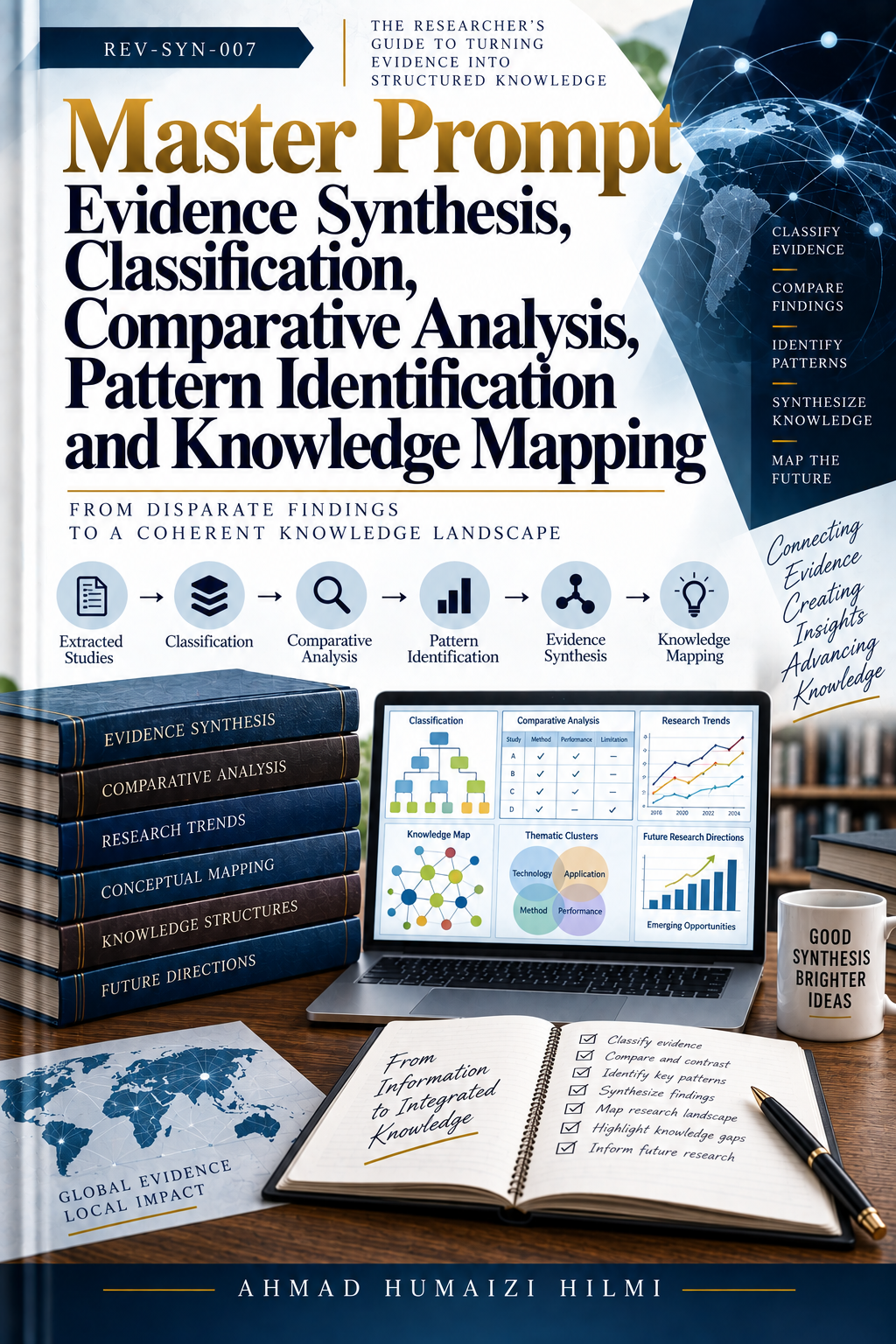
7. REV-SYN-007 — Evidence Synthesis, Classification, Comparative Analysis, Pattern Identification and Knowledge Mapping
Description
This Master Prompt would focus on transforming the verified, appraised and analysis-ready evidence base into structured, comparative and analytically meaningful knowledge. It would guide researchers in selecting synthesis approaches appropriate to the review questions and characteristics of the evidence; defining the unit of synthesis; constructing transparent classification systems; grouping studies according to meaningful analytical dimensions; comparing methodologies, theories, frameworks, populations, contexts, technologies, interventions, mechanisms, materials, processes, applications, outcomes and findings; and identifying recurring patterns, convergence, divergence, temporal developments, contextual variation and distinct research streams. The synthesis should therefore move deliberately from Appraised Evidence Base → Synthesis Purpose and Unit → Classification Scheme → Evidence Grouping → Descriptive Mapping → Comparative Analysis → Within-Group Synthesis → Cross-Group Synthesis → Convergence and Divergence → Temporal and Contextual Pattern Identification → Quantitative/Qualitative Integration Where Appropriate → Evidence and Knowledge Mapping → Structured Knowledge → Synthesis Audit → Handoff to Critical Interpretation.
A major emphasis would be placed on moving beyond paper-by-paper description. Rather than constructing a review around sequential statements such as “Author A found…, Author B found…, Author C found…,” researchers would reorganize the evidence around concepts, mechanisms, methodological approaches, theoretical relationships, technologies, performance dimensions, populations, contexts, outcomes or other analytical structures justified by the review question. The uploaded literature demonstrates several legitimate forms of synthesis. For example, the Knowledge Graph review comparatively maps 102 studies according to methodologies, tools, datasets, applications and challenges while distinguishing breadth-oriented inter-paper and depth-oriented intra-paper approaches. The electrohydrodynamics review compares model families according to their capabilities, advantages, disadvantages, limitations and obtainable results, illustrating technology- and method-centered synthesis rather than author-centered narration. Other uploaded work combines systematic review with quantitative meta-analysis and narrative synthesis, demonstrating that different forms of evidence may require different but complementary synthesis strategies.