

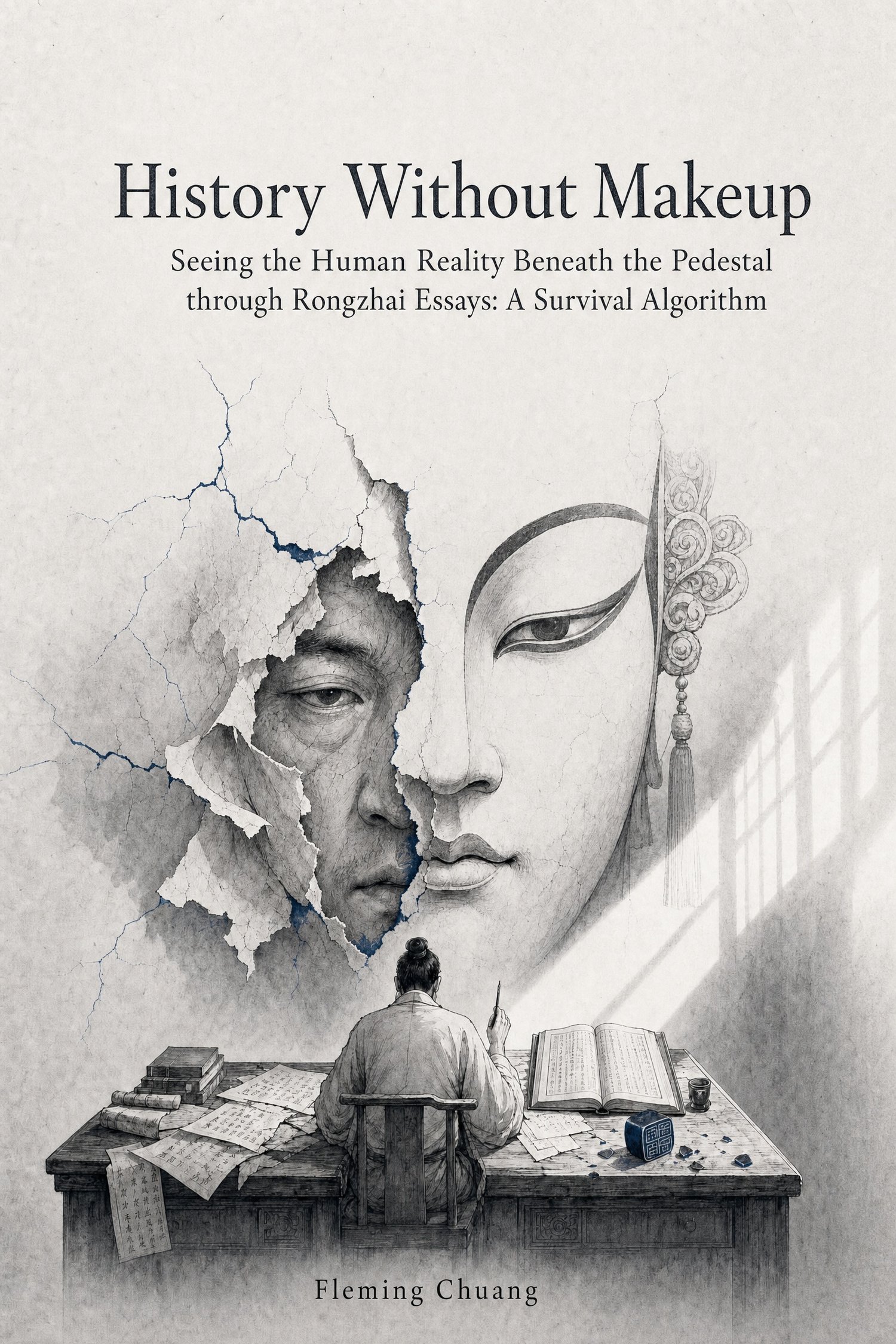
History Without Makeup
What if history is less a gallery of heroes than a laboratory of human behavior?
In History Without Makeup, Fleming Chuang looks beneath polished historical legends to recover the fear, ambition, hesitation, calculation, and self-deception that shaped some of China’s most consequential figures. Using Hong Mai’s Rongzhai Essays as a guiding text, the book asks what official narratives leave out—and why those omissions still matter in modern life.
Across twelve chapters and four thematic modules, Su Dongpo’s political hesitation becomes a study in cognitive dissonance; Cao Cao’s public promises reveal the strategic value of credibility; and Wang Anshi’s reforming certainty shows how moral conviction can harden into a cognitive closed loop. Qin Hui and Han Tuozhou illuminate the debts and blind spots created by concentrated power, while the stories of unnamed contributors, wealthy families, reclusive literati, and broken friendships expose the hidden rules governing credit, inheritance, reputation, and human obligation.
The book then turns to Hong Mai himself. His deliberate invisibility, encrypted criticism, and refusal to treat his own conclusions as absolute offer a practical philosophy for dangerous, competitive, and uncertain environments. Concepts from psychology, behavioral economics, sociology, game theory, negotiation, and leadership help translate these historical patterns into questions for today: How do you survive factional workplaces without losing your judgment? How can leaders protect dissent and avoid information cocoons? Why does a carefully built persona become a high-interest social debt? What preserves trust when favors become ledgers?
Neither a conventional dynastic history nor a clinical psychology manual, History Without Makeup is accessible, provocative narrative nonfiction for readers who want more than inspirational slogans. It is an invitation to read history without worship, authority without surrender, and modern life without illusion—and to build a clearer survival algorithm of your own.