
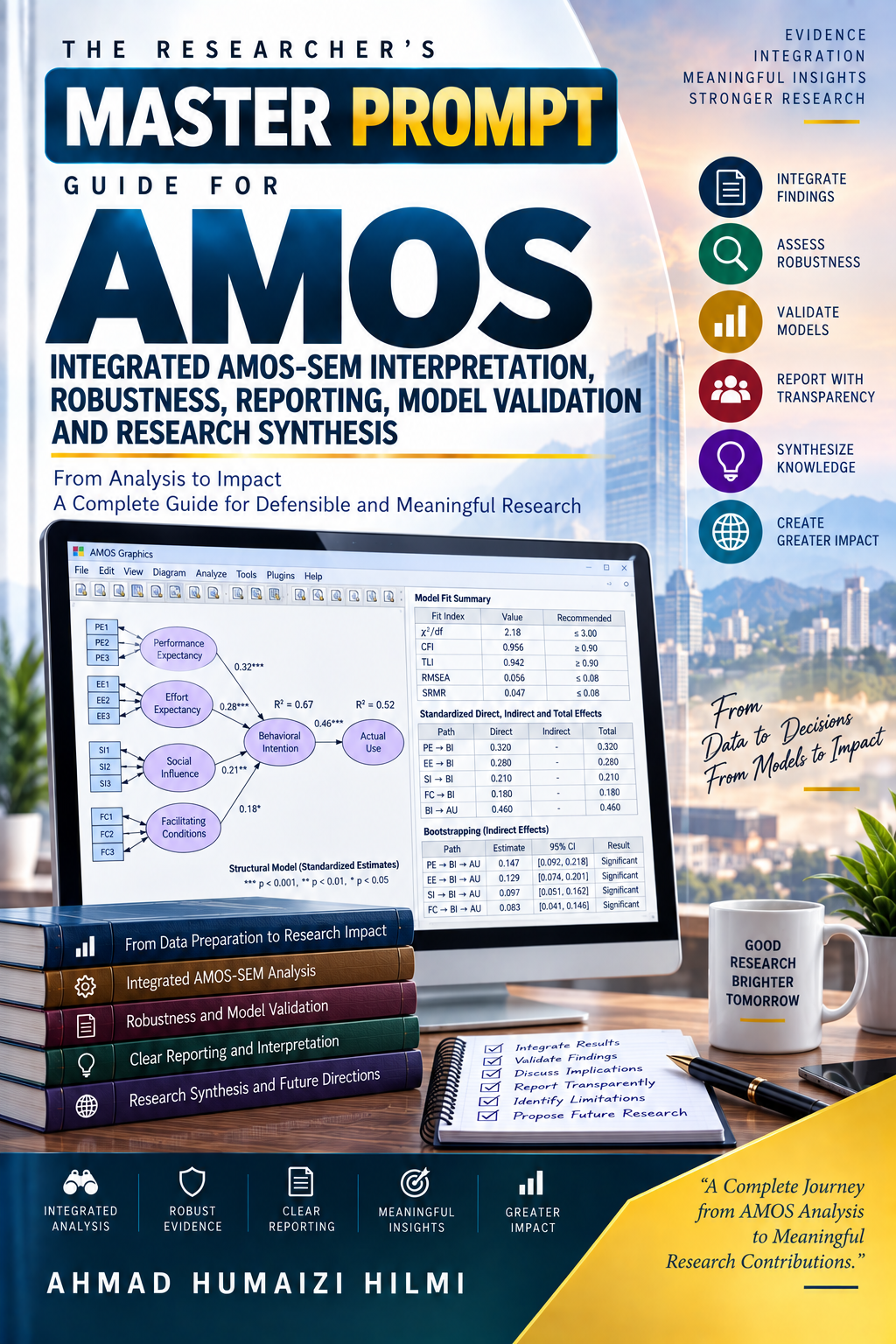
AMOS-SYN-010 — Integrated AMOS-SEM Interpretation, Robustness, Reporting, Model Validation and Research Synthesis
Description
This Master Prompt focuses on transforming the complete AMOS-SEM workflow into an integrated, transparent and defensible research account. It guides researchers in synthesizing data preparation, preliminary screening, measurement-model development, CFA results, reliability and validity evidence, goodness-of-fit assessment, structural relationships, hypothesis testing, direct and indirect effects, mediation, moderation, group comparisons and advanced analyses into one coherent interpretation rather than presenting the analyses as disconnected statistical procedures.
A major emphasis is placed on distinguishing empirical evidence from theoretical interpretation, statistical significance from substantive importance, and statistical association from causal evidence. The uploaded studies demonstrate the importance of sequential validation. For example, the mineral-extraction study proceeds from EFA to CFA, establishes reliability and validity, examines model fit, evaluates multicollinearity and explained variance, and only then interprets direct and mediated structural relationships. The teaching-quality dataset similarly integrates data cleaning, sample adequacy, reliability, EFA and AMOS CFA before describing the final validated measurement structure.
This theme also accommodates complementary or robustness approaches without treating them automatically as replacements for AMOS. The uploaded brand-loyalty study compares maximum-likelihood SEM with 2SLS simultaneous-equation modeling and interprets convergence between the approaches as robustness evidence. The uploaded tourism study combines covariance-based SEM with fsQCA because SEM estimates net effects while fsQCA examines configurations, equifinality and the combined influence of multiple conditions. The final synthesis should therefore establish what the AMOS evidence supports, what remains uncertain, how complementary analyses alter or reinforce interpretation and what future validation is required.