
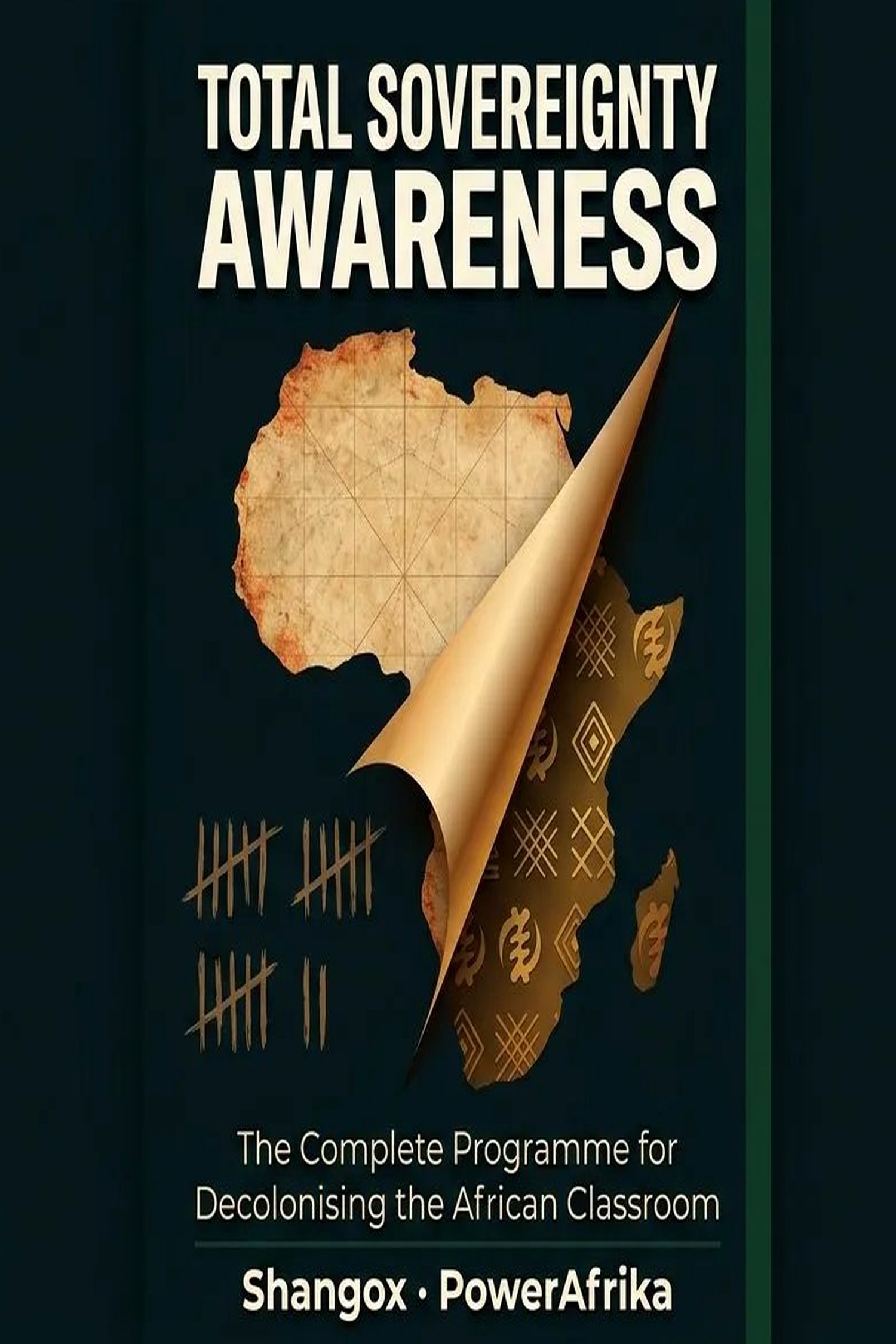
Total Sovereignty Awareness: The Complete Programme for Decolonising the African Classroom
In 1971, at Okuapemman Secondary School in Ghana, an English Master walked to the front of the room and declared that English was the queen of all subjects. The student who heard that declaration did not question it. He had no framework within which the declaration was questionable—because the colonial curriculum had never taught him to ask the forensic question.
This book is that framework.
Total Sovereignty Awareness is the first complete educational programme for decolonising the African classroom. It is not a book about decolonisation. It is a book about sovereignty—and sovereignty, as Chapter 17 will tell you, is not a position you hold. It is a practice you perform. Tomorrow morning. In the classroom that is already there. With the students who are already in it. With one additional question.
What the colonial curriculum does to the African student
The colonial curriculum does not operate through force. It operates through formation—installing a worldview so quietly, across every subject and every examination, that the student never knows it is there. By the time a student completes secondary school, the framework no longer appears as an imposition. It appears as reality itself.
This book names that condition, documents its mechanisms, and provides the specific instruments teachers need to interrupt it—from inside the existing curriculum, without abandoning examination preparation, and without waiting for institutional permission.
How the five stages work
The programme is built across five stages, each developing a specific capacity. Together they move the teacher and student from unreflective compliance to sovereign, evidenced, personally committed practice.
Stage One – The Diagnosis. Students apply four forensic questions to the curriculum they are receiving: Who made this? When and in whose context? Whose interests does it serve? What does it cost me to receive it without examination? The Reflective Journal and the Diagnostic Essay document what the recognition produces.
Stage Two – The Excavation. Students trace the four-level Ownership Chain of a specific curriculum object—from publisher to historical context to institutional interest to the African intellectual tradition the object suppressed. The Prosecution Brief is the written outcome.
Stage Three – The Deconstruction. The “Who Benefits” methodology is applied across three or more subjects. Students trace the complete mechanism from curriculum feature to student formation to institutional beneficiary. The Deconstruction Portfolio documents the cross-curricular pattern.
Stage Four – The Reconstruction. African knowledge systems are introduced as genuine intellectual infrastructure—Akan constitutional theory, Yoruba mathematics, Ubuntu philosophy, Sankore scholarship, Ma at ethics—placed alongside the Western tradition as a second foundation, not a decoration. The Sovereign Alternative Document asks what one subject would look like if it had been designed for African children.
Stage Five – The Activation. Sovereignty as a practice, not a position. The daily forensic question. The eleven-minute Teaching Action. The Capstone Prosecution Brief. The world outside the classroom.
What the book contains
23 chapters across six parts—one part for each stage, plus the Teacher's Formation (Stage Zero)
878 pages of forensic argument, classroom exercises, and assessment frameworks
17 practical exercises with subject suitability, time required, and step-by-step instructions
Complete assessment rubrics for every stage—from the Diagnostic Essay to the Capstone Prosecution Brief
5 appendices: the TSA Lesson Planning Template, the Complete Exercise Library, the full Assessment Framework, Recommended Reading with annotated entries, and the PowerAfrika Prosecution Archive
Glossary of 20 key terms with precise TSA definitions
Case studies from real classrooms: Okuapemman Secondary School, the Adu-Boahen history textbook, the Hippocrates–Aristotle–Tacitus prosecution, the Neoliberationist Classroom, the African Teachers Community, and the school that changes over five years
Who this book is for
African secondary school teachers. Teacher training colleges. University education faculties. Curriculum designers. Parents who want their children to know the intellectual traditions of their people. Every African who has ever suspected that the map they were given does not match the territory.
What it does not require
You do not need a reformed curriculum. You do not need institutional permission. You do not need to abandon the examination. The programme operates within the existing curriculum—adding one forensic question to the lesson you are already teaching. That question takes three minutes. It costs nothing. And it changes everything.
What you receive
PDF (clickable, 878 pages, fully bookmarked)
Launch price: $24.99 USD (standard price after 60 days: $34.99 USD)
African teachers: use code TEACHER40 at checkout for 40% off ($14.99). Because the book was written for you.
The keys were cut long ago—in Sankore, in the Ifá corpus, in Ubuntu, in the Akan stool. They were not lost. They were buried. This book is the excavation map.
The prosecution begins in your classroom. Tomorrow.