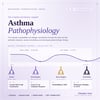
Asthma Pathophysiology Flowchart
Full product description
Stop piecing asthma together from scattered lecture slides.
This bundle takes you through the entire disease process in one connected story — genetic risk → allergen sensitisation → the early and late asthmatic response → airway remodelling → clinical phenotypes → modern biologic therapy — so you actually understand why each drug class works, not just what to memorize for the exam.
What's inside
1. Full-Color Pathophysiology Flowchart
A single-page visual map of the entire disease cascade, organized into 6 clear stages: predisposing factors, triggers & sensitisation, the biphasic inflammatory response, airway remodelling, clinical manifestations, and complications & management.
2. Detailed Narrative Explanations
Page-by-page written breakdowns that expand on every box in the flowchart — the actual mechanisms behind ORMDL3/17q21 genetics, IgE class switching, the early vs. late asthmatic response, eosinophilic tissue damage, subepithelial fibrosis, and the mechanism of action behind every major drug class and biologic (omalizumab, mepolizumab, benralizumab, dupilumab, tezepelumab, and more).
3. Ready-to-Teach Module Outline
A structured 6-unit teaching module (12–14 hours of content) with learning objectives, content outlines, case-based tutorial prompts, and a full assessment strategy — built for instructors, but just as useful as a self-study roadmap if you're studying solo.
Who this is for
- Nursing students (BSN) building pathophysiology foundations
- Respiratory therapy trainees
- Medical students (Year 2–3) reviewing pulmonology
- PA/NP program students
- Educators who want a ready-made lecture + case tutorial structure
Why this bundle works
Most study resources give you either a diagram or a wall of text. This gives you both, cross-referenced — so you can scan the flowchart for the big picture, then drop into the narrative explanation the moment you need the "why." Covers current concepts including the T2-high/T2-low phenotype split, the alarmin axis (TSLP/IL-25/IL-33), and the full modern biologic landscape through GINA 2025 guidance.
Format
Delivered as PDF (and editable DOCX where noted)
Print-friendly and screen-friendly layouts
Instant digital download