
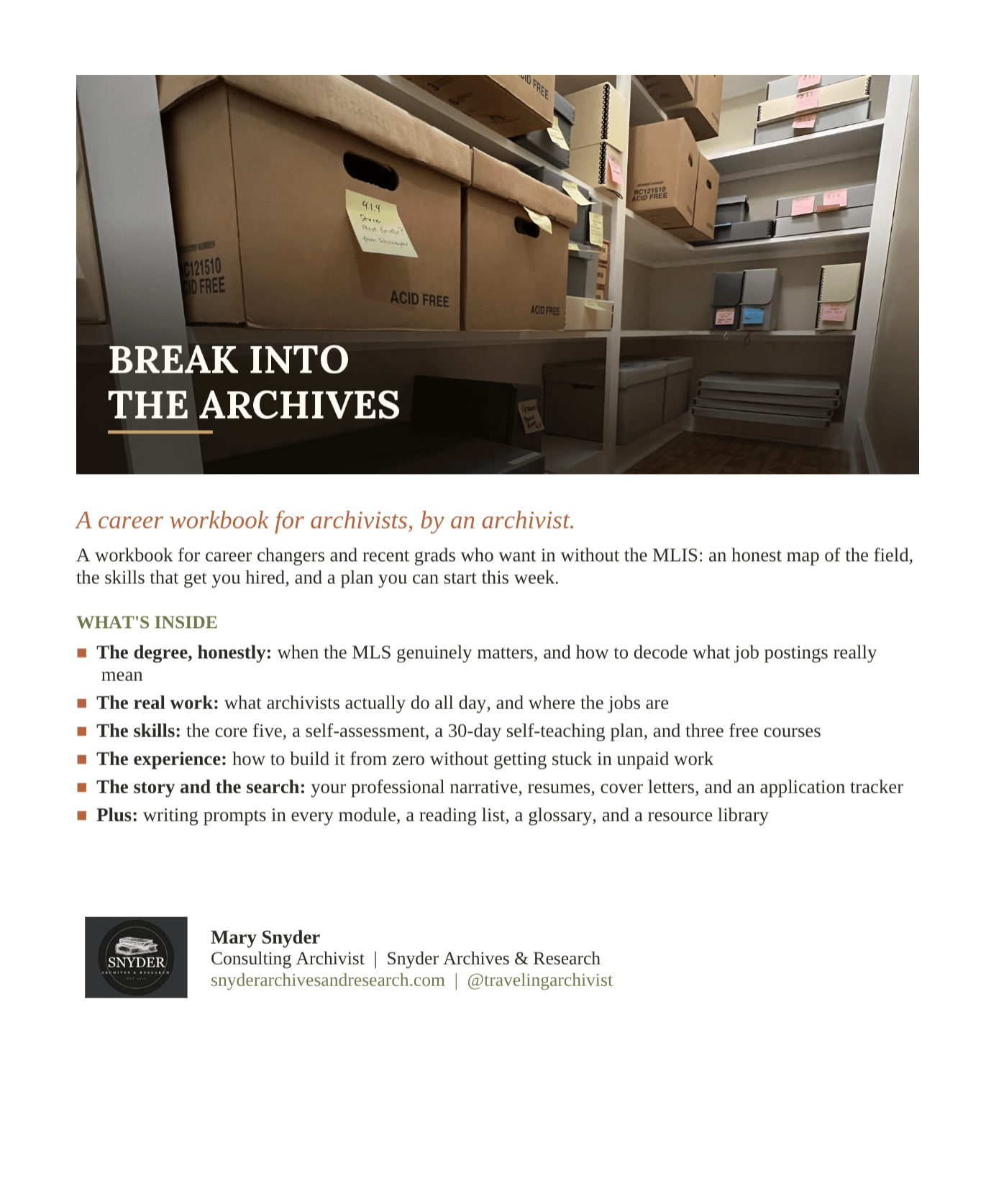
Workbook: Break Into Archives
An honest roadmap into archival work for career changers and recent grads, with no MLIS required. Inside are 34 pages of guidance, writing prompts, trackers, free courses, and help building the professional story that gets you hired.
Almost every day, someone asks me the same question: "How do I become an archivist if I can't afford a master's degree?"
I've answered it in comments and in videos. This workbook is my full answer. It holds everything I know about the gap between wanting this work and getting paid to do it.
I'm Mary Snyder. I'm an archivist and public historian, I run my own archival practice, and I earned my MLIS the long way while working full-time. So I'll be honest with you: sometimes the degree matters. But there is far more room in this field than the job boards suggest, and many employers care more about whether you can do the work than where you learned it.
This workbook teaches you the work and shows you how to prove you can do it.
What's inside
Seven modules take you from wondering whether this is possible to running a real job search.
- Let's Get Honest About the Degree: when the MLIS matters, when it doesn't, and how to read "MLS preferred" in a job posting
- What This Work Actually Is: what archivists really do all day, and why many in the field argue that archives are never neutral
- The Skills That Actually Get You Hired: DACS, metadata, digitization, and preservation, with a 30-day self-teaching plan and three free online courses you can start this month
- Building Experience From Zero: strategic volunteering, community archives, and a personal project that puts real archival work on your resume
- Your Archival Story: how to build a specific, memorable professional narrative that shows hiring committees what you can do
- The Job Hunt: where archivists actually find jobs, and how to write a resume and cover letter that work without letters after your name
- Building a Path That Lasts: the honest economics, contract and independent work, and how to stay in the field without burning out
You also get:
- Writing prompts in every module, so your thinking becomes your cover letters and interview answers
- Fillable trackers for your experience, skills self-assessment, and applications
- A progress checklist that keeps your modules, readings, and courses in one place
- A curated reading list anchored by Trouillot, DACS, and Fuentes, with only books I've read and stand behind
- 56 working links, so every organization, job board, free course, and resource is one click away
- A 19-term glossary, so you can speak the field's language in applications and interviews
The math
One SAA workshop costs $100 or more. A single graduate credit often costs over a thousand dollars. The degree this workbook helps you work around can cost $20,000 to $80,000. This workbook is $20.
Who this is for
Career changers, recent grads, history lovers, and anyone who keeps circling archival work but can't justify graduate school. If you've ever searched "can you work in archives without a master's" late at night, I wrote this for you.
Who this is not for
Anyone looking for a shortcut that skips the work. This is a workbook. It will ask you to write, make lists, send emails, and process actual collections. The people who get results are the ones who fill in the blanks.
You belong in the stacks. Let's map your way in.