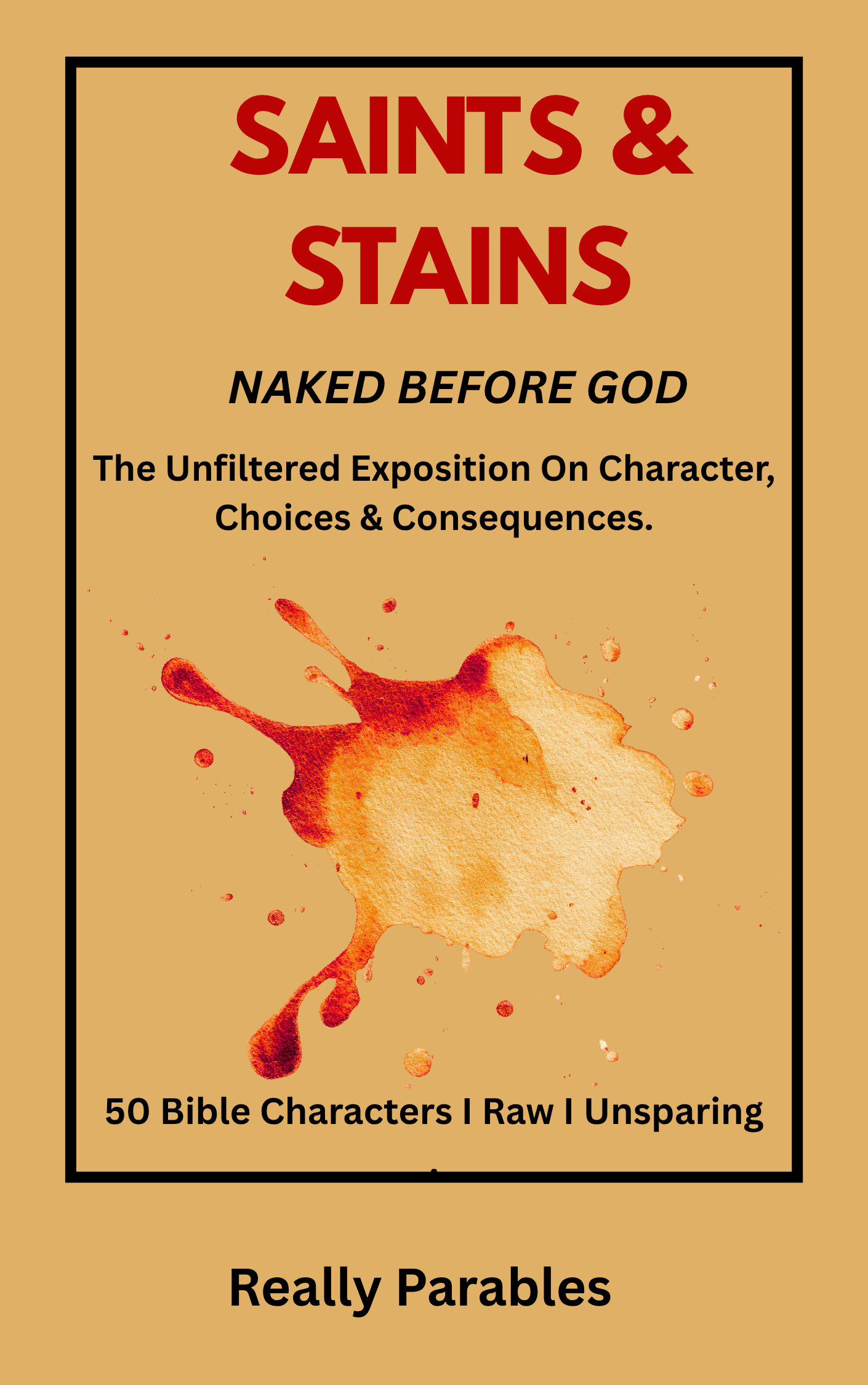
SAINTS & STAINS Naked Before God
Nothing in all creation is hidden from God's sight. Everything is uncovered and laid bare before the eyes of him to whom we must give account. — Hebrews 4:13
The Bible is the most psychologically honest document in human history. It does not airbrush its heroes. It does not conceal the depravity of its villains behind polite euphemism. It shows exactly what is there — the full, unvarnished, gut-turning truth about what human beings are capable of, in both directions.
SAINTS AND STAINS: NAKED BEFORE GOD is the book that takes that honesty seriously.
Fifty biblical lives. Twenty-five who chose well. Twenty-five who chose catastrophically. Each one examined with the full force of psychological analysis, biblical exposition, and the kind of moral directness that calls evil evil and good good — without sugar-coating, without pastoral politeness, without the comfortable softening that lets everyone off the hook.
This is not a devotional. It is not a character study for small groups. It is a dark psychology book rooted in Scripture — the kind that keeps you up at night, not because it is frightening, but because you keep recognising yourself in the pages.
THE INTRODUCTION: Character Is Chosen
The central claim of this book is not comfortable: you are not primarily the product of your environment. You are the product of your choices. The fifty lives documented in this book — drawn from circumstances ranging from Egyptian slavery to royal courts to Roman prisons — demonstrate beyond reasonable argument that it is possible to choose rightly in the most adverse circumstances, and possible to choose catastrophically wrongly in the most privileged ones. The conscience is real. Free moral agency is real. The excuse of environment has limits. And the record of your choices is being written whether you are paying attention to it or not.
PART ONE — THE SAINTS: Twenty-Five Who Chose Well
These are not the famous saints of the stained-glass window. Many of them you have never heard preached. All of them chose rightly when rightly was expensive.
— Shiphrah and Puah: the midwives who defied Pharaoh and became the first conscientious objectors in recorded history — Zelophehad's five daughters: who stood before Moses, the priests, and the entire assembly of Israel and argued a legal case — and won, changing the law for every daughter who came after them — The Nameless Girl of 2 Kings 5: a child slave who had every reason to hate Naaman, who pointed him toward the prophet anyway, and whose two sentences changed the theological consciousness of a foreign general and an entire nation — Jonathan's armour-bearer: whose whole-soul commitment to a suicidal military plan was the human act that triggered a divine intervention — Abigail: who stopped a massacre in four hours on a donkey with provisions and a speech — Obadiah: the palace administrator who hid a hundred prophets in caves while working for the king who was hunting them — The Widow of Zarephath: who gave her last meal to a stranger and received unending supply — Rizpah: who kept vigil over her sons' bodies for months until a king was moved to act — inventing the political vigil two thousand years before Mahatma Gandhi — Huldah: the prophet whose word triggered the greatest national revival in Judah's history — and whom almost no one has ever heard preached — The Woman at the Well: flawed, outcast, and the most effective evangelist in the Gospel of John — whose communication technique was more precise than most trained preachers — The Prostitute in Solomon's Court: who surrendered her claim to her son rather than see him harmed, and demonstrated the deepest form of love available — Rahab: the Canaanite harlot in the genealogy of Jesus — Joseph: the complete portrait — fourteen paragraphs from the coat to the palace to the reunion — and the verdict: God intended it for good
PART TWO — THE STAINS: Twenty-Five Who Chose Badly
These are not cartoonish villains. They are recognisable human beings who made wrong choices that each felt manageable — until the accumulation produced something they could not survive.
— Nabal: whose name meant fool, who lived up to it, and whose arrogance was so comprehensive that he died of fright when he heard what it had nearly cost him — Achan: whose hidden garment produced thirty-six deaths — the definitive case study in the catastrophic mathematics of private sin — Gehazi: who traded the greatest spiritual inheritance of his generation for silver and clothing — in an afternoon — Ananias and Sapphira: who died for a lie told at a prayer meeting — the most severe judgment in the New Testament, and why it was proportional — Lot's Wife: three words from Jesus. One column of salt. Everything you need to know about the person who is delivered but whose heart remains in what they were delivered from — Balaam: the prophet who kept trying to find a way to say what God had forbidden him to say because the payment was attractive — and whose name became a permanent category of spiritual corruption — Rehoboam: who inherited the greatest kingdom in Israel's history and halved it in three days with one contemptuous sentence — Jezebel: the most complete portrait of systematic evil in the Old Testament — the prophets she hunted, the Naboth murder she engineered through bureaucratic precision, her defiant death, and her name in Revelation 2:20 — Bathsheba: victim, survivor, and eventual agent — the most complex arc in the narrative, handled without simplification — Er and Onan: two brothers, two forms of wickedness, both judged by God — and the specific moral analysis that makes Onan's sin so instructive for contemporary sexual ethics — Reuben: the firstborn who forfeited everything through a single act of instability — and the deathbed verdict that made the forfeiture permanent — Samson: the greatest waste of supernatural gift in Scripture — and the most devastating sentence in the narrative: he did not know that the Lord had left him — Pilate: who publicly declared his innocence while completing his guilt — the patron of every leader who has washed their hands of what they were authorising — Judas: the distinction between remorse and repentance, the comparison with Peter, and the final verdict that changes everything: he was not destroyed by the betrayal. He was destroyed by the remorse that could not become repentance
THE EPILOGUE: The Reckoning
A direct, specific, personal admonition to the reader. To the one who has been living well: continue — but do not presume on the record of past faithfulness. To the one who has been living badly: the window of repentance is open — but do not assume it will remain open indefinitely. And to every reader: the account you will give is individual, specific, and unavoidable.
Each of the fifty profiles contains: full biblical exposition, the specific psychological and moral dynamics at work, a lesson drawn from the evidence, and a modern corollary — from business, sport, history, or diplomacy — where the same pattern is visible with different names and a different century.
This book will make you uncomfortable. That is its primary qualification.
PDF — Instant download — 117 pages