

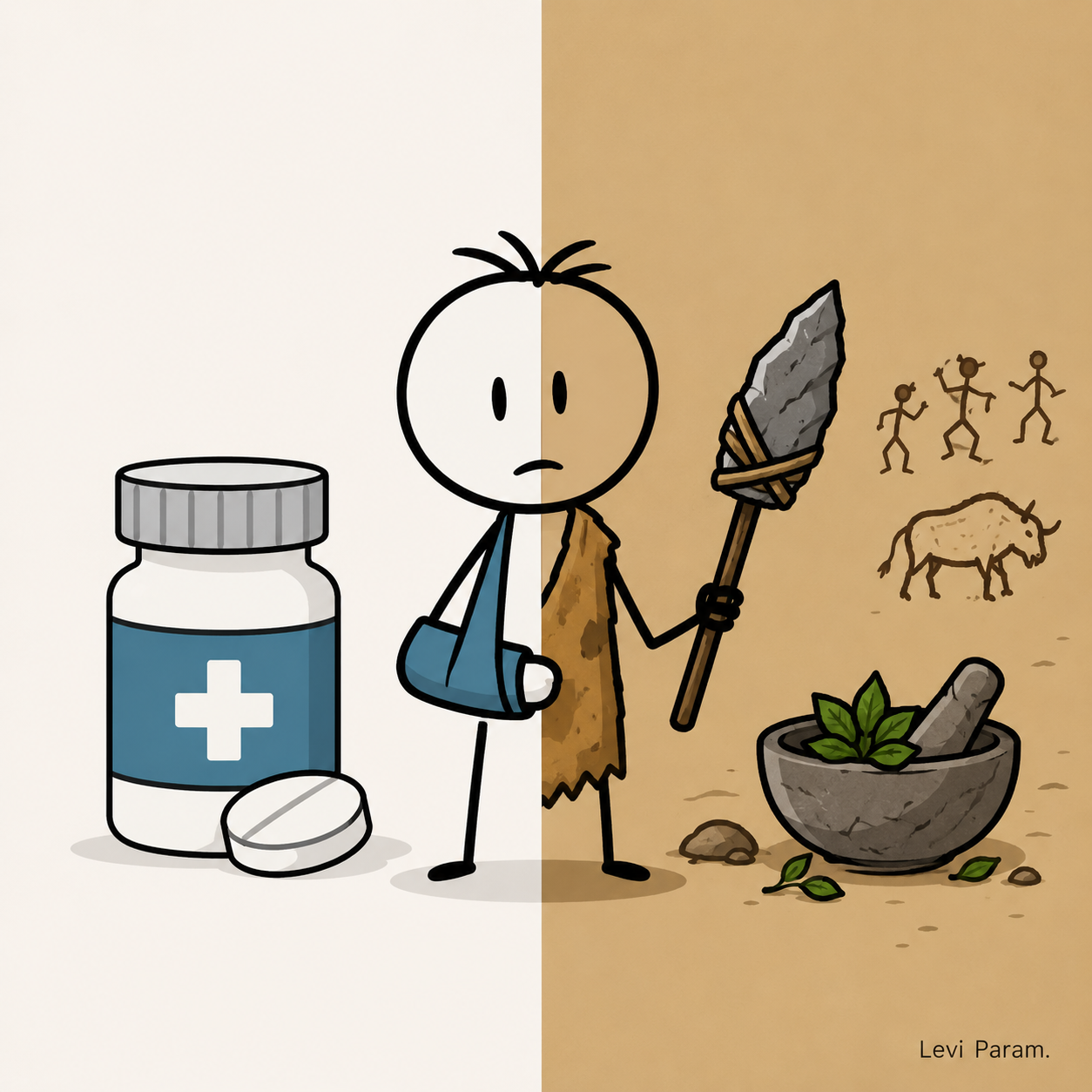
What Did Ancient Humans Do When Something Broke Inside Their Body? - AUIDOBOOK [⭐𝟱/𝟱] (𝟷𝟸 𝚂𝚘𝚕𝚍)
On Sale
$24.99
$24.99
What Did Ancient Humans Do When Something Broke Inside Their Body?
Until recently in human history, there were no hospitals, no painkillers, no surgery as we know it. So what did ancient humans actually do when something went wrong inside their body — a broken bone, a tooth infection, a deep wound? The answer is far more sophisticated than scientists once assumed.
In this audiobook, we discuss:
- The 1.77 million year old evidence that ancient humans cared for the injured and helpless
- The 14,000-year-old drilled tooth: the oldest confirmed dental procedure in history
- Why Ötzi the Iceman's tattoos shocked researchers at The Lancet
- How ancient shamanic rituals were triggering real neurochemical pain relief
- The Sumerian "joy plant" — and the evidence of its use 4,000 years before writing
- Why ancient Egyptians packed honey into wounds — and why hospitals still do it today
- How ancient midwives developed empirical pain management without laboratories
Sources:
- Dmanisi edentulous skull (ancient care evidence): Lordkipanidze, D. et al. (2005). "Anthropology: The earliest toothless hominin skull." Nature, 434(7034), 717–718.
- 14,000-year-old drilled tooth (Riparo Fredian): Oxilia, G. et al. (2015). "Earliest evidence of dental caries manipulation in the archaeological record." Scientific Reports, 5, 12150.
- Ötzi's tattoos as proto-acupuncture: Dorfer, L. et al. (1999). "A medical report from the stone age?" The Lancet, 354(9183), 1023–1025.
- Ötzi's osteoarthritis and tattoo mapping: Kean, W.F. et al. (2013). "Ötzi the Iceman: his wounds and pathologies." South African Medical Journal, 103(12).
- Synchronized group activity and pain tolerance: Dunbar, R.I.M. et al. (2012). "Performance of music elevates pain threshold and positive affect: Implications for the evolutionary function of music." Evolutionary Psychology, 10(4), 688–702.
- Edwin Smith Papyrus (cauterization): Breasted, J.H. (1930). The Edwin Smith Surgical Papyrus. University of Chicago Press.
- Ancient opium use (Neolithic poppy evidence): Merlin, M.D. (2003). "Archaeological evidence for the tradition of psychoactive plant use in the old world." Economic Botany, 57(3), 295–323.
- Honey as antibacterial wound treatment: Molan, P.C. (1992). "The antibacterial activity of honey: 1. The nature of the antibacterial activity." Bee World, 73(1), 5–28.
- Ergot in ancient obstetrics: Moir, J.C. (1974). "The history and present-day use of ergot." Canadian Medical Association Journal, 111(6), 606–612.
- Maternal mortality in pre-modern populations: Gurven, M. & Kaplan, H. (2007). "Longevity among hunter-gatherers: A cross-cultural examination." Population and Development Review, 33(2), 321–365.