
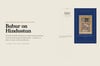
Babur on Hindustan — The First Mughal Emperor's Description of the Country He Had Entered
Babur's father died when a pigeon-house on the edge of the fortress ravine collapsed. Babur,
who was eleven, wrote that his father flew, with his pigeons and their house, and became a
falcon. The same year the boy became a king, of a province he could not hold. He took
Samarkand, the city he wanted most, three times, and lost it three times. He spent his youth
with no army, no city and no money.
Then, in 1526, he came down through the passes and broke the Delhi Sultanate in a single
morning at Panipat.
And then he sat down and wrote a book. Not about the war. About the birds.
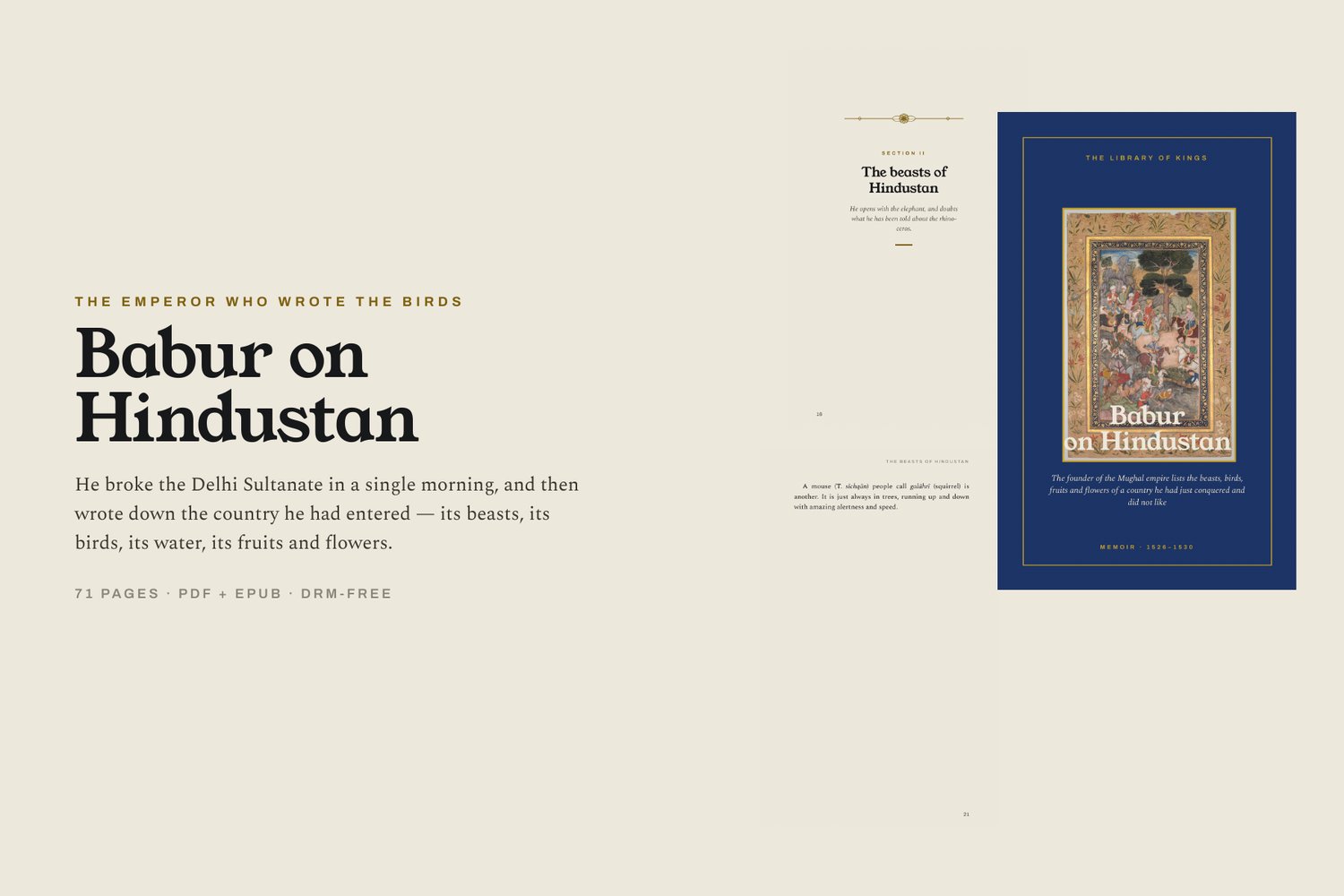
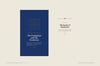
This is that book. It is the description of Hindustan that Babur left in his memoir: his
verdict on the country, and then the elephant, the rhinoceros, the peacock, the parrot, the
crocodile and the river dolphin, the mango, the plantain, the flowers. He is precise,
competitive, frequently rude, and completely unable to stop noticing. He opens with the
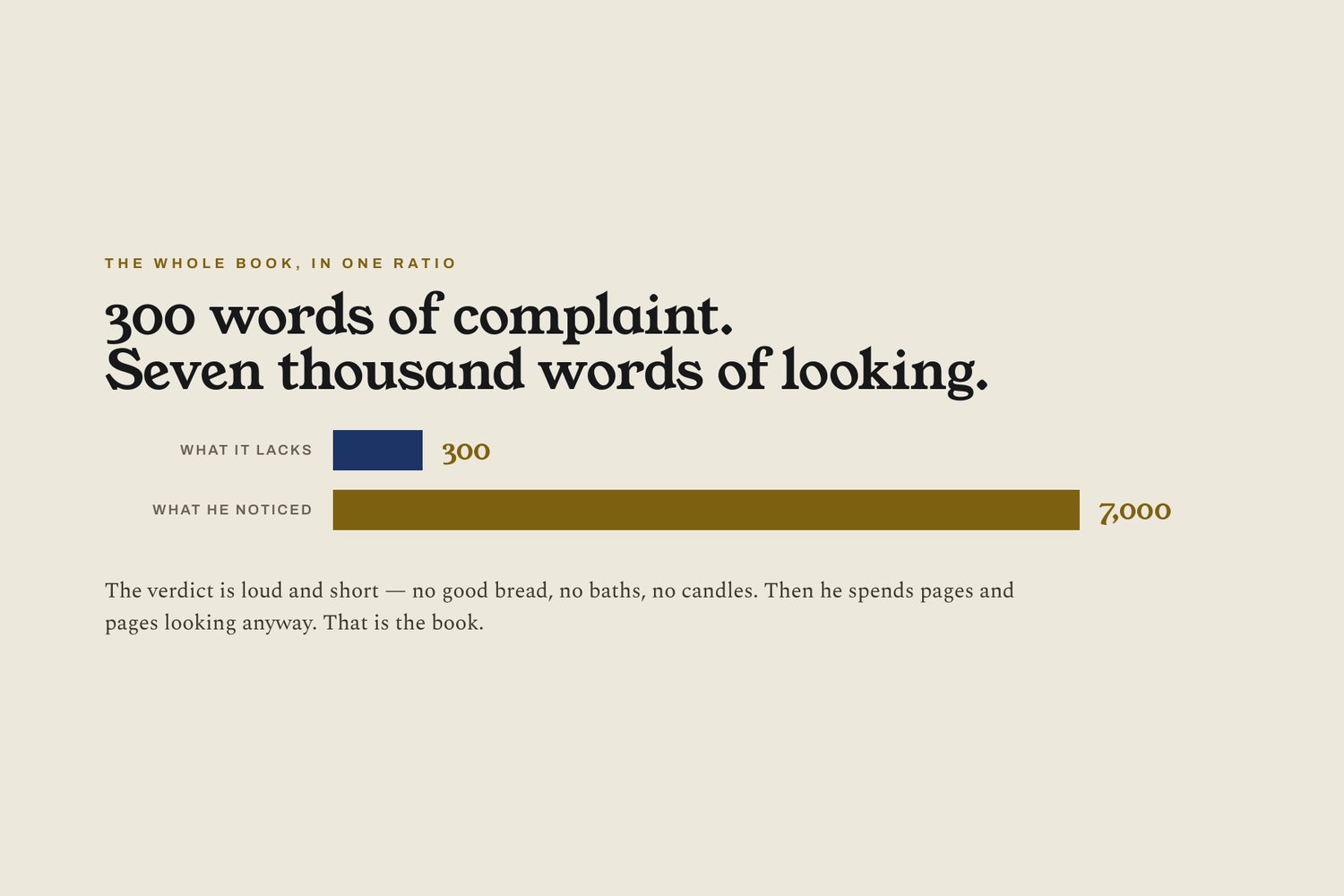
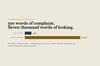
complaint — no good horses, no good bread, no baths, no candles — and then spends thousands of
words looking anyway. The complaint is loud and short. The noticing goes on for pages.
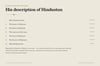
Inside
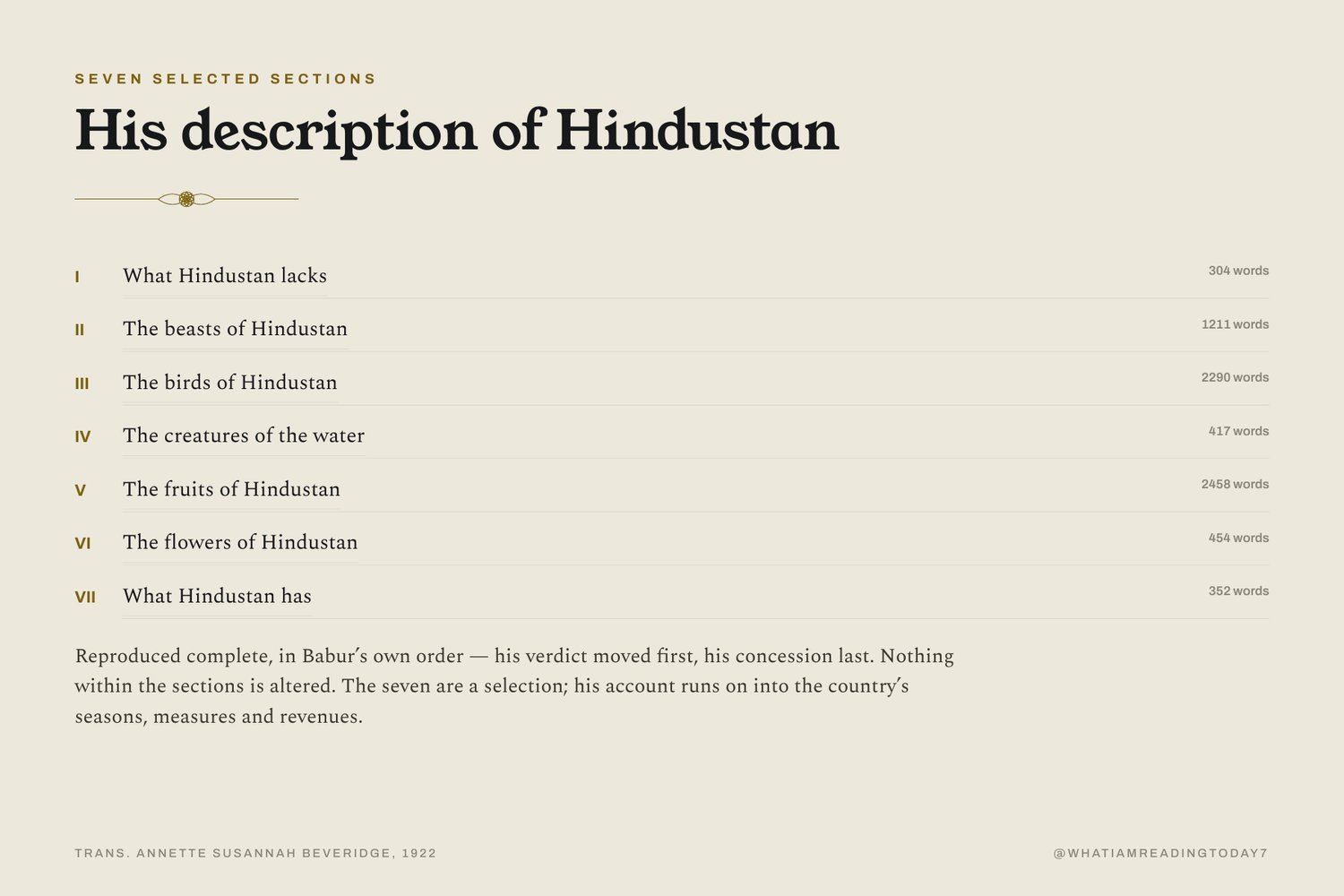
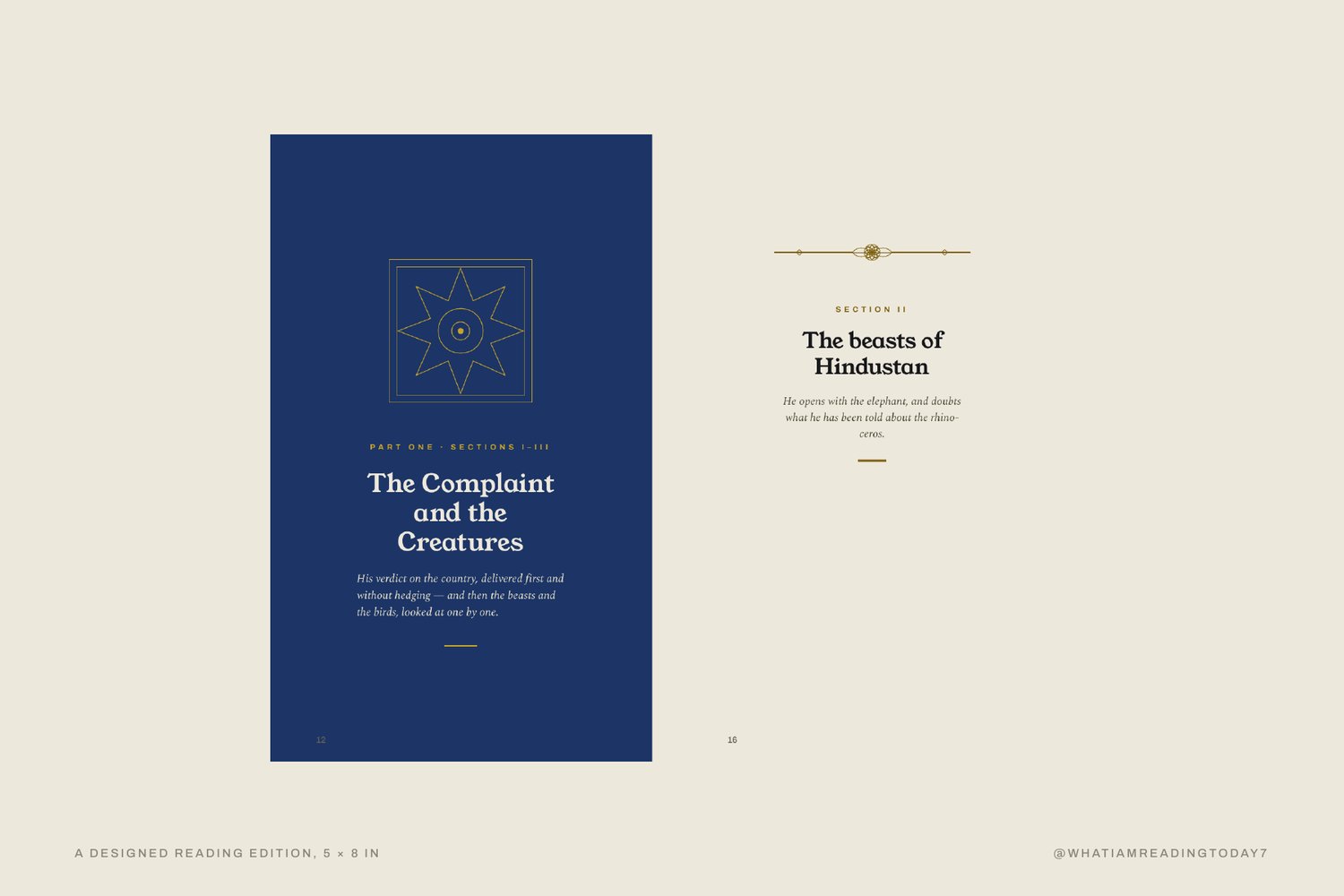
- seven selected sections of his description of Hindustan, reproduced complete;
- the register of the creatures — all forty-one of them, each with Babur's own term
(the elephant hāt(h)ī, the kalah-fish, the water-hog that leaps like a fish but never
leaves the water) and a note of what he says about it;
- a chronology of Babur's life, from Fergana to Agra;
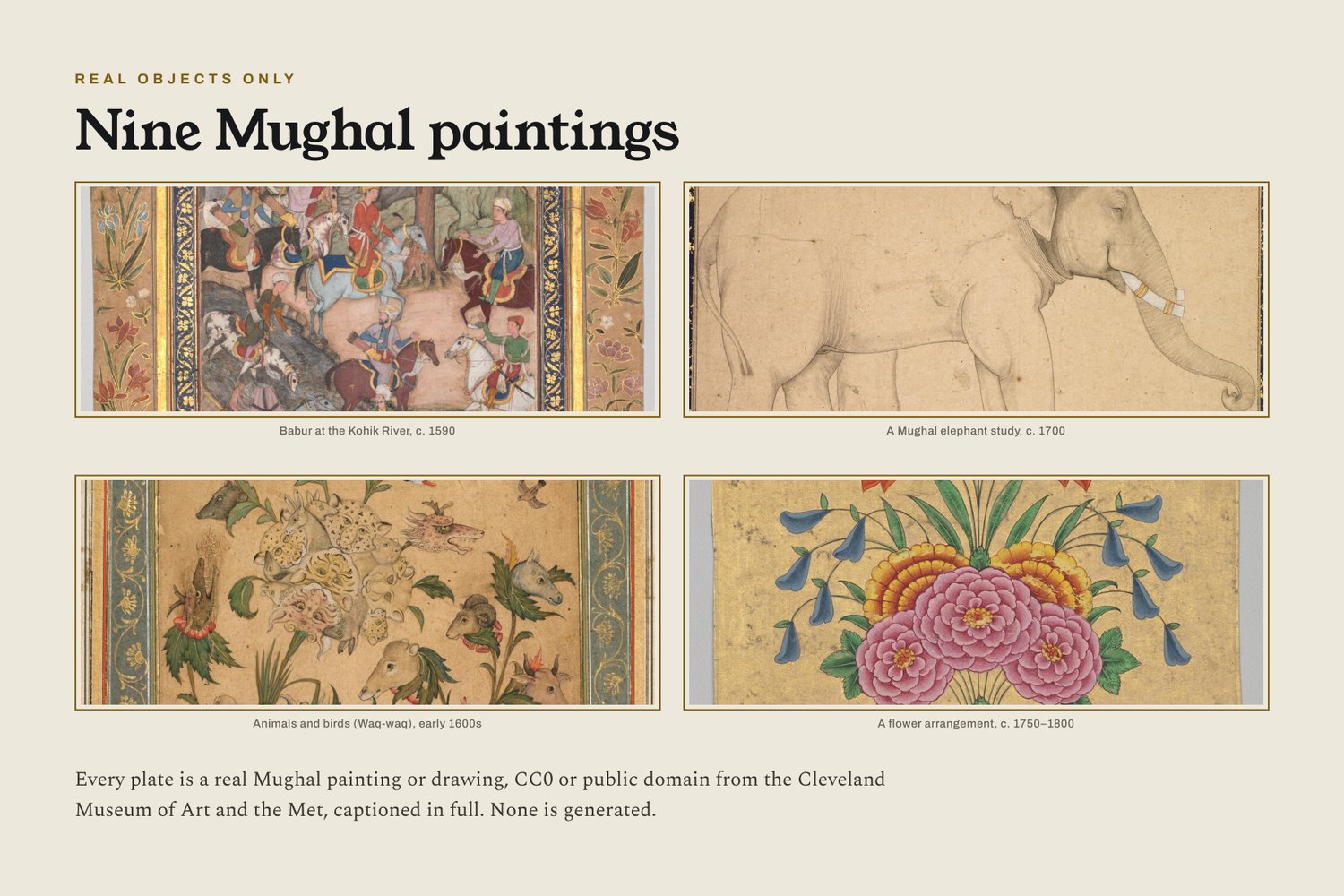
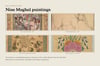
- nine Mughal paintings and drawings, each a real object, captioned in full;
- a preface, a short life, a note on the sources, and a colophon.
The edition
Designed at 5 × 8 inches in the house historical register — Young Serif, Spectral and Archivo
on a warm paper ground, with lapis and gold for the Mughal illumination. 71 pages.
The text
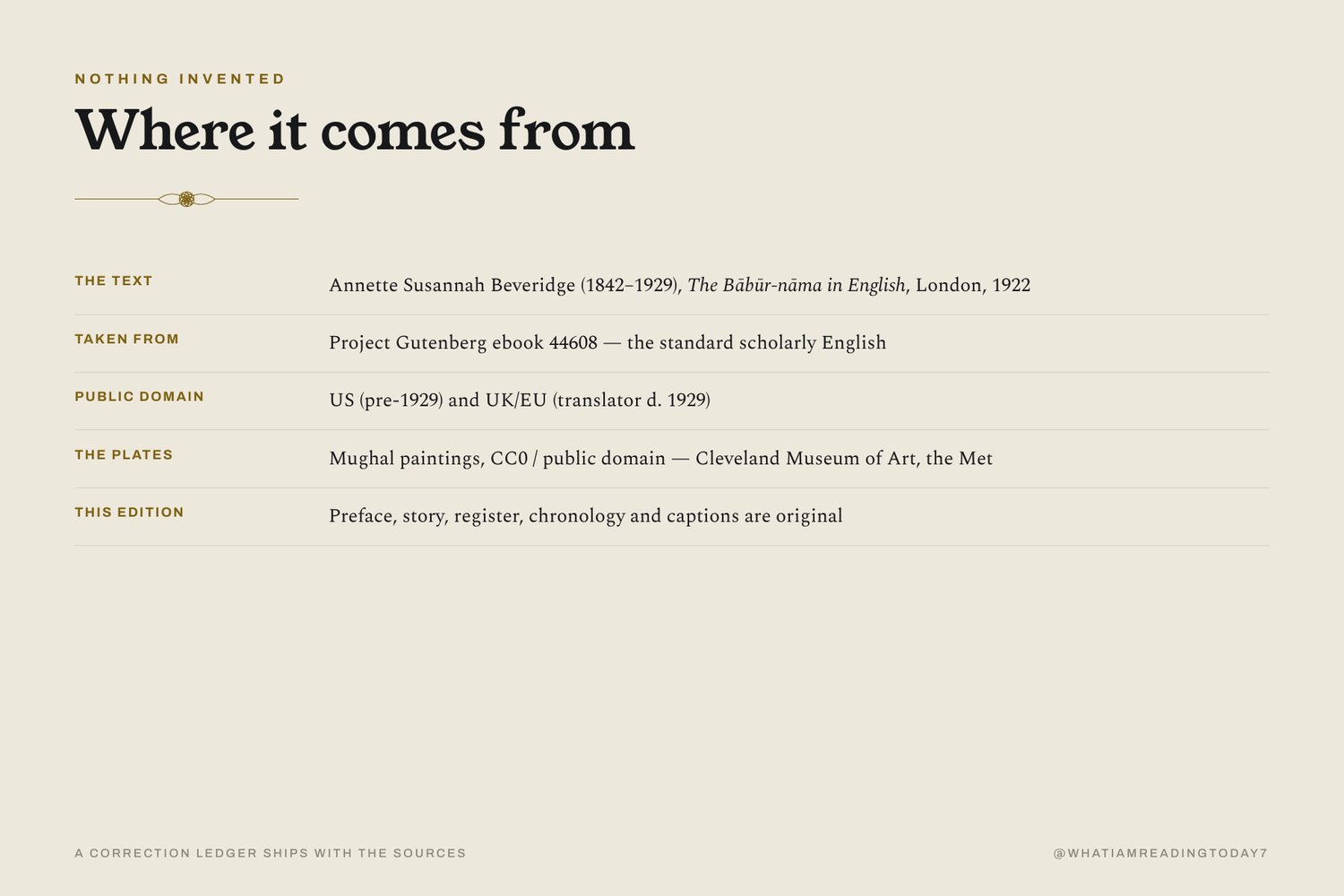
Babur's memoir was written in Chagatai Turkish in the 1520s. This is the English translation
of Annette Susannah Beveridge (1842–1929), first published in London in 1922 and taken
from Project Gutenberg. Beveridge died in 1929, so the translation is public domain in the
United States and in the United Kingdom and European Union. Her bracketed clarifications and
her transliteration are kept as she set them; her marginal folio references and footnotes are
removed. The seven sections printed here are a selection from his account of Hindustan, which
runs on into the country's seasons, measures and revenues. The preface, the story, the
register, the chronology and the captions are original to this edition.
You receive
- a 71-page designed PDF at 5 × 8 inches, for screen reading or printing at home;
- a reflowable EPUB, with the plates intact and the fonts embedded, for Kindle, Kobo, Apple
Books and phone;
- DRM-free — yours to keep and move between devices.
Newly set and edited by Vishal T · @whatiamreadingtoday7