

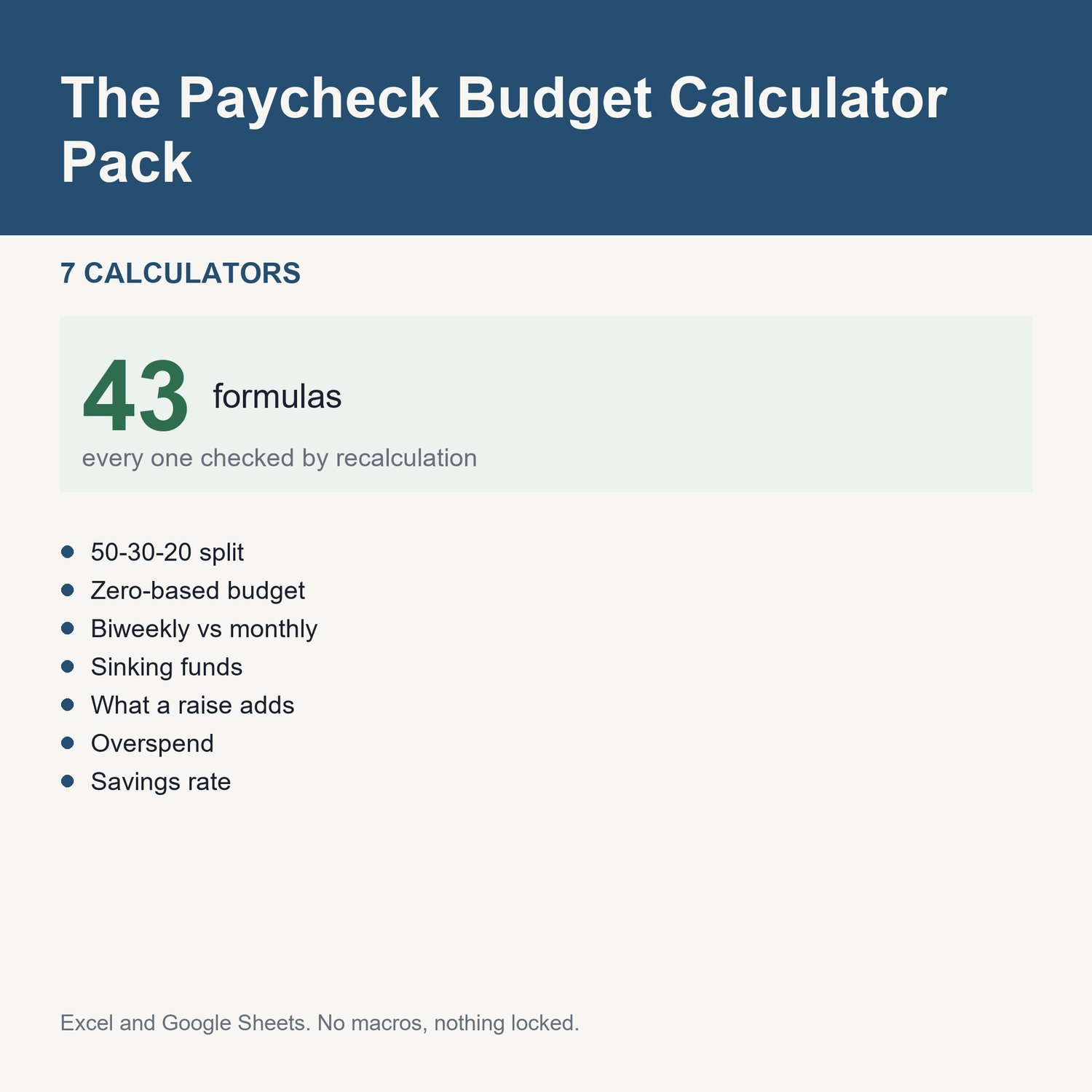
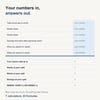

The Paycheck Budget Calculator Pack — Seven linked calculators, every formula checked by recalculation
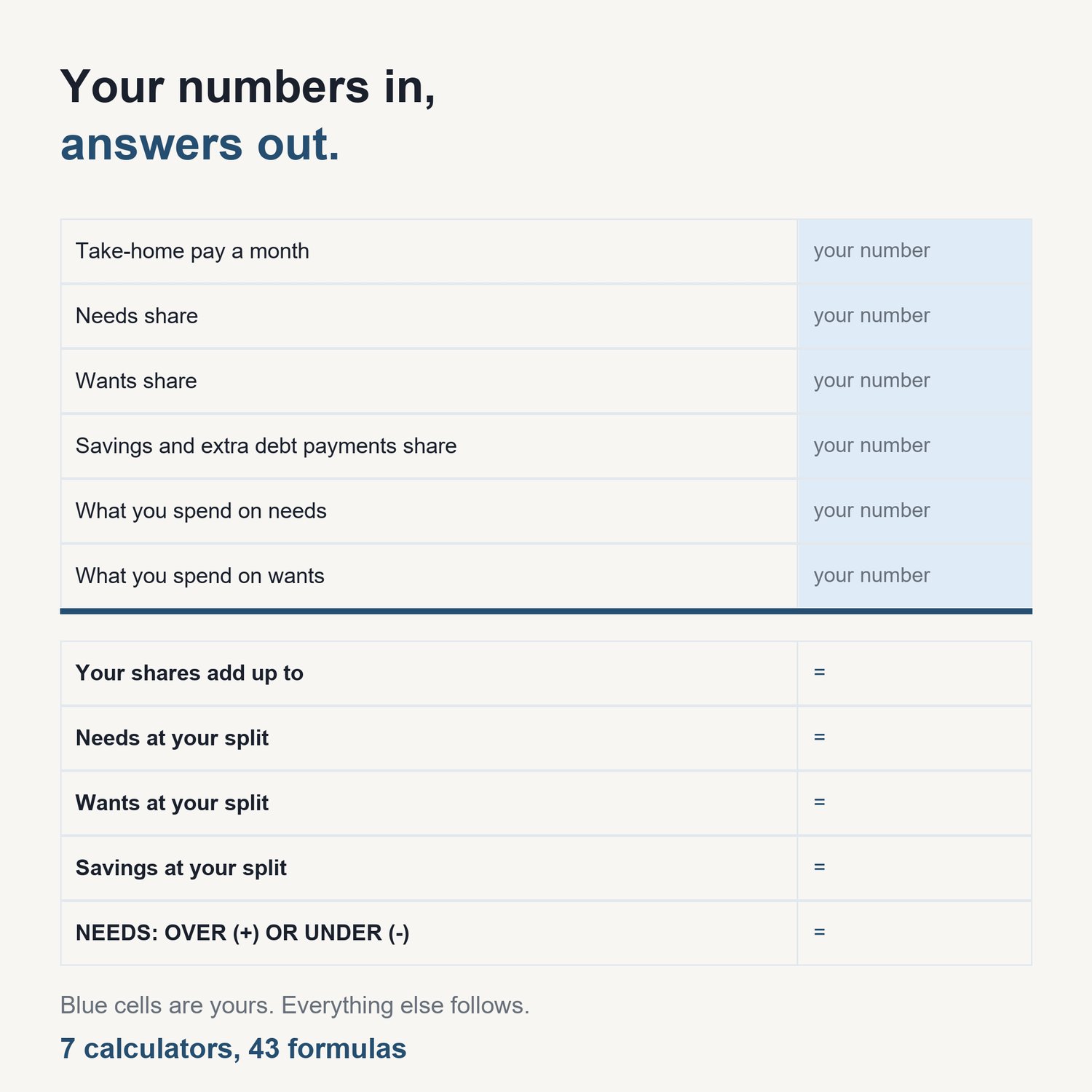
Seven calculators for the arithmetic of living on a paycheck: splitting it, giving every dollar a job, the two extra paychecks a biweekly year brings, the bills that come once a year, a raise, an overspend and your savings rate. Overwrite the blue cells with your own numbers; everything else follows. If you are paid every two weeks, start with sheet 3: on the worked example the extra paychecks add up to $4,430 a year that a two-paycheck budget never plans for. Every formula in this workbook was recalculated and checked against an independent implementation before it shipped; see the Verification sheet.
What is in it
7 calculators, one per sheet. Overwrite the blue cells with your own numbers and everything else follows — nothing is locked, there are no macros, and it opens in Excel, Numbers, LibreOffice and Google Sheets.
- 50-30-20 split — What does a 50/30/20 split of take-home pay look like against what you spend?
- Zero-based budget — Has every dollar of this month's pay been given a job?
- Biweekly vs monthly — If you are paid every two weeks, what happens to the extra paychecks?
- Sinking funds — How much do you set aside each month for bills that come once a year?
- What a raise adds — What does a raise actually add to each paycheck?
- Overspend — One category went over -- where does the money have to come from?
- Savings rate — What share of your pay are you actually saving?
Every formula was checked
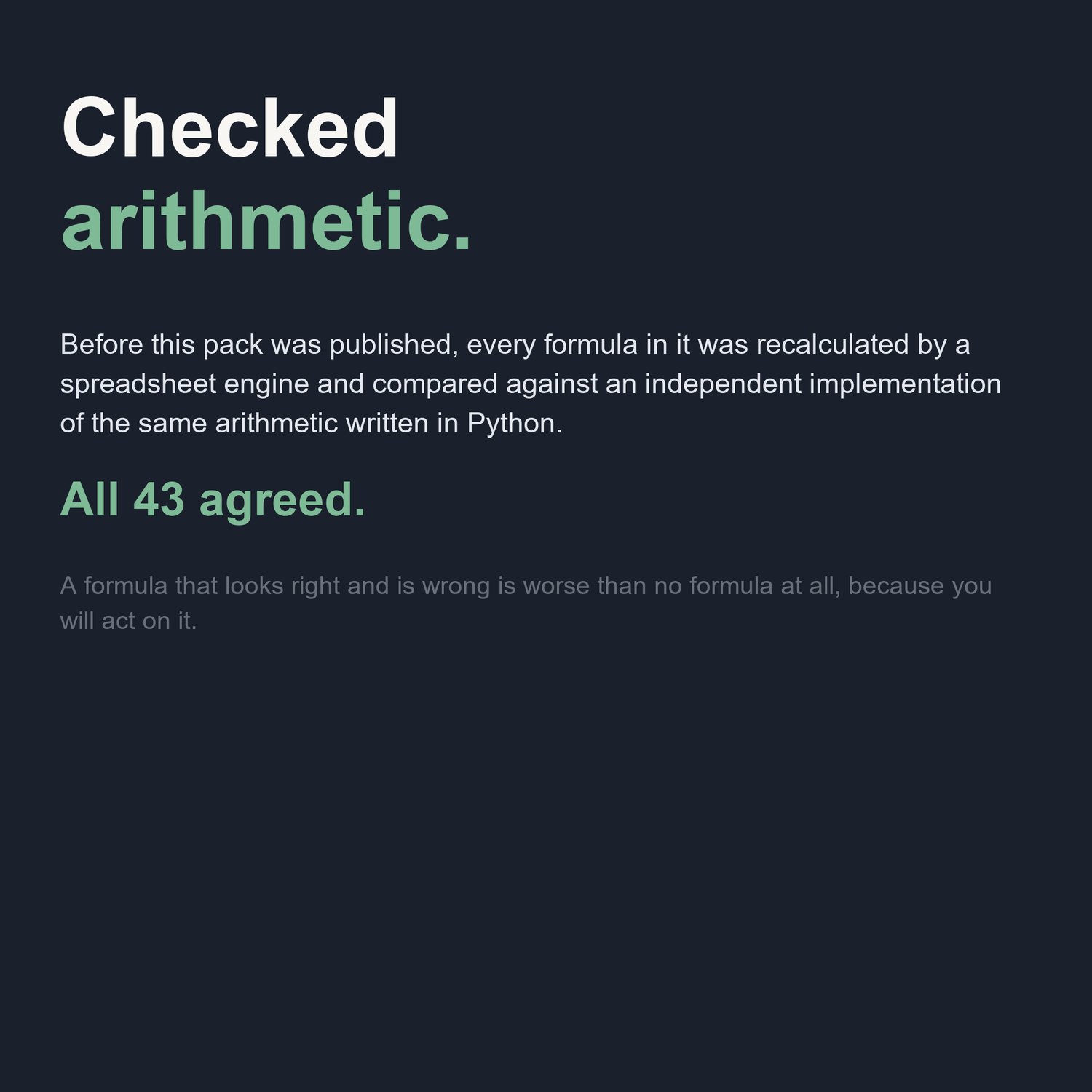
This pack contains 43 formulas. Before it was published, every one of them was recalculated by a spreadsheet engine and compared against an independent implementation of the same arithmetic written in Python. All 43 agreed to within a cent, and the workbook carries a Verification sheet saying so.
That is an unusual thing to be able to claim about a spreadsheet, and it is the main reason to buy this one rather than download a free template. A formula that looks right and is wrong is worse than no formula at all, because you will act on it.
What each calculator assumes
There is a sheet listing this, because a calculator that hides its assumptions is just a number generator:
- Each dollar of spending belongs to exactly one of the three groups. Where needs end and wants begin is your call.
- One month's pay against one month's plan. Irregular bills belong in a category too -- sheet 4 works out how much.
- Every paycheck is the same size. A year has 365 or 366 days, a little over 26 two-week periods, so now and then a year holds 27 paydays; set the paycheck count to yours.
- Each bill is the same size as last time. If a bill rises, the set-aside should rise with it.
- The tax rate you enter applies to every dollar of the raise, and deductions are a flat share of it. If the raise crosses into a different tax bracket or benefit threshold, the real figure differs.
- The overspend is covered this month, from the categories listed, in proportion to their budgets.
- Every figure is monthly. Money saved and then spent in the same month is not counted as saved.
What this is not
Not financial, tax or legal advice, and not a recommendation to buy, sell, borrow or sign anything. These are calculators: they show what a choice costs, not which choice is right for you. Where a published rate or threshold is used it is the one current when the pack was built — those change, the arithmetic does not.
Honest about the format
One .xlsx workbook, 7 calculator sheets plus Start Here, Assumptions and Verification. Not a PDF, not a physical product, not a Notion template. Available immediately after purchase; nothing ships.
Refunds
If this isn't what you expected, email me within 30 days and I'll refund you in full — no need to explain. Because it's an instant download I can't take the file back, so I'd rather you just had your money back.