
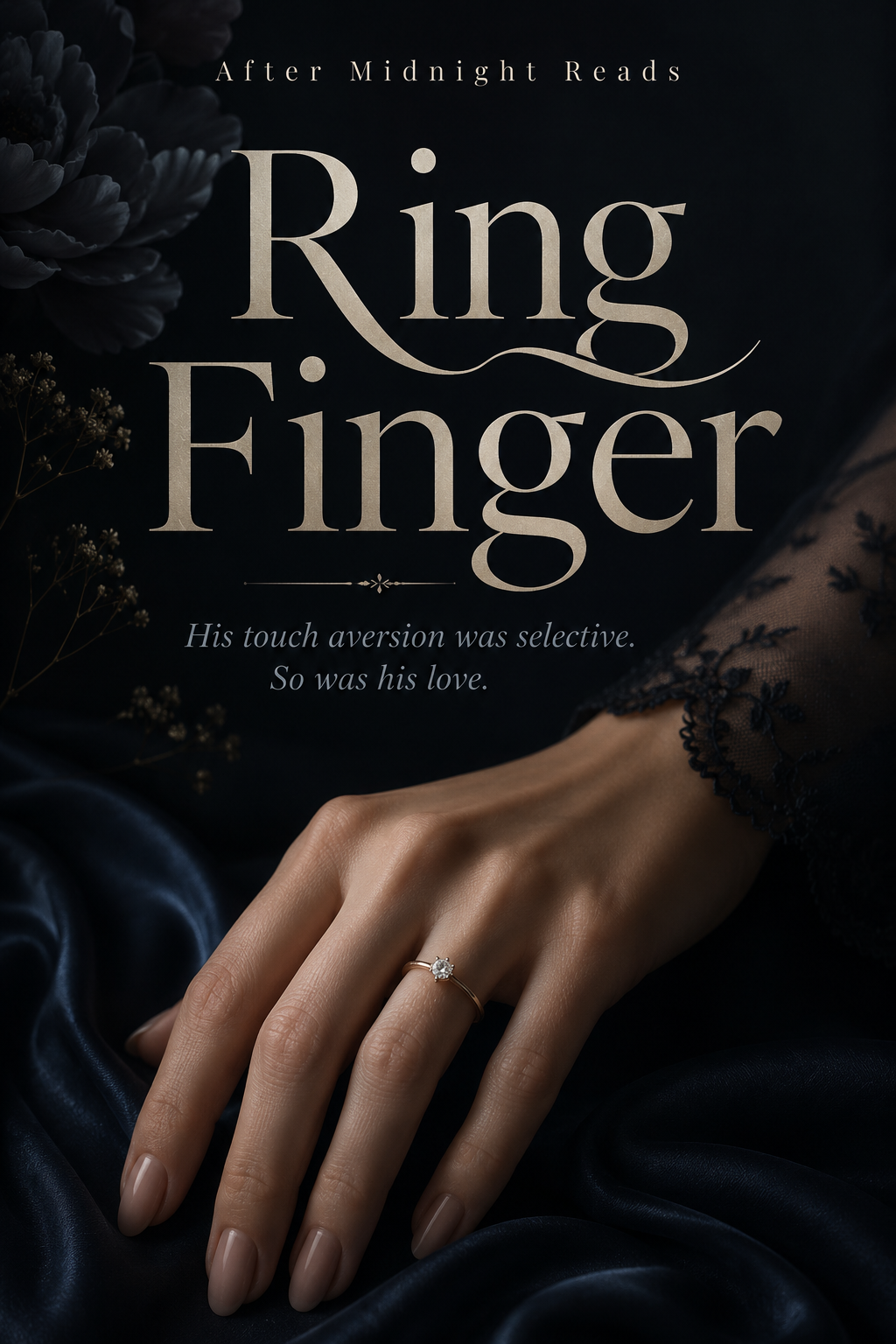
Ring Finger
She gave him twelve years and a lifetime of night shifts.
He gave her an engagement ring — sized for someone else.
Elena loved Caleb carefully, from a distance, because he couldn’t be touched.
Or so she thought.
One morning, she watched him take another woman’s spoon without hesitation.
That was the day she understood:
She was never his exception.
Read Part 1 below. Unlock the complete story to continue.
Read the free preview below. Unlock the complete story to continue.
What you’ll get:
A complete emotional romance short story as a downloadable PDF.
Tropes:
Quiet leaving · emotional betrayal · selective touch aversion · ring finger reveal · too-late regret
FREE PREVIEW
PART 1 — THE SPOON
The engagement party is in seven days.
I know this the way I know my own heartbeat — not from checking, just from being alive in this particular body on this particular morning. The winter light comes through my curtains thin and white. The neighbor's dog starts up at 6:47, exactly as it always does. I am lying on my back staring at the ceiling, and I have already been here before.
Not this apartment. Not this ceiling.
This Tuesday.
---
The last time I lived through this week, I thought the hardest thing about loving Caleb Hartley was the distance.
Not emotional distance — physical. He has a clinically documented aversion to physical contact — it's in his medical file, which I've had signed copies of since we were twenty-two, when his therapist asked if there was someone in his life who could be informed. I signed as his emergency contact the same way I had been signing things for him since we were teenagers: without being asked twice.
He won't shake hands. He wears thin gloves in public when he can get away with it. He does not hug. He does not let himself be touched, and he does not touch others.
I learned to love him around this. I learned to say *I love you* without reaching for his arm. I learned to sit beside him on couches with six inches of air between us and interpret that space as intimacy rather than rejection. I learned to read affection in the particular quality of his silence in a room, and warmth in the fact of him coming home at all.
I thought I was getting good at it.
I was wrong about what I was getting good at.
---
The end, when it came, was not where I would have written it.
It was nine months after the engagement party, in a hospital, on a day that was supposed to be about nothing else. I had been lying awake for most of the night before when I went to our storage unit looking for the box of his grandmother's things and found, instead, a folder I had no reason to open.
The photographs were organized. Sorted by date. Printed on paper, the way people only do now when something matters enough to make it physical — when it needs to be held, looked at, kept.
I don't spend time thinking about what I did after that. Or about the hospital room. Or about the particular silence of a phone that should have rung and didn't. My body made its own decision at some point, the way bodies do when they've been asked to carry too much for too long, and whatever happened next belongs to a version of my life that I will not repeat.
What I am thinking about this Tuesday morning — lying still, listening to the dog and the garbage truck and the specific quality of the light — is very simple.
I have seven days.
And this time, I'm going to use them.
---
The engagement contract is in the third drawer of my filing cabinet, underneath my nursing certification and a folder of utility bills I've kept meaning to throw away.
I've read it twice before. Once when it was drawn up, and once six months ago when I was trying to understand what my options were. I read it a third time this morning because I want to be certain I remember every clause correctly, and because certainty is the only currency I currently have enough of.
Caleb's grandmother, Margaret Hartley, died two years ago this March. She was seventy-four years old and she had been watching over both of us, in her particular quiet way, since we were teenagers. She left Caleb the house in Westchester and her investment accounts and a handwritten note that said: *Elena is family. Please don't forget that.*
Three weeks after the funeral, Caleb put a manila envelope on my kitchen table and slid it across to me. He was standing on the other side of the table, which was where he stood when we talked about things that required careful distance between them. I had long since stopped reading anything into this.
"My grandmother wanted this," he said.
Inside the envelope: an engagement ring in a grey velvet box, a two-page contract, and a letter in Margaret's handwriting that I have not been able to read a second time.
The contract specifies the terms. If either party wishes to dissolve the engagement, they must provide six months' written notice to the estate's executor. If *I* dissolve it, I pay the estate eighty thousand dollars. If Caleb dissolves it, the penalty is his to determine.
The eighty thousand is not, technically, a punishment for leaving. Margaret was more careful than that. It is a repayment clause on the trust she established for me during the engagement years — the certification courses she funded, the housing supplement while I finished my licensing hours, the years of steady support the estate provided on the understanding that I was becoming part of the family. *On the understanding.* If I dissolve the engagement, the estate recoups its investment.
Margaret was a practical woman. She had watched her grandson for sixty years and she knew precisely which direction the risk ran.
I close the contract and open the banking app on my phone.
Current balance: $4,211.63.
I sit with this number for a moment. Then I open a new note and write: *80,000*. Beneath it I write: *six-month notice period does not apply to the payment itself.*
I can pay after I leave. I can work out the installments from somewhere that isn't here. The question is not the contract and the question is not the six months. The question is only the money, and money is a problem I know how to solve the same way I have always solved it.
I've been working nights since I was seventeen years old. I know what that's worth.
I get dressed. I go to pick up my old supervisor's paperwork.
---
Her name is Nancy Park, and she has been trying to get me to come back to the hospice for eight months.
"Elena." Her voice, when I call from the bus, is immediately warm. "Please tell me you're calling about the position."
"I am," I say.
"Thank God. Can you start Thursday?"
I say yes, and she starts telling me about the updated intake process, and I watch the city move past the window and run the numbers in my head one more time. Ten weeks at full nights, possibly eight if I pick up overflow shifts. A payment plan after that for whatever remains.
The bus stops near the university. I step off, and I'm walking toward Nancy's building on the nursing school's third floor, and I'm thinking about scheduling and overtime thresholds, and I'm not thinking about Caleb at all until I pass the window of the coffee shop on Whitmore Street.
---
We've been coming to this coffee shop for six years. Not often — Caleb doesn't like the afternoon crowds, and the espresso machine is too loud for him when the line is long — but enough that I know every table in the place. The corner booth. The two-tops by the window with the uneven legs. The large table in the back that's always taken by the same group of graduate students on Tuesday and Thursday afternoons.
I see him before he sees me.
He's at the window table, the booth with the bench seats that catches the best of the morning light, and he's across from a woman with dark hair who is laughing at something. She has a good laugh — the kind that doesn't hold anything back. Her coat is draped over the bench beside her and she's talking with her hands, fully inhabited by whatever she's saying, and she is almost luminously at ease in a way that has nothing to do with trying.
I've seen photographs of Ava Sinclair before. Caleb mentioned her three months ago the way he mentions colleagues he finds interesting: briefly, without emphasis. She's completing her PhD at twenty-nine, he said. Her dissertation examines aversion responses to physical touch. She published in *Cognitive Neuroscience* last spring.
He showed me one of her papers. I read the abstract.
I stop walking.
The window glass is between us. He hasn't seen me. From where he's sitting, I'm just another coat on the sidewalk.
She's still talking, and then she reaches for her coffee and picks up the stirring spoon — the small metal spoon she's been using to stir her own drink — and she holds it out across the table toward him.
Offering it.
He reaches out and takes it from her fingers.
No pause. No adjustment. No the slight and practiced sideways shift of the hand that I have spent twelve years learning to anticipate. He takes the spoon from her fingers the way you take something from someone you've been taking things from your whole life — easily, automatically, as if the possibility of not doing so has never crossed your mind.
He stirs his coffee. He sets the spoon on the saucer.
He says something. She laughs again.
---
Twelve years.
Twelve years of learning that when I reach for his arm, his body moves before his mind can decide. Not unkind — he is never unkind — just reflexive, the way a person blinks when something comes too close to their eye. Twelve years of handing him things and watching him take them with his fingertips, with the careful minimum of contact, always. Twelve years of understanding that this was documented, involuntary, not a choice he was making — that it wasn't about me, that it was simply the way his nervous system was wired, that I was not the problem.
I believed this.
I believed it because he told me, once, quietly, after I'd had the worst of the learning-curve evenings: *It's not you. It has never been about you.*
He was telling the truth. I understand that now. It was never about me at all.
---
I walk past the window before he can look up.
I make it half a block before my legs slow of their own accord, and I sit down on a low concrete wall outside a parking garage because something has to take the weight of this and it might as well be a wall.
The concrete is cold through my coat. A pigeon is investigating the gutter. Across the street, a woman is folding a stroller one-handed while her phone is wedged between her ear and her shoulder, and she's doing it with the focused competence of someone who has done harder things.
I sit.
I'm not crying. I want to be precise about this: I am not going to cry, and it isn't because I'm holding myself together. It's because the thing that was keeping the grief pressurized — the small, persistent, unreasonable possibility that I had been misreading things, that there was an explanation I hadn't yet understood, that the photographs and the distance and the envelope on the kitchen table all added up to something other than what they added up to — that thing is gone now.
He took her spoon.
Whatever the diagnosis said, it apparently never mentioned her.
And I was never, in twelve years, the exception. I was the rule. I was the one that proved the rule existed. She was the one the rule didn't apply to.
---
*[Unlock the complete story to continue.]*