
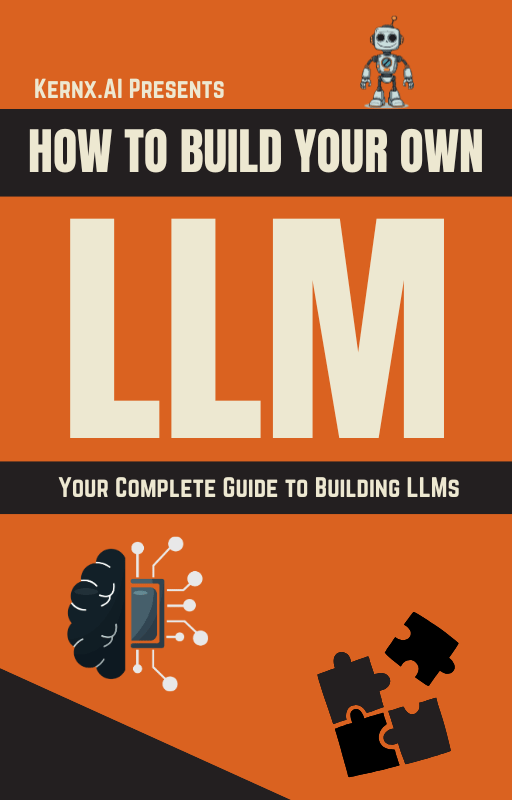
How to Build Your Own LLM (A Complete Guide on Building LLMs)
On Sale
$5.00
$5.00
How to Build Your Own LLM
(A Complete Guide on Building LLMs)
Stop consuming AI content.
Start building with it.
This book takes you from:
- Understanding how LLMs work
- To building real-world AI systems using RAG, agents, memory, tool calling, pipelines, and production workflows.
Built for:
- AI beginners
- developers
- AI founders
- prompt engineers
- creators
- future AI engineers
What You’ll Get Inside
- 6 Structured Levels
- 24 Deep-Dive Chapters
- 100+ Hands-On Exercises
- Practical Challenges After Every Chapter
- MCQs & Validation Tests
- Action Checklists
- Real AI System Design Thinking
- End-to-End LLM Product Building
This is not passive learning.
Every chapter forces you to:
- implement
- test
- optimize
- validate
- build
You’ll learn by doing.
The 6 Levels
Level 1 — Foundations
LLMs, tokens, prompts, hallucinations, context windows
Level 2 — Control
Prompt engineering, system prompts, structured outputs, evaluation
Level 3 — Real Power
RAG, embeddings, vector databases, chunking, indexing
Level 4 — Building Systems
Agents, pipelines, tool use, memory systems
Level 5 — Optimization & Scale
Latency, cost optimization, fine-tuning vs RAG, deployment
Level 6 — Advanced Thinking
AI product design, multi-model systems, failure handling, end-to-end builds
Every Chapter Includes
Action Checklists
- Concrete things to complete before moving on.
Hands-On Exercises
- 100+ exercises designed to expose real gaps in understanding.
Validation Tests & MCQs
- Know whether you actually learned the concept.
Mini Challenges
- Small focused builds after every chapter.
Advanced Reflection
- For deeper system and architecture thinking.
By The End Of This Book
You’ll be able to:
- Build RAG pipelines
- Design prompt systems
- Create AI agents
- Structure AI outputs
- Optimize cost & latency
- Build scalable LLM workflows
- Think like an AI engineer instead of an AI user
🎁 Bonus Included
“50 AI Project Ideas to Build After This Book”
Not random ideas.
Projects categorized by difficulty:
- Beginner
- Intermediate
- Advanced
And each project includes:
- what to build
- core concepts involved
- recommended stack
- difficulty level
- expansion ideas
- monetization potential
- optional challenges