
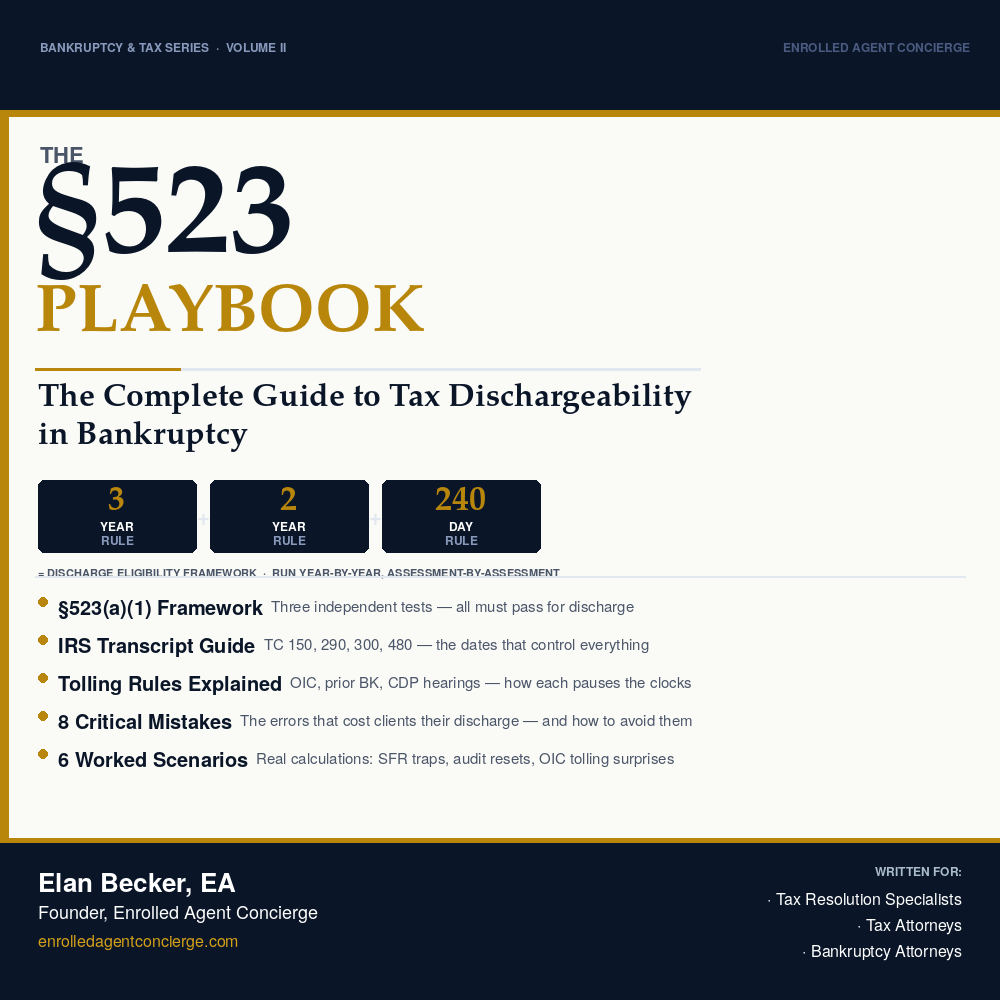
How to Master the Three-Year, Two-Year, and 240-Day Rules Under §523(a)(1) and Discharge Tax Debt Permanently
Your clients' tax debt might be dischargeable.
Most practitioners never find out.
The §523 Playbook gives tax resolution specialists, tax attorneys, and bankruptcy attorneys a step-by-step framework to calculate discharge eligibility correctly using IRS transcripts, tolling rules, and real-world scenarios so no client gets the wrong answer twice.
The problem:
Tax professionals are leaving bankruptcy discharge opportunities on the table every day not because they don't know what §523(a)(1) says, but because calculating it correctly requires three independent tests, transcript-verified dates, and tolling adjustments that compound in ways that aren't obvious.
A single missed extension date flips a dischargeable tax to non-dischargeable. An OIC filed two years ago tolls every clock and most practitioners never adjust for it. A client who filed a late return after an SFR may still fail the two-year rule, even with a TC 150 on the transcript.
Done incorrectly, it gives clients false comfort that is shattered post-discharge. Done correctly, it eliminates debts your clients believed were permanent.
A practitioner-ready framework not theory, not a textbook
The §523 Playbook was written specifically for professionals who work at the intersection of tax law and the Bankruptcy Code. It skips the background lecture and goes straight to the calculation framework: which dates matter, where to find them on IRS transcripts, how tolling works, and what mistakes most commonly cost clients their discharge.
Every chapter is built around how you actually use this in a client file, not how §523 looks in a law review article.
What's inside
- The §523(a)(1) Framework- all three tests explained
- The three-year, two-year, and 240-day rules as independent tests that must all pass with plain-language explanations of what each requires and exactly how to measure it.
- IRS transcript navigation the transaction codes that matter
- Tolling- the rules practitioners miss most often
- OIC pending periods, prior bankruptcy stays, CDP hearings, and Tax Court litigation how to calculate each toll, add them cumulatively, and apply them to all three clocks.
- The IRS backlog opportunity clients you may have turned away
- How current IRS staffing delays have shifted TC 150 and TC 290 dates in ways that make previously ineligible clients newly dischargeable. Includes a specific action item to review old files.
- Six annotated real-world scenarios with full calculations
- Straightforward discharges, late-filed return traps, partial discharges from audit resets, and the OIC tolling scenario that looks dischargeable until the math catches you all walked through step by step.
- Quick-reference framework use it in every client file
- A one-page discharge date formula, tolling quick-reference table, and step-by-step calculation checklist you can pull out for any client matter.
The 8 mistakes covered
Chapter 8 alone is worth the price of admission
These are the errors that cost practitioners credibility and clients their discharge mapped to exactly where in the calculation each one hides.
- Mistake 01
Ignoring extensions in the three-year rule
- Mistake 02
Treating IRS-prepared SFRs as filed returns
- Mistake 03
Forgetting tolling entirely
- Mistake 04
Running one analysis for the entire debt
- Mistake 05
Advising without pulling transcripts
- Mistake 06
Assuming two passing tests means discharge
- Mistake 07
Missing the late-filed return exception
- Mistake 08
Not revisiting old analyses as dates shift
"Tax dischargeability is one of the most consequential determinations in bankruptcy practice. Done correctly, it can eliminate debts that clients believed were permanent. Done incorrectly, it leaves money on the table or worse, gives clients false comfort that is shattered post-discharge."
Elan Becker, EA · Enrolled Agent Concierge
Written for Tax Resolution Specialists, Bankruptcy Attorneys, Tax Attorneys
Whether you are a seasoned bankruptcy practitioner who has never focused on the precise timing mechanics, or a tax resolution professional adding bankruptcy strategy to your toolkit, this guide gives you the framework to run the analysis correctly, every time, for every client file!