Your Cart
Loading

You Handle the Hardest Tax Debt Cases. These Guides Make Sure You Get Them Right.

When a client walks in with six figures of IRS debt and a potential bankruptcy filing, the margin for error is zero. Discharge timelines, lien survival, automatic stay exceptions-one miscalculation can leave your client worse off than when they started.

These practitioner-grade guides give you the structured frameworks, IRC citations, and case law analysis you need to advise with precision at the intersection of bankruptcy and tax resolution
The Gap That Creates Real Risk

Most practitioners are comfortable advising on IRS resolution or bankruptcy in isolation. But when these two areas collide — as they do in the majority of serious tax debt cases — the analysis becomes dramatically more complex.


The external problem: No single resource maps how discharge timing rules, lien priorities, IRS procedural requirements, and bankruptcy code provisions actually interact in practice.


The internal problem: You’re left wondering whether your analysis is complete. Whether you’ve missed a tolling event that resets the 240-day clock. Whether the lien survives discharge. Whether the automatic stay even applies to the IRS action your client is facing.


The truth: Practitioners handling high-stakes tax debt cases shouldn’t have to piece together guidance from scattered IRM sections, outdated CLE materials, and conflicting forum posts. You deserve structured, practitioner-grade analysis you can rely on.

Built by a practitioner, for practitioners

These guides are developed by Elan Becker, EA — an enrolled agent who specializes in the intersection of bankruptcy law and IRS tax resolution. His work is focused on the specific application gap that most resources ignore: how the rules actually operate when bankruptcy and tax collection intersect in a live client matter.


Every guide is written from inside the practitioner’s experience — with IRC citations, IRM crossreferences, relevant case law, and the kind of structured analysis frameworks that hold up when a client’s financial future depends on getting it right.

How These Guides Work in Your Practice

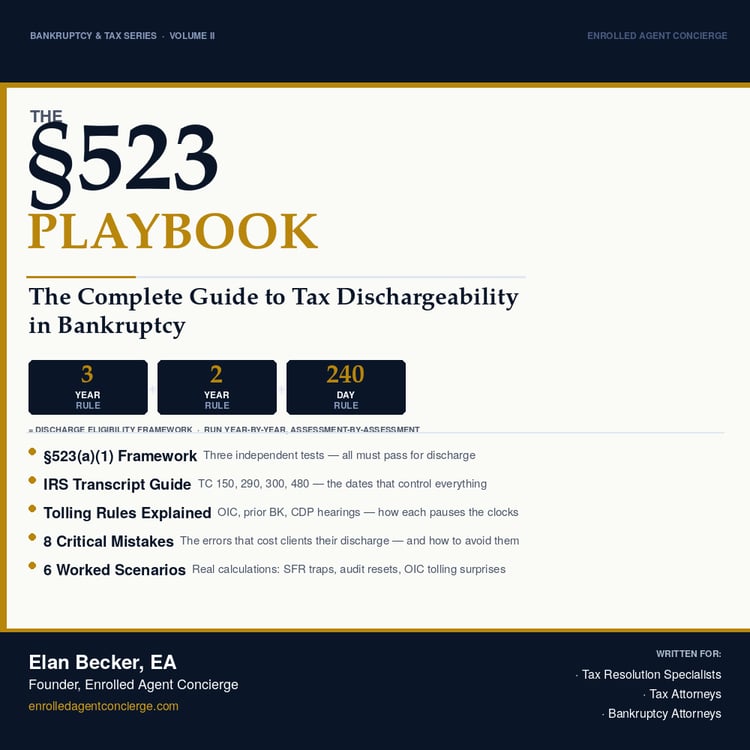
Step 1 — Identify the issue. Each guide targets a specific, high-stakes topic: discharge timing under §523(a)(1), lien avoidance strategies, automatic stay applications, or Section 505 tax determinations. Find the one that matches your client’s situation.


Step 2 — Work through the analysis. Use the structured frameworks, decision points, and authority citations inside the guide to build your case strategy. No theory — just the analysis path a practitioner actually needs.


Step 3 — Advise with confidence. Walk into the client meeting, the CDP hearing, or the bankruptcy court filing with a framework that’s grounded in the Code, the IRM, and the case law. Your analysis is structured. Your citations are current. Your client is protected.

What’s at Stake When the Analysis Is Wrong

In bankruptcy-tax cases, the consequences of incomplete analysis are concrete and irreversible:


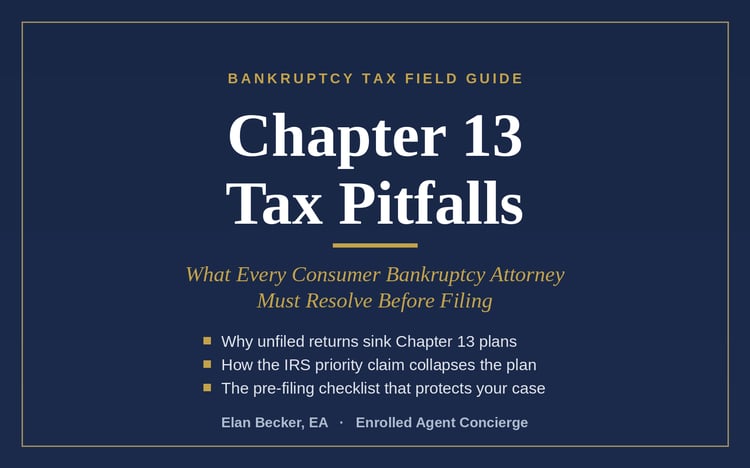
Undischarged debt. A miscalculated three-year or 240-day rule means the tax debt your client expected to discharge survives bankruptcy — and they’re back to square one with the IRS, plus the cost of the filing.


Surviving liens. A federal tax lien that attaches before bankruptcy can survive discharge entirely, leaving your client with a “fresh start” that still includes an IRS lien on every asset they own.


Missed procedural tools. Section 505 gives practitioners a powerful mechanism for resolving tax disputes inside bankruptcy — but most never use it, because most resources don’t cover it in enough depth to apply.


Credibility and exposure. Clients trust you to get this right. When a strategy fails because the analysis was incomplete, it’s your professional reputation — and potentially your malpractice exposure — on the line.

Advise Complex Tax Debt Cases with Precision and Authority

With the right frameworks, you stop second-guessing your analysis and start approaching every bankruptcy-tax case with clarity:


Discharge timing analysis that accounts for tolling events, amended returns, and the specific §523(a)(1) requirements — not just the simplified version.


Lien strategy that distinguishes between what can be avoided, what can be stripped, and what survives — so your client knows exactly where they stand post-discharge.


Procedural tools like Section 505 and the automatic stay applied correctly, giving your clients access to relief mechanisms most practitioners overlook.


Authoritative citations in every guide — IRC sections, IRM references, and case law — so your analysis is backed by the same authorities the court and the IRS rely on.

Equip Your Entire Team

If your firm handles tax debt and bankruptcy matters across multiple professionals, these guides are available under firm licensing. Give your team a shared analytical framework so every practitioner in your office is operating from the same level of precision.

Learn About Firm Licensing | Contact for Licensing

About Elan Becker, EA

Elan Becker, EA is an enrolled agent and bankruptcy-tax specialist who writes the guides behind Enrolled Agent Concierge. His work is built on a simple premise: practitioners handling the hardest tax debt cases deserve resources that match the complexity of the work.

Learn More

Your Clients Are Counting on Precise Analysis. Start Here.

Explore the current collection of practitioner guides and bring structured, authoritative frameworks into your next case.

Browse the Guides | Get Updates — email signup