
10 Vepsians raw DNA file 23andme format
The veps are first mentioned in the russian primary chronicle in 859AD as a leaderless tribe living near old ladoga and paying tribute to Viking raiders. According to the chronicles, the Veps were distinct from other Finnic people who they called Chud. The Russians essentially classified the Uralic peoples in northern russia into 3 categories, Chud Beloglazaya, meaning light eyed Chud, which included such people groups as Estonians, Finns, and Karelians, Chud chernoglazaya, meaning dark eyed Chud, which was a term they had reserved for those Finnic tribes living on the Sukhona river and Zavolochye region, and Ves which is an archaic termin for Vepsians.
There is a reason that the Russians did not use “Chud” to refer to the Vepsians. In Russian language, the root Chud means foreign, someone of a different culture. The Vepsians were the first Uralic people to adopt Christianity in 11th century, and since then have been an integral part of Rus’. Russians had continuous contact with the Vepsians, and assimilated many. The Northern Russians inherited many Vepsian traditions, such as the utilization of slash-and-burn agriculture. This agricultural method relies on cutting down and burning trees and then spreading the ash over the soil to create a friendly environment for the crops. Slavic russians traditionally used the open field system for agriculture, but in the north, where vepsian influence was strong, mostly slash-and-burn agriculture was practiced.
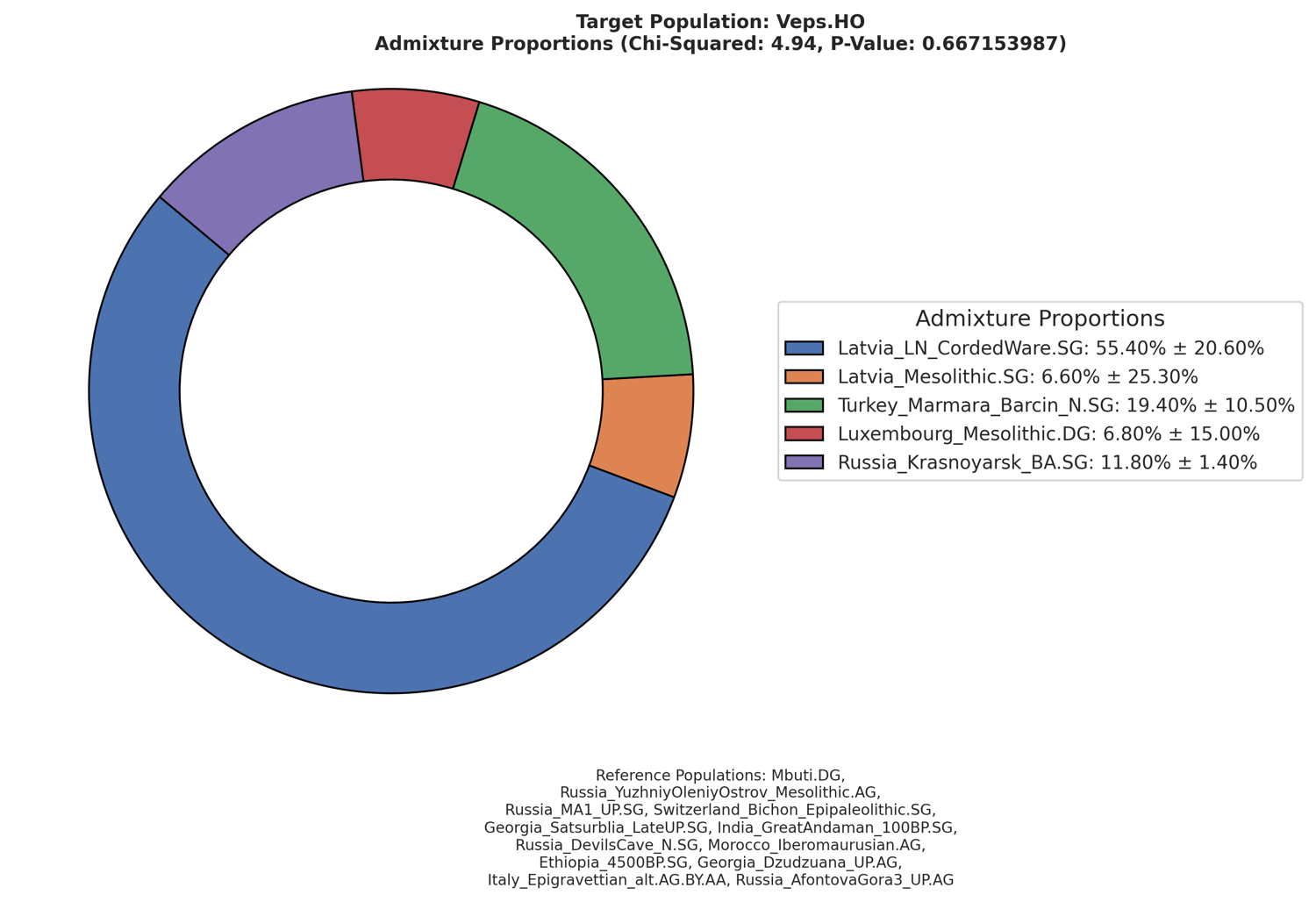
Vepsian genetics are very fascinating. Despite speaking a Uralic language, the Vepsians are more Indo-European than most people in Europe genetically. I ran this qp-admixture model on vepsians to illustrate my point. Over halved of their ancestry is steppe related, but they have a significant portion of anatolian farmer, hunter gatherer, and of course - siberian ancestry as well. The Veps are more siberian than the Finns are, scoring 12 percent siberian on my model.
In terms of their hunter gatherer vs farmer breakdown, the largest component in Vepsian DNA is anatolian neolithic farmer, same as in all the other Europeans. However, they have an elevated level of eastern hunter gatherer ancestry at 29 percent, which is higher than elsewhere in continental Europe and sets them apart from other Europeans.
In terms of deeper, or paleolithic, admixture, the Veps descend predominantly from the Dzudzuana cluster, which is a common west eurasian source of ancestry all west eurasians have DNA from. The Anatolian neolithic farmers descended entirely from Dzudzuana, whereas the Caucasus hunter gatherers descended mostly from Dzudzuana. Aside from Dzudzuana ancestry, the Veps also have a significant portion of ancient north eurasian, western hunter gatherer, and siberian ancestry, which can not be ignored as it is the source of their language.
For this video, I gathered the raw DNA data of 10 modern Vepsians from the human origins dataset. I ran them through my trait predictor tool for DNA analysis.