
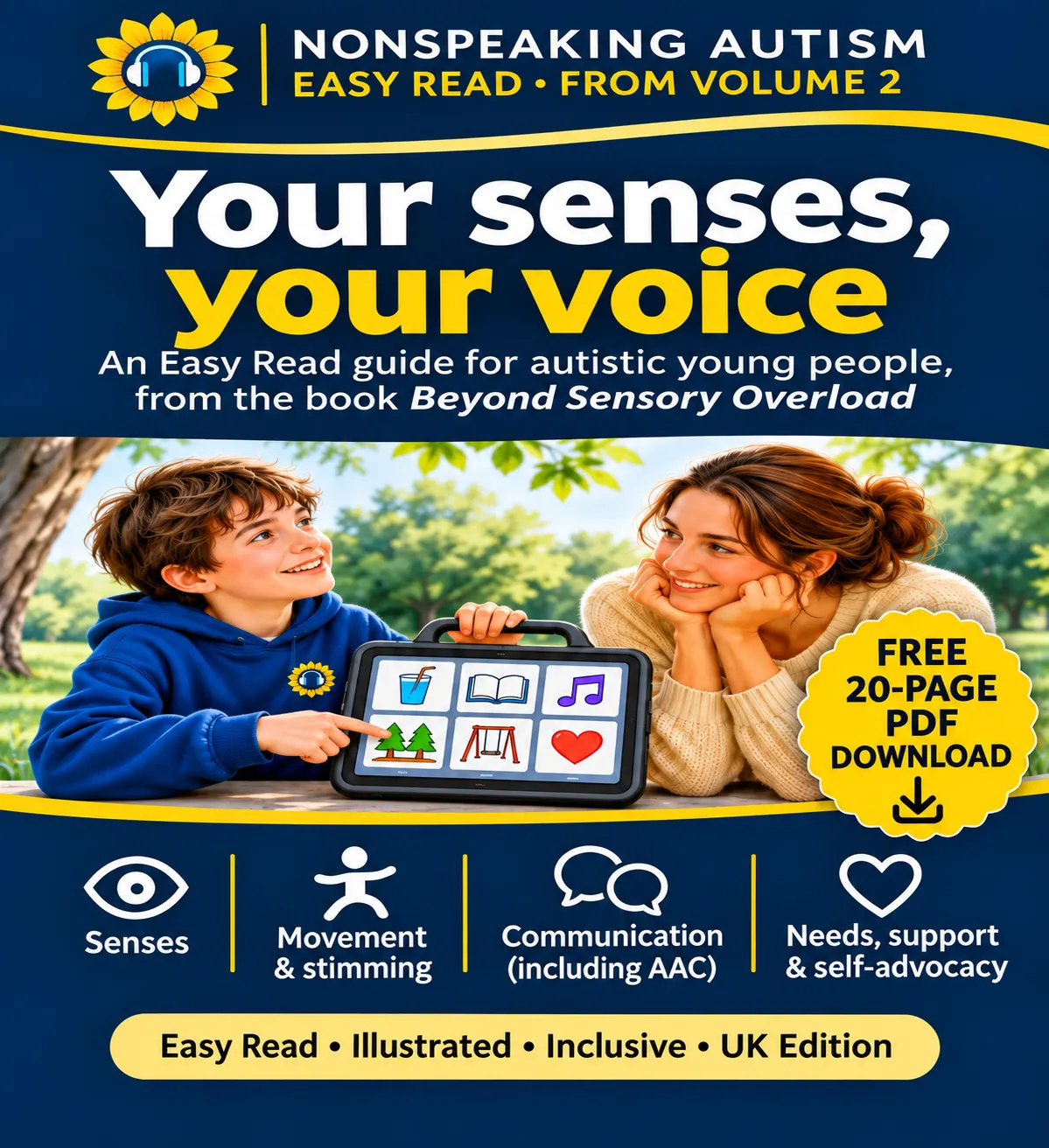
🌻 Your Senses, Your Voice
🌻 Your Senses, Your Voice
FREE 20-Page Easy Read Guide | UK Edition
An illustrated guide for autistic young people, adapted from Beyond Sensory Overload — Volume 2.
💛 FREE DIGITAL DOWNLOAD | 20-PAGE PDF | NONSPEAKING AUTISM
Every autistic young person deserves to understand their body, communicate their needs and feel listened to.
Your Senses, Your Voice is a free, illustrated Easy Read guide created by Nonspeaking Autism. It introduces sensory differences, body signals, movement, communication, personal choice and the importance of being supported in ways that respect the individual.
Adapted from Beyond Sensory Overload — Volume 2, this resource uses short sentences, clear illustrations and accessible explanations to help autistic young people explore their experiences.
It can be read independently or alongside a trusted adult, at the young person's own pace.
There is no single right way to experience the world, communicate or regulate sensory input.
The central message is simple: your senses matter, your communication matters, and your voice deserves to be heard.
🧠 What This Easy Read Guide Explores
🌈 1. Understanding Your Senses
Our senses help us experience the world around us.
The guide introduces:
- Seeing, hearing, touch, taste and smell.
- Movement and balance.
- Awareness of where our bodies are in space.
- Why some sensations may feel particularly strong.
- Why other sensations may feel enjoyable or comforting.
Sensory experiences are individual. What feels pleasant to one person may be uncomfortable for another.
💛 2. Understanding Signals From Inside Your Body
Our bodies give us information about what we need.
This includes:
- Hunger and thirst.
- Needing the toilet.
- Pain or discomfort.
- Feeling unwell.
- Other internal sensations.
Sometimes these signals can be difficult to recognise, interpret or explain.
The guide encourages young people to seek support and reminds adults that difficulty explaining a sensation does not mean it is unimportant.
🌻 3. Movement, Stimming and Sensory Enjoyment
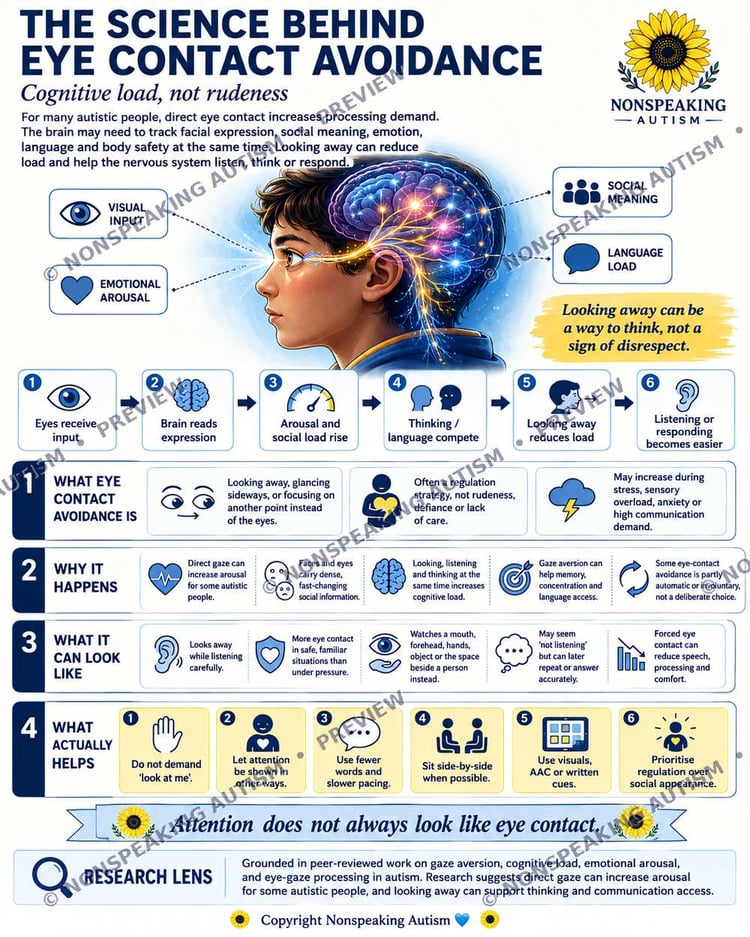
Movement and repetitive activities can be meaningful, enjoyable and supportive.
The guide explores activities such as:
- Jumping and swinging.
- Watching objects spin.
- Enjoying water.
- Moving the body in preferred ways.
- Stimming and sensory exploration.
Safe, self-directed movement should be understood and supported rather than automatically discouraged because it looks different.
4. Recognising When Things Feel Too Much
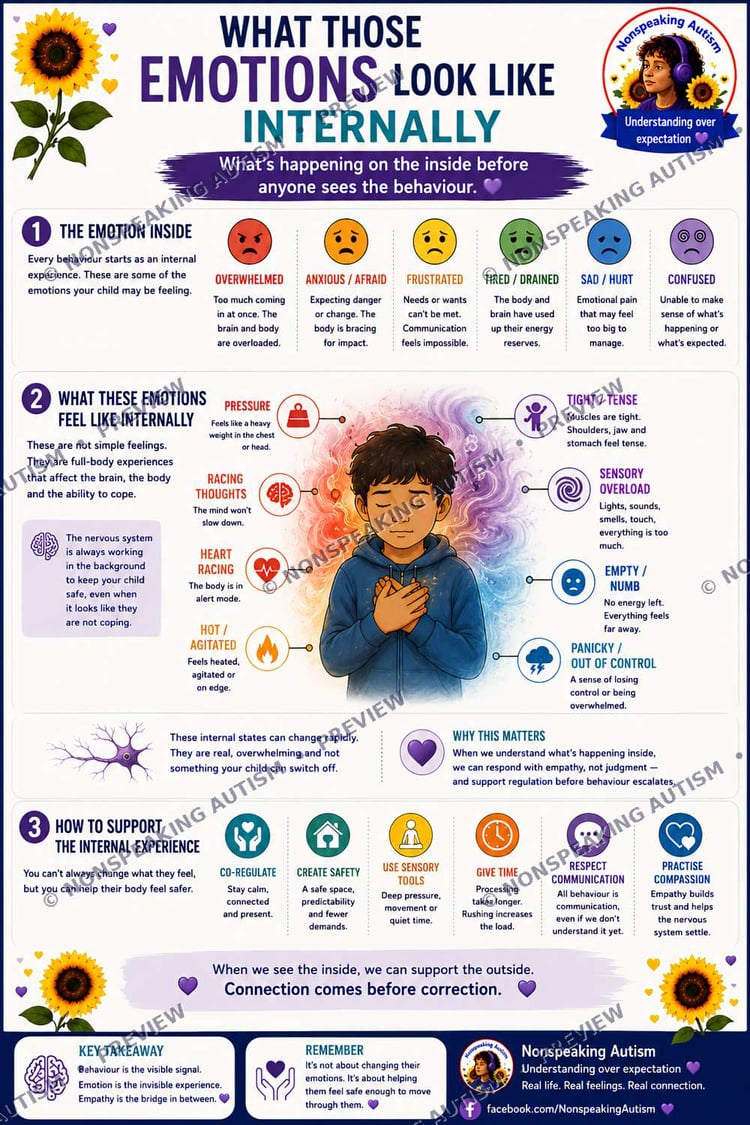
Noise, lighting, crowds, changes and other demands may sometimes become overwhelming.
A young person might:
- Cover their ears.
- Want to leave an environment.
- Become quieter.
- Need a break.
- Seek a calmer space.
The guide explains that needing support or a break is acceptable.
Adults can help by listening, reducing unnecessary demands and making the environment more comfortable.
💬 5. Communication Is More Than Speech
Not speaking does not mean having nothing to say.
The guide recognises different forms of communication, including:
- Spoken words.
- Pictures and symbols.
- Signs and gestures.
- Augmentative and Alternative Communication (AAC).
- Communication devices and picture boards.
- Writing.
- Facial expressions and body movements.
Communication support should remain available throughout the day.
A young person's communication must be respected, including when they communicate “no”, “stop” or “help”.
🩺 6. Pain, Health and Everyday Body Needs
Pain and illness can affect comfort, communication and everyday participation.
The guide encourages young people and adults to notice possible health needs, including:
- Earache or toothache.
- Tummy pain.
- Thirst and toileting needs.
- Sleep difficulties.
- Feeling unwell or uncomfortable.
It also explains that a doctor or dentist can help investigate possible pain or illness.
Pain should never be dismissed simply because someone cannot explain it through speech.
🏫 7. School, Home and Changes
School days can involve sensory, social and communication demands.
Some young people may need additional recovery time after school.
The guide introduces supportive approaches such as:
- Quiet time.
- Rest.
- Preferred movement.
- Pictures or objects to explain what happens next.
- Additional time to finish activities.
These approaches should be adapted to the young person's preferences and circumstances.
🫶 8. Your Body, Your Care and Your Choices
The guide introduces personal choice, bodily autonomy and respectful support.
It explains that:
- Adults should explain or show what they are going to do.
- Young people can communicate that they need a pause.
- Their discomfort with touch should be taken seriously.
- Holding or restraint must never be used simply to force compliance.
- Genuine emergencies may require proportionate action to keep people safe.
The adult appendix provides further safeguarding information and refers to relevant guidance for England.
✏️ Interactive Activity — My Page
Page 14 includes a personal worksheet.
Young people can explore and record:
- Things I like.
- Things that can be too much.
- How I say stop.
- What helps me feel calm.
- Who I go to for help.
The worksheet is designed for writing or drawing on paper and includes instructions for typing into boxes on a phone, tablet or computer.
Adults should respect the young person's choices and ask permission before sharing their completed information.
📖 Additional Information for Adults
Pages 15–20 contain an appendix to help families, educators and professionals use the guide thoughtfully.
It includes:
- Guidance on reading the resource together.
- Using familiar AAC systems and symbols.
- Respecting the young person's choices and personal information.
- Safeguarding information about touch, holding and restraint.
- Copyright and permitted-use information.
- UK support organisations and useful contacts.
- Research references and supporting guidance.
The appendix is intended to support understanding, not replace individual assessment or professional judgement.
🔬 Research-Informed Educational Resource
This guide draws on published research, professional guidance, communication rights frameworks and accessible-information guidance.
Its approach recognises that:
- Sensory experiences vary between individuals.
- Interoceptive awareness can differ.
- Stimming may have different meanings and functions.
- AAC can support communication and participation.
- Pain and distress may be communicated in different ways.
- Personal choice, accessible information and respectful support are important.
The guide does not claim that every autistic young person experiences the same sensory differences or benefits from the same strategies.
Research note: Easy Read formats can improve access to information, but accessibility is individual. Some readers may benefit from familiar symbols, additional explanation or support from someone they trust.
📚 Selected Research and References
The full PDF contains 18 numbered references across pages 18–20.
Selected sources include:
1. Chinn, D. & Homeyard, C. (2017).
Easy read and accessible information for people with intellectual disabilities: is it worth it? A meta-narrative literature review. Health Expectations, 20(6), 1189–1200.
https://doi.org/10.1111/hex.12520
2. Chen, Y., et al. (2024).
A systematic review and meta-analysis of the relationship between sensory processing differences and internalising/externalising problems in autism. Clinical Psychology Review, 114, 102516.
https://doi.org/10.1016/j.cpr.2024.102516
3. Klein, M., Witthöft, M. & Jungmann, S. M. (2025).
Interoception in individuals with autism spectrum disorder: a systematic literature review and meta-analysis. Frontiers in Psychiatry, 16, 1573263.
https://doi.org/10.3389/fpsyt.2025.1573263
4. Kapp, S. K., et al. (2019).
‘People should be allowed to do what they like’: autistic adults' views and experiences of stimming. Autism, 23(7), 1782–1792.
https://doi.org/10.1177/1362361319829628
5. Johnson, E., van Zijl, K. & Kuyler, A. (2023).
Pain communication in children with autism spectrum disorder: a scoping review. Paediatric & Neonatal Pain, 5(4), 127–141.
https://doi.org/10.1002/pne2.12115
6. NICE Clinical Guideline CG170.
Autism spectrum disorder in under 19s: support and management.
https://www.nice.org.uk/guidance/cg170
7. American Speech-Language-Hearing Association (ASHA).
Augmentative and Alternative Communication (AAC).
https://www.asha.org/practice-portal/professional-issues/augmentative-and-alternative-communication/
The guide also references children's rights, disability rights, accessible information, restraint guidance, sleep research and school distress.
These references provide background evidence and guidance. They do not establish that any particular strategy will work for every individual.
Four new research references (15–18)
- Communication (page 7): a meta-analysis finding that combining AAC with NDBI procedures may lead to better language outcomes than NDBIs alone for children on the autism spectrum with minimal speech. aac-learning-center
- Pain (page 9): a review finding that autistic children utilized various verbal and nonverbal methods to communicate their pain experiences. nih
- Sleep (page 10): a 2024 meta-analysis linking sleep problems with behavioural difficulties.
- School and home (page 11): a 2025 UK study of school distress. It found that most children experiencing school distress were autistic, with the odds ratio of diagnosed autistic CYP experiencing School Distress, relative to their non-autistic peers, which was 46.61. frontiersin
Sources:
- Childline: We’re here for you
- Contact: Stoke Local Offer listing
- Communication Matters: about us
- ERIC Helpline
- Pope et al. (2024) summary, AAC-RERC
- Johnson et al. (2023), Pain communication in children with ASD
- Mullally & Connolly (2025), Frontiers in Psychiatry
👨👩👧 Who Is This Resource For?
This free guide may be useful for:
- Autistic children and young people, including nonspeaking and minimally speaking individuals.
- Parents, carers and families.
- Teachers, teaching assistants and SENCOs.
- SEND support teams and specialist schools.
- Speech and language therapists.
- Occupational therapists.
- Healthcare professionals.
- Social care and family support practitioners.
- Professionals supporting AAC users.
- Anyone seeking a respectful introduction to sensory needs and communication.
Although written for autistic young people, the guide may also help adults reflect on how they recognise and respond to individual communication and sensory preferences.
📦 What You Receive
💛 FREE DOWNLOAD — £0.00
- 1 × Your Senses, Your Voice — UK Edition
- 20-page illustrated PDF guide
- Easy Read-style explanations and supporting pictures.
- Information about senses, movement, communication and personal needs.
- A personal activity worksheet on page 14.
- Adult guidance and safeguarding information.
- UK support organisations and contacts.
- 18 research and guidance references.
- Nonspeaking Autism branding and copyright information.
The PDF is provided without promotional watermarks.
This is a digital PDF download only. No physical book or printed item will be posted.
The guide is intended for reading digitally or printing for permitted personal, educational and professional use.
⚠️ Important Educational and Safeguarding Disclaimer
This resource provides general educational information.
It is not a diagnostic tool, medical assessment, individual treatment plan or substitute for advice from an appropriately qualified professional.
Sensory distress, communication changes, pain, illness, anxiety and other experiences can have different causes.
Do not assume that a change in behaviour is automatically caused by autism or sensory processing.
Seek appropriate medical advice if a young person experiences new, persistent, severe or concerning symptoms.
Where safeguarding or restrictive intervention is involved, professionals must follow current legislation, organisational procedures and applicable guidance. The guide's discussion of school restraint requirements specifically relates to England; requirements may differ elsewhere in the UK.
For a life-threatening emergency in the UK, call 999. For urgent medical advice, NHS 111 is available in England, Scotland and Wales.
©️ Copyright and Permitted Use
© 2026 Nonspeaking Autism. All rights reserved.
This resource is provided free for personal, non-commercial educational and professional use.
You may:
- Download and print copies for personal or family use.
- Print and distribute copies within classrooms, schools, colleges, clinics, therapy services and professional training sessions.
- Share the complete, unchanged PDF with families, carers, educators and professionals.
- Display the resource in educational, healthcare and community settings.
You may not:
- Sell the resource or include it in products offered for sale.
- Remove or alter the Nonspeaking Autism logo, copyright notice or attribution.
- Edit, reproduce or redistribute modified versions without written permission.
- Claim the resource as your own work.
Please retain the original branding and credit:
Nonspeaking Autism — nonspeaking-autism.com
These permissions apply to non-commercial educational and professional use only.
💛 The Message Behind This Guide
Autistic young people should not have to communicate in one particular way to be understood.
Their movement may be meaningful.
Their sensory preferences deserve respect.
Their discomfort deserves attention.
Their communication deserves access, time and a response.
And their choices should matter.
Your senses matter. Your voice matters. You deserve to be heard.
See beyond. Support the nervous system.
🌻 Nonspeaking Autism
Different ways. Bright minds.
nonspeaking-autism.com