

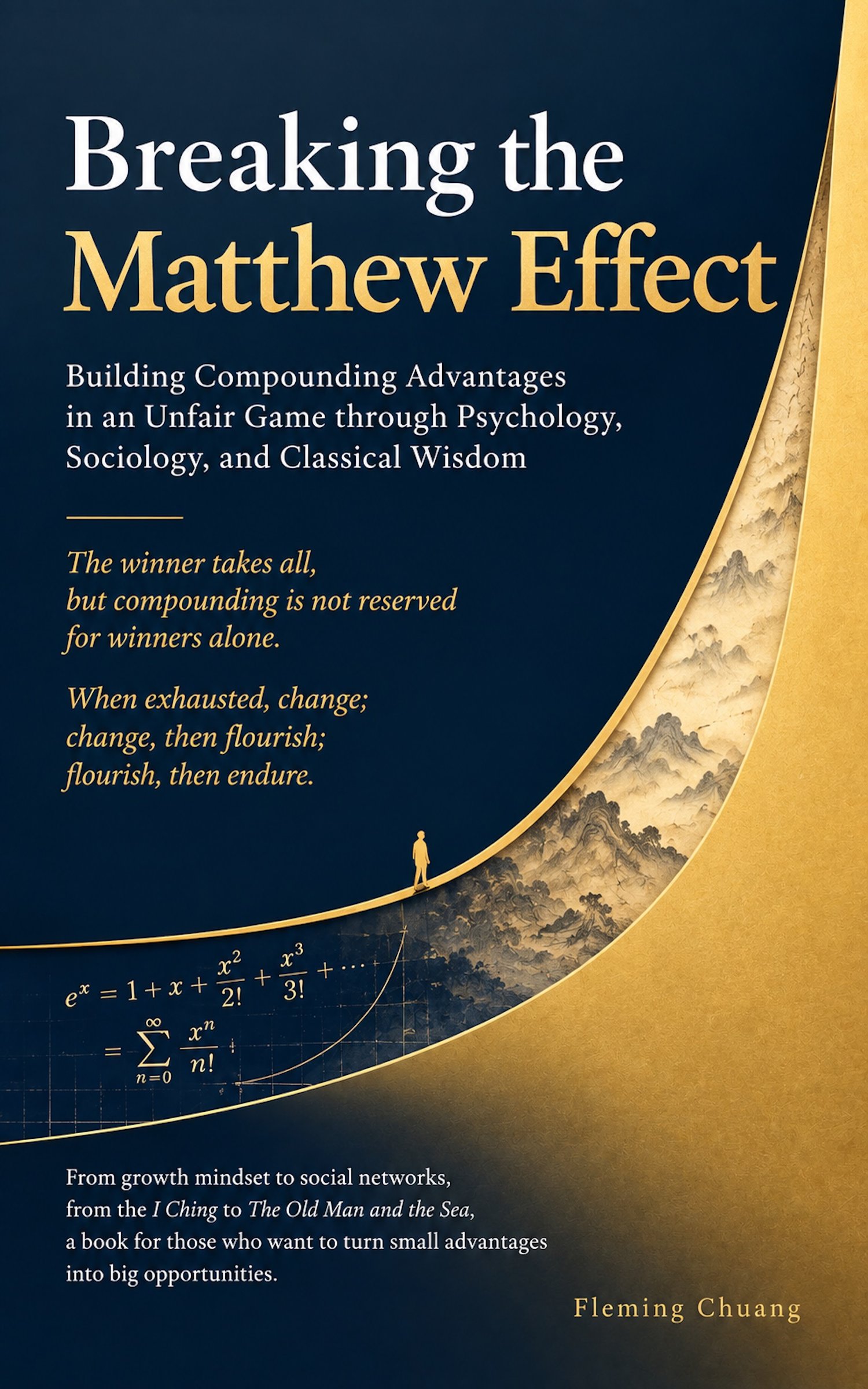
Breaking the Matthew Effect: In an unfair game, use psychology, sociology, and classic wisdom to build odds that accumulate.
Why do some advantages keep multiplying while others disappear—even when the people involved work just as hard?
The Matthew Effect is often reduced to a bleak formula: the rich get richer, the famous become more famous, and winners take all. Breaking the Matthew Effect offers a different way to understand the phenomenon. It treats cumulative advantage not as an unchangeable fate, but as a dynamic system that can be observed, understood, and strategically influenced.
Using Zhang Jie’s career as a recurring case study, the book traces how an early advantage can fail to compound, how a change of field can reopen opportunity, and how small differences can become major gaps through path dependence, attention, networks, and feedback loops. From Merton’s Matthew Effect and Barabási’s preferential attachment to the attention economy, social mobility, self-fulfilling prophecy, confirmation bias, and social comparison, the book maps the mechanisms behind winner-takes-all dynamics.
It then turns inward. Growth mindset, self-efficacy, deliberate practice, flow, delayed gratification, habits, resilience, narrative psychology, and self-determination become a “psychological engine” for positive compounding. The book argues that inner strengths can accumulate just as external advantages do.
But personal effort is only part of the equation. Social networks, weak ties, mentors, communities, environmental choice, communication, organizational strategy, and opportunity structures can amplify—or cancel—the value of individual effort. Drawing on sociology and network theory, the book shows why choosing the right field and building bridges across social worlds can matter as much as working harder within an existing game.
The analysis then reaches beyond modern social science to classical wisdom. The I Ching, Tao Te Ching, The Art of War, the Analects, Mencius, Zhuangzi, historical writings, Western classics, and modern works such as Atomic Habits and Principles are treated not as decorative quotations, but as maps for thinking about timing, position, adaptation, endurance, systems, and strategy.
Finally, the book turns these ideas into practical systems: resource inventories, compounding goals, daily routines, opportunity-network maps, psychological risk management, long-term game selection, and methods for turning individual success into opportunities for others.
This is not a promise that hard work always leads to success, nor an argument that social structures do not matter. It is an invitation to understand the structure without surrendering agency. Within limits, there is still room for action; in adversity, there is still strategy; and in slow progress, there is still compounding.
The winner takes all—but compounding is not reserved for winners alone. Small advantages can roll into big opportunities. Understand the game, build your flywheel, and move from being chosen to being able to choose.