
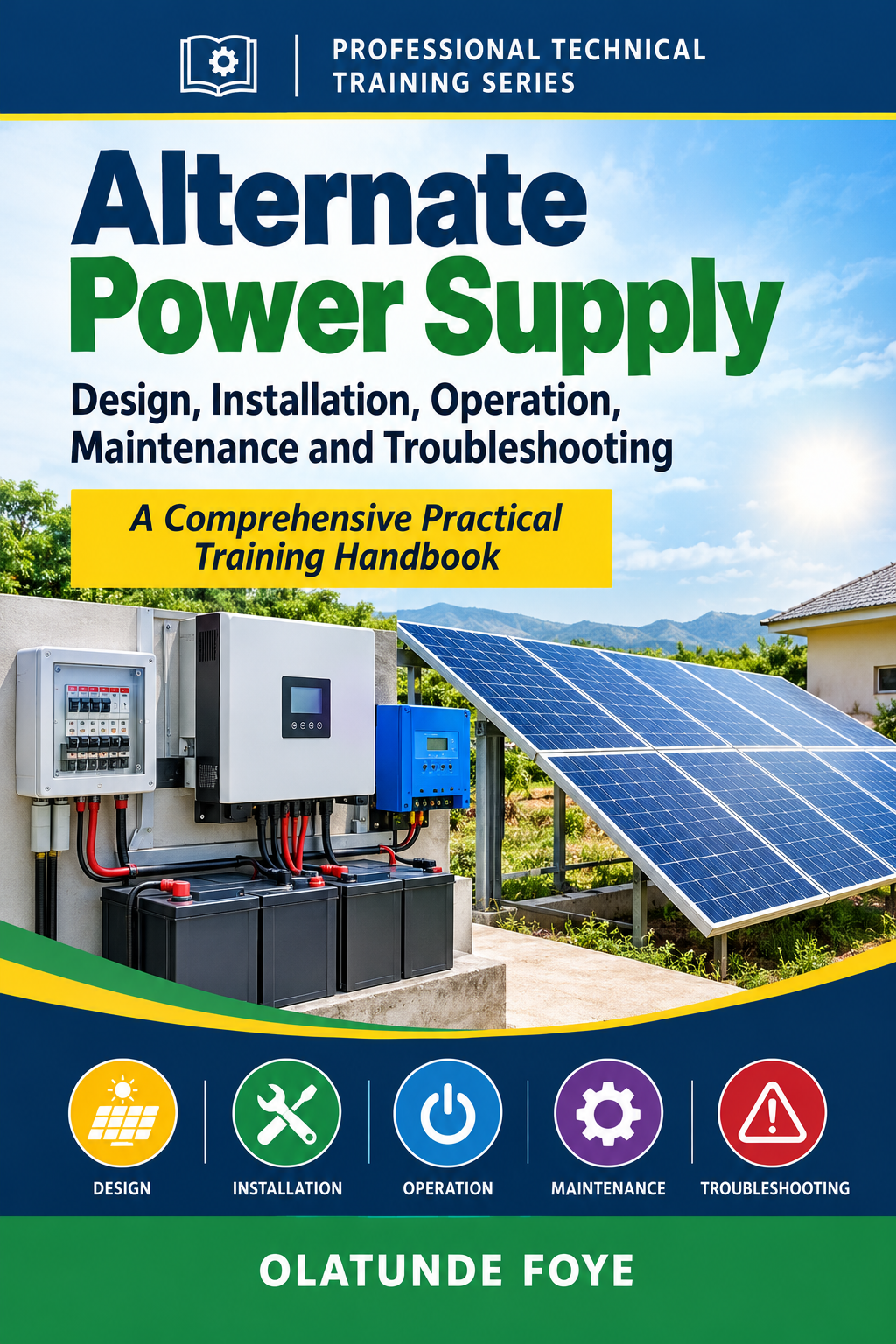
Alternate Power Supply
ALTERNATE POWER SUPPLY
Design, Installation, Operation, Maintenance and Troubleshooting
A Comprehensive Practical Training Handbook
By Olatunde Foye
Reliable electricity is essential for homes, businesses, industries, educational institutions, healthcare facilities, and modern digital infrastructure. However, unreliable grid power, rising energy costs, and the growing demand for dependable electricity have made alternative power solutions increasingly important. Solar photovoltaic systems, inverters, batteries, generators, and hybrid power technologies provide practical ways to improve energy reliability, reduce dependence on the grid, and support uninterrupted operations.
Alternate Power Supply: A Comprehensive Practical Training Handbook is a practical, technically oriented guide designed to equip students, technicians, electricians, installers, maintenance personnel, and aspiring renewable energy professionals with the knowledge and skills required to understand, design, install, operate, maintain, and troubleshoot alternative power systems.
Written with practical application in mind, this handbook bridges the gap between theoretical knowledge and real-world installation work. It introduces the fundamental principles of electricity and energy systems before progressing to equipment selection, system sizing, installation procedures, protection, commissioning, routine maintenance, fault diagnosis, and professional service delivery.
What You Will Learn
Inside this comprehensive handbook, you will explore:
· Electrical Fundamentals: Voltage, current, resistance, power, energy, AC and DC systems, electrical calculations, and essential measurement techniques.
· Solar Photovoltaic Technology: How solar panels work, interpreting panel specifications, assessing solar resources, configuring arrays, and understanding the factors that affect energy production.
· Inverters and Power Conversion: Inverter types, ratings, operating principles, waveform characteristics, efficiency, overload capacity, and appropriate equipment selection.
· Battery Technology and Energy Storage: Lead-acid and lithium batteries, including LiFePO4; battery capacity, usable energy, charging characteristics, battery management systems, and safe installation practices.
· Solar Charge Controllers: PWM and MPPT technologies, controller selection, charging principles, and correct configuration.
· System Design and Sizing: Load assessment, daily energy consumption, solar array sizing, battery-bank sizing, inverter selection, charge-controller sizing, and cable calculations.
· Wiring, Protection and Safety: Cable selection, voltage-drop calculations, fuses, circuit breakers, isolators, surge protection, earthing, grounding, and safe electrical practices.
· Generators and Hybrid Power Solutions: Integrating solar, battery storage, generators, and utility power to improve reliability and energy availability.
· Installation and Commissioning: Site assessment, mounting, wiring, equipment configuration, inspection, testing, and performance verification.
· Operation and Energy Management: Load prioritisation, energy conservation, battery management, backup-duration estimation, and efficient system operation.
· Maintenance and Troubleshooting: Preventive maintenance, fault identification, interpreting alarms, diagnosing common failures, and restoring systems safely.
· Professional Practice and Business Skills: Preparing bills of quantities, developing customer quotations, selecting components, documenting installations, and delivering professional technical services.
A Practical Handbook for the Training Room and the Field
This book goes beyond explaining technical concepts. It provides practical worksheets, design calculations, equipment-selection guidance, checklists, troubleshooting references, sample bills of quantities, quotation formats, and maintenance procedures to support hands-on learning and professional application.
The worked examples and exercises help readers develop the confidence to assess electrical loads, plan appropriate system configurations, interpret equipment specifications, calculate essential design values, identify installation errors, and approach common faults systematically.
The handbook also highlights the importance of electrical safety, correct equipment ratings, manufacturer instructions, applicable standards, and proper testing. Readers are encouraged to apply these principles throughout the design, installation, and maintenance process.
Who Should Read This Book?
This handbook is suitable for:
· Electrical and electronics students.
· Renewable energy and solar installation trainees.
· Electricians and electrical technicians.
· Solar PV and inverter installation professionals.
· Maintenance engineers and technical support personnel.
· Engineering and technical training institutions.
· Entrepreneurs establishing solar installation and alternative energy businesses.
· Homeowners and facility managers seeking a better understanding of backup power systems.
· Instructors developing practical courses in solar energy, inverters, batteries, and hybrid power systems.
Whether you are beginning your journey in alternative energy or seeking to strengthen your existing technical competence, this handbook offers a structured foundation for learning and practical development.
Build Your Skills. Deliver Reliable Power Solutions.
Alternative power technology is more than the installation of solar panels, batteries, and inverters. It requires sound design, careful equipment selection, correct wiring, effective protection, proper commissioning, and consistent maintenance. A weakness in any of these areas can compromise system performance, safety, reliability, and service life.
Alternate Power Supply: Design, Installation, Operation, Maintenance and Troubleshooting provides a systematic learning resource to help readers understand these interconnected responsibilities and develop the competence required to work more effectively in the alternative energy sector.
Study the principles. Practise the procedures. Apply the calculations. Build the competence to design, install, maintain, and troubleshoot reliable alternative power systems.
OLATUNDE FOYE