
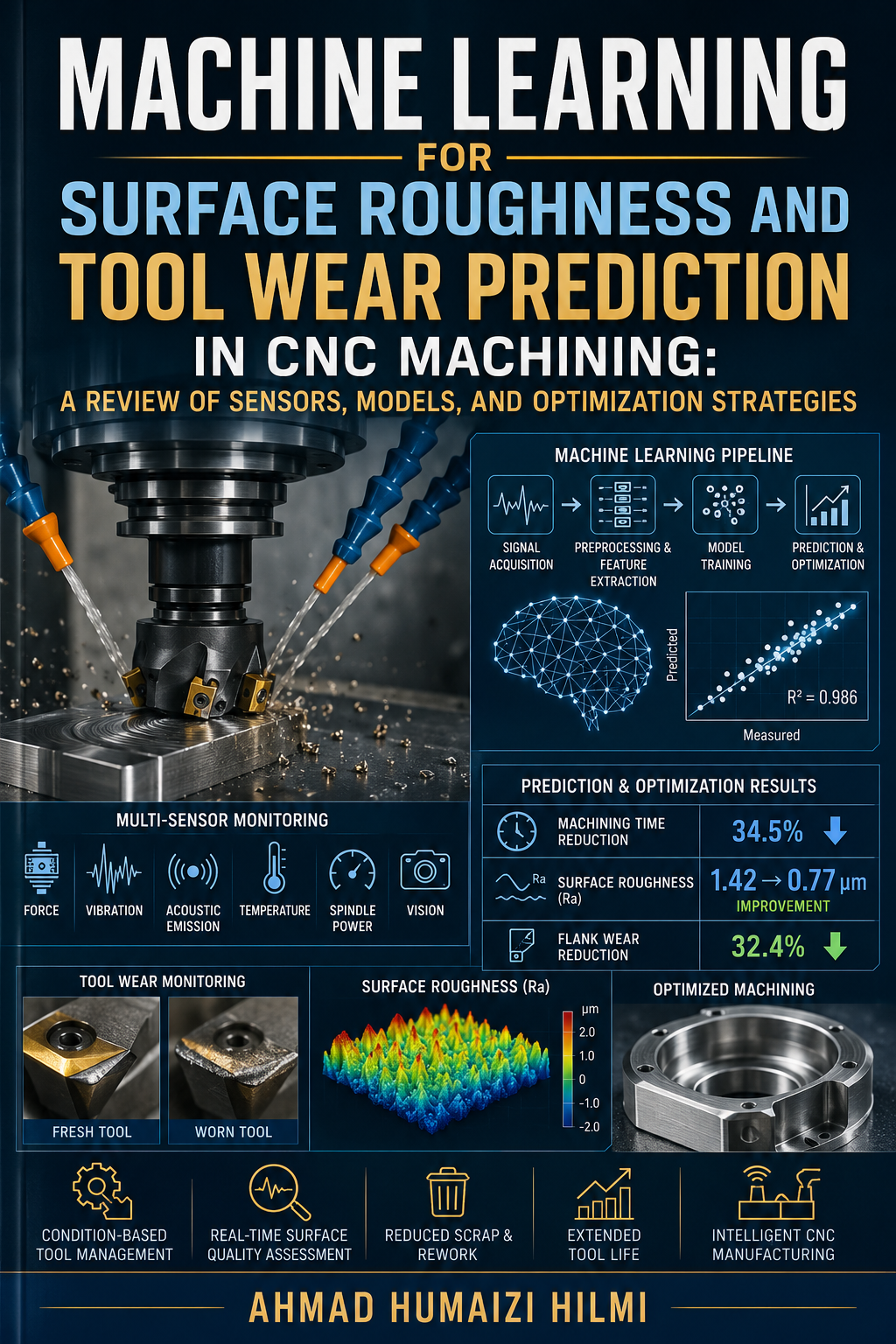
Machine Learning for Surface Roughness and Tool Wear Prediction in CNC Machining: A Review of Sensors, Models, and Optimization Strategies
Surface roughness and cutting-tool wear are critical indicators of machining quality, productivity, and process stability in computer numerical control (CNC) machining. However, conventional approaches based on offline surface measurement and process-specific design-of-experiments methods provide limited capability for real-time monitoring and may exhibit poor generalization beyond the conditions under which they were developed. This review critically examines recent advances in machine-learning-based prediction of surface roughness and tool wear, with particular emphasis on sensing technologies, data-processing strategies, predictive models, and machining optimization. The reviewed literature encompasses turning, three- and five-axis milling, electrical discharge machining, wire electrical discharge machining, and selected assisted machining processes applied to aluminium alloys, stainless and tool steels, Ti-6Al-4V, Inconel 718, and other nickel-based alloys. Principal machining variables include cutting speed, spindle speed, feed, depth of cut, tool geometry, coating, and cooling or lubrication conditions, while surface quality is primarily characterized using Ra, Rz, and Sa. Force, vibration, acoustic emission, temperature, spindle power, and vision sensing are examined together with signal preprocessing, feature extraction, feature selection, and multi-sensor data preparation. The review shows that response-surface and Gaussian-process approaches are particularly applicable to small experimental datasets, whereas Random Forest and Gradient Boosting models provide strong performance for moderate tabular datasets, and CNN–RNN architectures and semi-supervised approaches offer potential for multi-sensor time-series and limited-label applications. Among the reported results, a Gradient Boosting model achieved an R² of 0.986 for crater tool-wear prediction in aluminium-alloy turning. Process optimization also produced substantial improvements, including a 34.5% reduction in machining time, an improvement in Ra from 1.42 to 0.77 μm, and a 32.4% reduction in flank wear using a separable-insert machining strategy. The principal contribution of this review is an integrated framework linking machining variables, sensor modalities, signal-processing pipelines, machine-learning model selection, validation, and optimization strategies. The findings provide a foundation for developing reproducible and transferable predictive monitoring systems capable of supporting condition-based tool management, near-real-time surface-quality assessment, reduced scrap, extended tool life, and intelligent CNC manufacturing.