
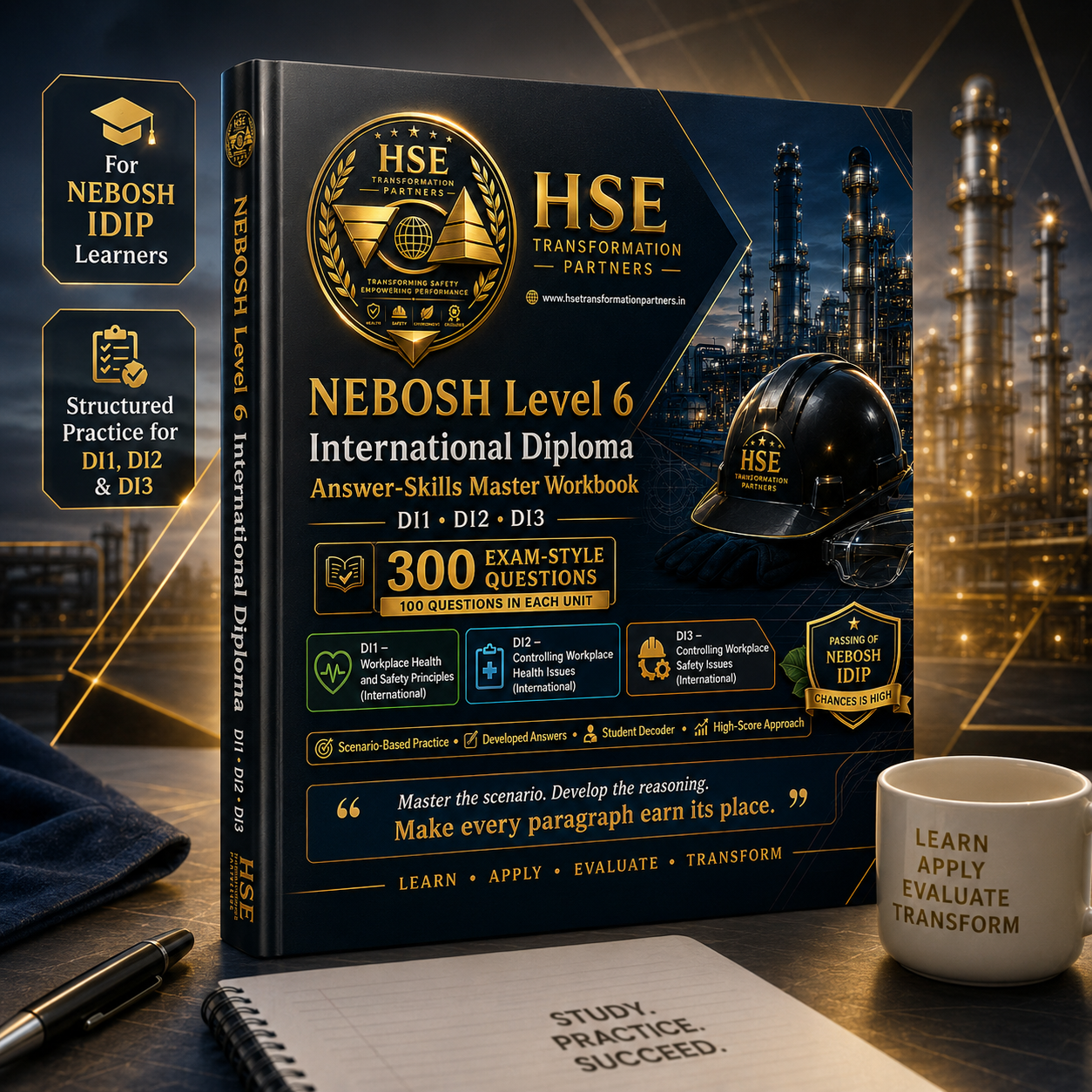
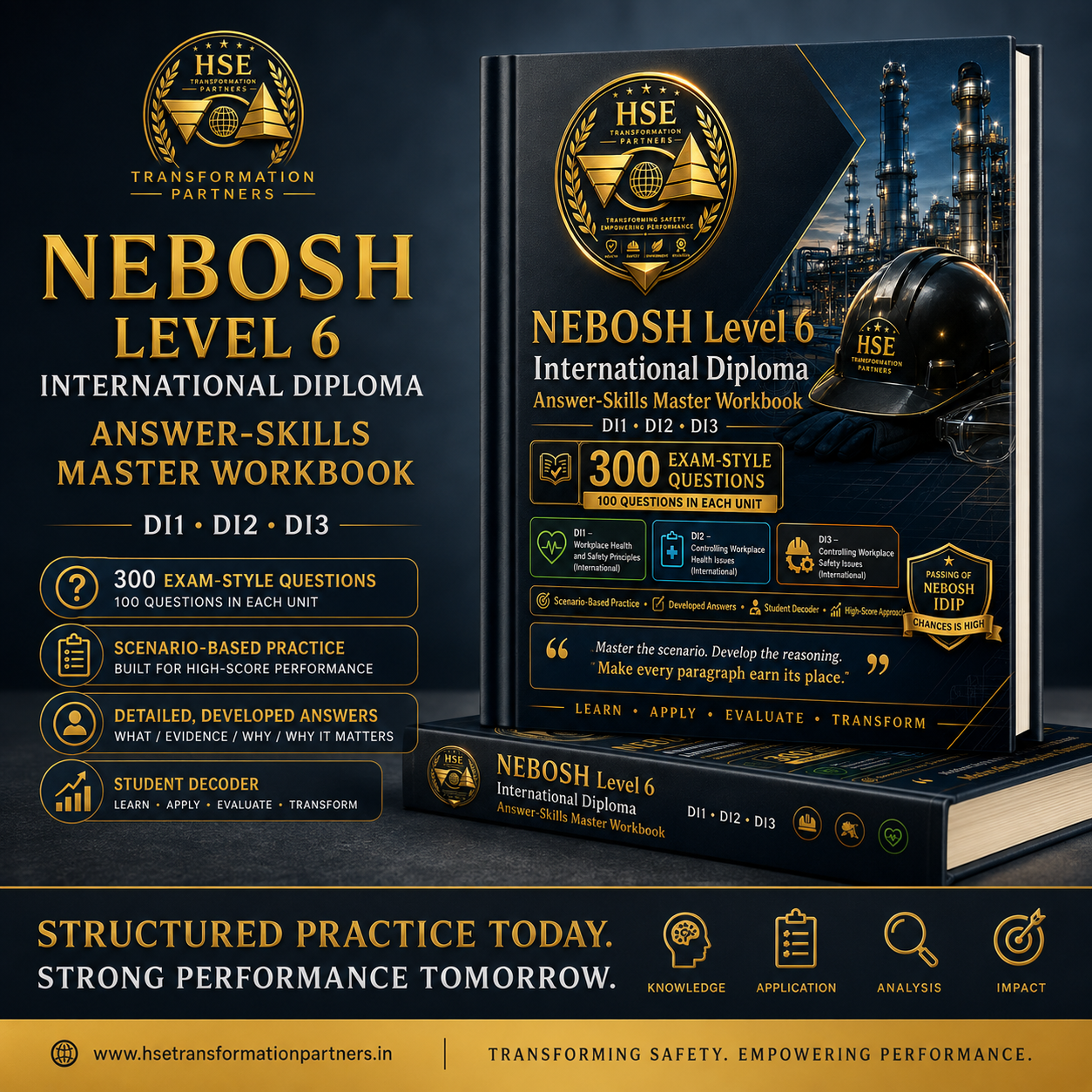
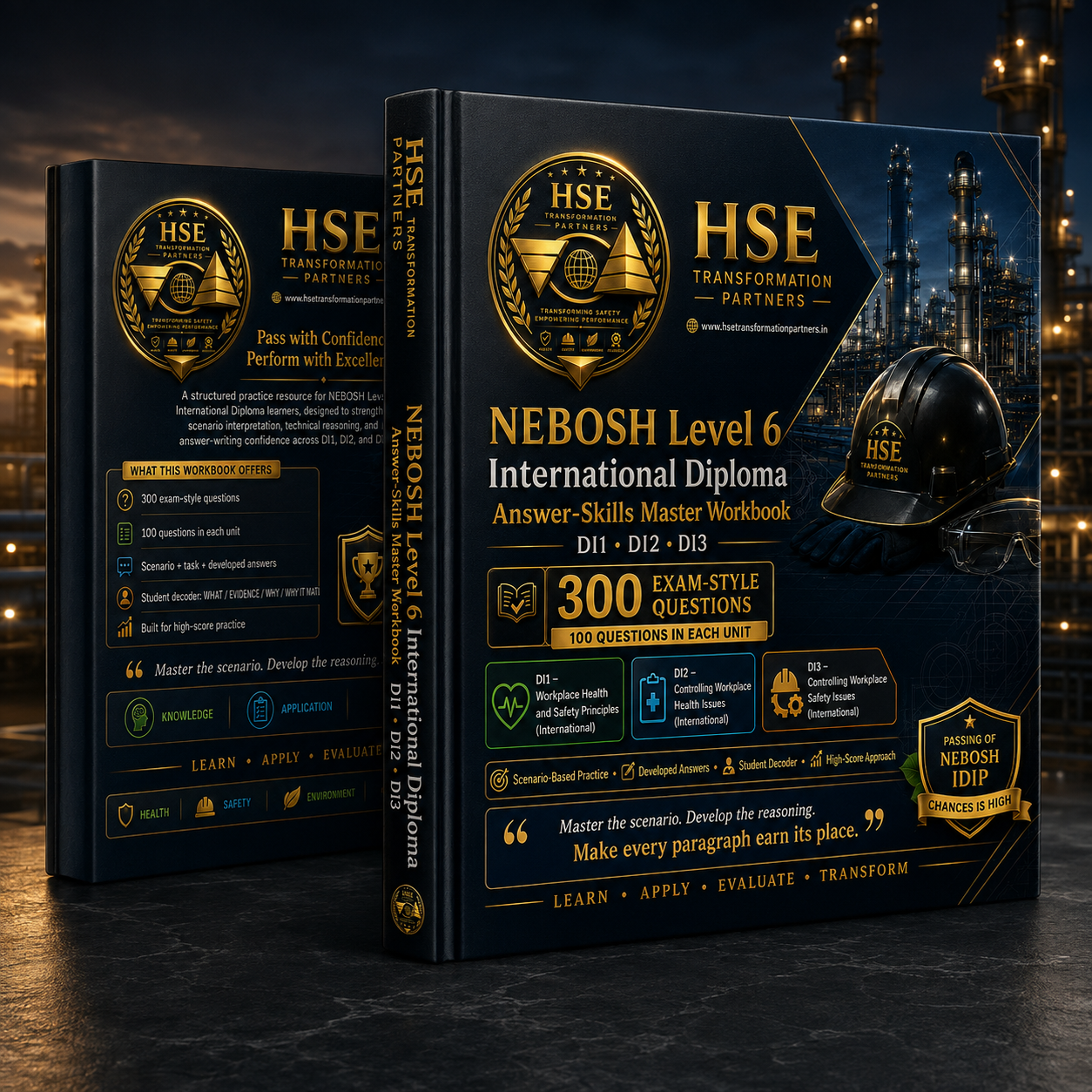
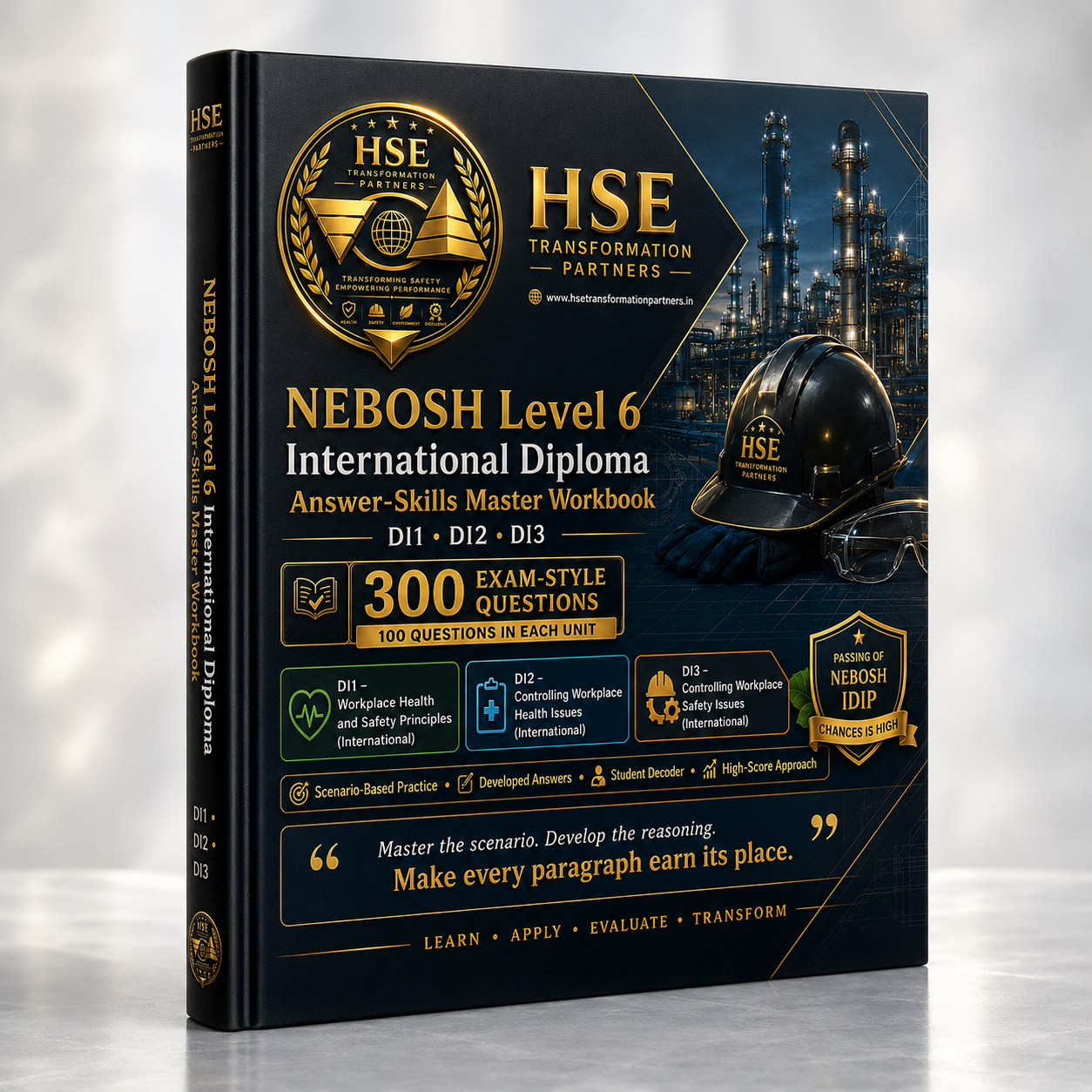




NEBOSH Level 6 International Diploma – Answer-Skills Master Workbook
NEBOSH Level 6 International Diploma – Answer-Skills Master Workbook is a comprehensive practice resource created for learners who want to move beyond simply knowing health and safety theory and learn how to apply that knowledge effectively in NEBOSH-style assessments.
Developed under HSE Transformation Partners, this workbook is designed around one of the most important realities of the NEBOSH International Diploma: success depends not only on what a learner knows, but on how well they read a scenario, identify relevant evidence, apply technical knowledge, develop reasoning, and communicate professional judgement clearly.
The workbook brings together DI1, DI2 and DI3 in one structured learning resource and contains 300 exam-style practice questions — 100 questions for each unit. Each question has been designed to help learners practise the type of analytical thinking required at Level 6 rather than relying on memorisation.
What makes this workbook different?
Many learners understand the syllabus but still struggle when they see an unfamiliar scenario. They may know the technical topic, but they are unsure:
- What exactly is the question asking?
- Which parts of the scenario are important?
- How many points should be written for the marks available?
- How should a technical point be connected to the scenario?
- What is the difference between stating something and properly developing it?
- How should words such as comment, evaluate, explain, justify, advise and recommend influence the response?
- Why does one answer sound strong while another answer may gain little credit?
- How can knowledge be converted into a clear, professional Level 6 response?
This workbook has been developed specifically to address those difficulties.
The core learning method used throughout the book is:
WHAT → EVIDENCE → WHY / HOW → WHY IT MATTERS
The learner is encouraged to identify the technical issue, support it with scenario evidence, explain the reasoning behind it, and then demonstrate its significance, consequence, benefit, weakness or required improvement.
This prevents one of the most common weaknesses in Diploma answers: writing generic textbook statements without applying them to the situation described.
300 Exam-Style Questions Across DI1, DI2 and DI3
The book contains extensive practice across all three International Diploma units.
DI1 – Workplace Health and Safety Principles (International) develops skills in areas such as leadership, organisational culture, competence, consultation, human factors, risk management, monitoring, auditing, professional ethics, policy, organisational change, contractor management and other core health and safety management principles.
DI2 – Controlling Workplace Health Issues (International) provides practice in applying occupational health principles to realistic workplace situations, including hazardous substances, exposure assessment, occupational hygiene, health surveillance, noise, vibration, biological hazards, ergonomics, musculoskeletal risks, thermal environment and other health-related topics.
DI3 – Controlling Workplace Safety Issues (International) develops practical application across workplace safety risks such as fire and explosion, dangerous substances, machinery, work equipment, maintenance, electricity, lifting operations, workplace transport, construction activities and other significant safety hazards.
The objective is not simply to expose learners to more questions. It is to expose them to different situations, different wording, different task demands and different ways that the same technical knowledge may need to be applied.
Fully Developed Demonstration Answers
Each practice question includes a developed model response.
These answers are not intended to be memorised. Instead, they demonstrate how an answer can move from a basic technical statement into a stronger applied response.
A learner can therefore compare:
What I would have written
with
What a more developed answer could look like
and then identify what was missing from their own response.
This comparison process can help learners recognise weaknesses such as repetition, unsupported statements, insufficient scenario application, unexplained conclusions and excessive reliance on generic knowledge.
The Student Decoder
One of the most valuable features of this workbook is the Student Decoder.
Alongside the worked answer, the learner is guided through the thinking behind it.
Instead of only showing what was written, the workbook explains why it was written that way.
The decoder helps the learner understand the purpose of each developed point by examining questions such as:
What is the technical issue?
Which scenario evidence supports this point?
Why is the point relevant to the task?
How does the issue affect health and safety?
Why does it matter to the organisation, workers or others?
What additional consequence, weakness, benefit or improvement should be explained?
This is particularly useful for learners who find Level 6 analytical writing difficult, learners for whom English is not their first language, and learners who understand health and safety technically but struggle to convert that knowledge into assessment-quality responses.
Learn the Method — Not the Answer
The philosophy behind the workbook is simple:
Your goal is not to memorise 300 answers. Your goal is to become capable of answering the next question — even when you have never seen the scenario before.
The workbook therefore encourages learners to use each question in three stages.
First, learn by studying the scenario, task, model response and explanation together.
Then practise by hiding the answer, creating an independent answer plan and comparing it against the demonstration.
Finally, simulate by attempting unfamiliar questions without support and reviewing the response only after completion.
This progression helps learners move gradually from guided learning to independent assessment performance.
Understand How Marks Should Influence Your Answer
A common challenge for Diploma learners is judging how much to write.
The workbook repeatedly encourages learners to use the marks available as a guide to the breadth and development of their response.
A higher-mark task normally requires more distinct relevant contributions and greater development than a low-mark question.
The workbook therefore teaches learners to plan before writing, avoid repeating the same idea in different words and ensure that each paragraph contributes something useful to the task.
The principle is:
Make every paragraph earn its place.
Build Scenario-Reading Skills
NEBOSH Diploma assessments require learners to work with realistic scenarios.
The difficulty is often not knowing the topic — it is finding the important clues hidden inside the scenario.
This workbook trains learners to read scenarios like investigators.
They learn to identify:
management decisions, unsafe conditions, weaknesses in controls, positive practices, human factors, training deficiencies, competing business pressures, leadership behaviours, cultural indicators, maintenance issues, failures in communication, organisational changes, contractor problems and other clues that can later be converted into developed answer points.
With repeated practice, learners can become faster at separating relevant information from background detail.
Strengthen Professional Judgement
The NEBOSH Level 6 International Diploma is a professional qualification.
Therefore, strong answers often need more than definitions.
Learners may be expected to analyse, evaluate, comment, advise, justify, prioritise or recommend.
The workbook therefore places emphasis on judgement.
A learner is encouraged not merely to state that something is “poor” or “good”, but to explain:
why it is poor,
what evidence supports that judgement,
what the consequences could be,
and what a competent health and safety professional would recommend.
Repeated practice can help develop the professional reasoning expected from someone operating at Diploma level.
Suitable for Different Types of Learners
The workbook has been designed to support both confident learners and those who initially find the Diploma challenging.
A stronger learner can use the 300 questions for intensive examination-style practice, answer comparison and refinement.
A learner who struggles with assessment writing can follow the Student Decoder slowly and learn how each point is constructed.
A learner with limited confidence in English can study the recurring answer pattern and understand how a professional point can be written clearly without unnecessary complicated language.
The aim is to make the reasoning process visible, repeatable and learnable.
Why Regular Practice Matters
Reading a textbook builds knowledge.
But Diploma assessment success also requires retrieval, application, interpretation and written reasoning.
That is why this workbook encourages:
Attempt → Compare → Understand → Rewrite
When a learner attempts a question before viewing the answer, discovers what was missing, understands why the model response is stronger and then rewrites the answer independently, the activity becomes active learning rather than passive reading.
Over time, this can strengthen assessment confidence and help learners develop a more disciplined answering method.
More Than a Question Bank
This is not simply a collection of 300 questions.
It is an answer-skills training workbook.
Its purpose is to connect three essential elements:
Knowledge
Knowing the health and safety principles.
Application
Recognising where those principles apply within a scenario.
Communication
Explaining them clearly enough for another professional to understand the reasoning.
When these three skills work together, learners are better prepared to deal with unfamiliar assessment situations.
Who Should Use This Book?
This workbook is particularly suitable for:
NEBOSH Level 6 International Diploma learners preparing for DI1, DI2 and DI3; learners who have completed tuition but need structured assessment practice; candidates retaking a unit and wanting to strengthen answer technique; health and safety professionals progressing from knowledge-based qualifications to Diploma-level analytical work; tutors looking for additional scenario-based discussion material; and learners who want to improve their ability to write structured, evidence-based professional health and safety responses.
A Practical Route Towards Stronger Performance
No workbook can guarantee a particular mark, Pass, Credit or Distinction.
However, a learner who systematically works through this resource, attempts the questions independently, studies the reasoning behind the worked answers, identifies personal weaknesses and repeatedly rewrites responses is practising the exact skills that matter when facing a new scenario:
Read carefully.
Identify evidence.
Apply knowledge.
Develop the reasoning.
Explain why it matters.
Use the marks intelligently.
Review before submitting.
That disciplined process can substantially improve preparedness and confidence.
Important Academic and Assessment Notice
This publication is an independent learner-support and training resource produced by HSE Transformation Partners.
The questions and worked demonstrations are intended for practice and skill development. They are not official NEBOSH examination questions, examiner reports or mark schemes, unless a specific official source is expressly identified.
The workbook does not replace the current NEBOSH syllabus, official assessment guidance, Learning Partner tuition, recognised reference materials or wider professional reading.
Learners must never copy model answers from this workbook into a live assessment. Work submitted for a NEBOSH assessment must be the learner's own work and must comply with current NEBOSH assessment and malpractice requirements.
Suggested promotional closing text
300 Questions. Three Units. One Purpose: Better Answers.
Master the scenario.
Develop the reasoning.
Understand what the task is really asking.
Turn technical knowledge into professional judgement.
Learn why strong answers work — and why weak answers do not.
NEBOSH Level 6 International Diploma – Answer-Skills Master Workbook
DI1 • DI2 • DI3
Learn. Apply. Evaluate. Transform.
HSE Transformation Partners
Transforming Safety. Empowering Performance.