



Inventory Order Analyzer - A Project ARGOS Application
INVENTORY ORDER ANALYZER
EOQ, Ordering Frequency & Inventory Cost Calculator
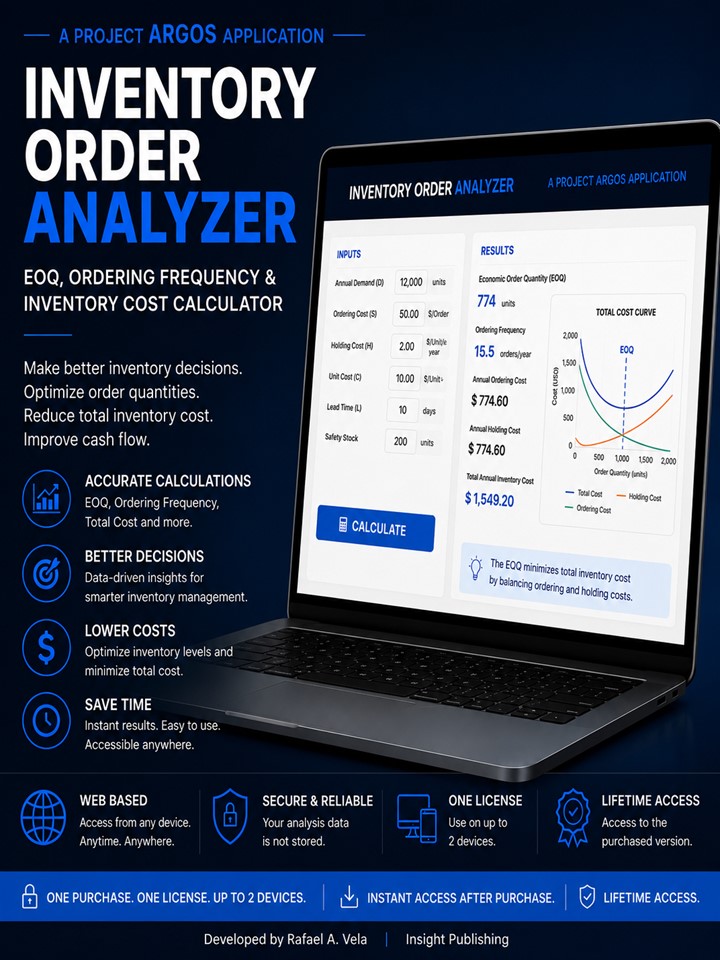
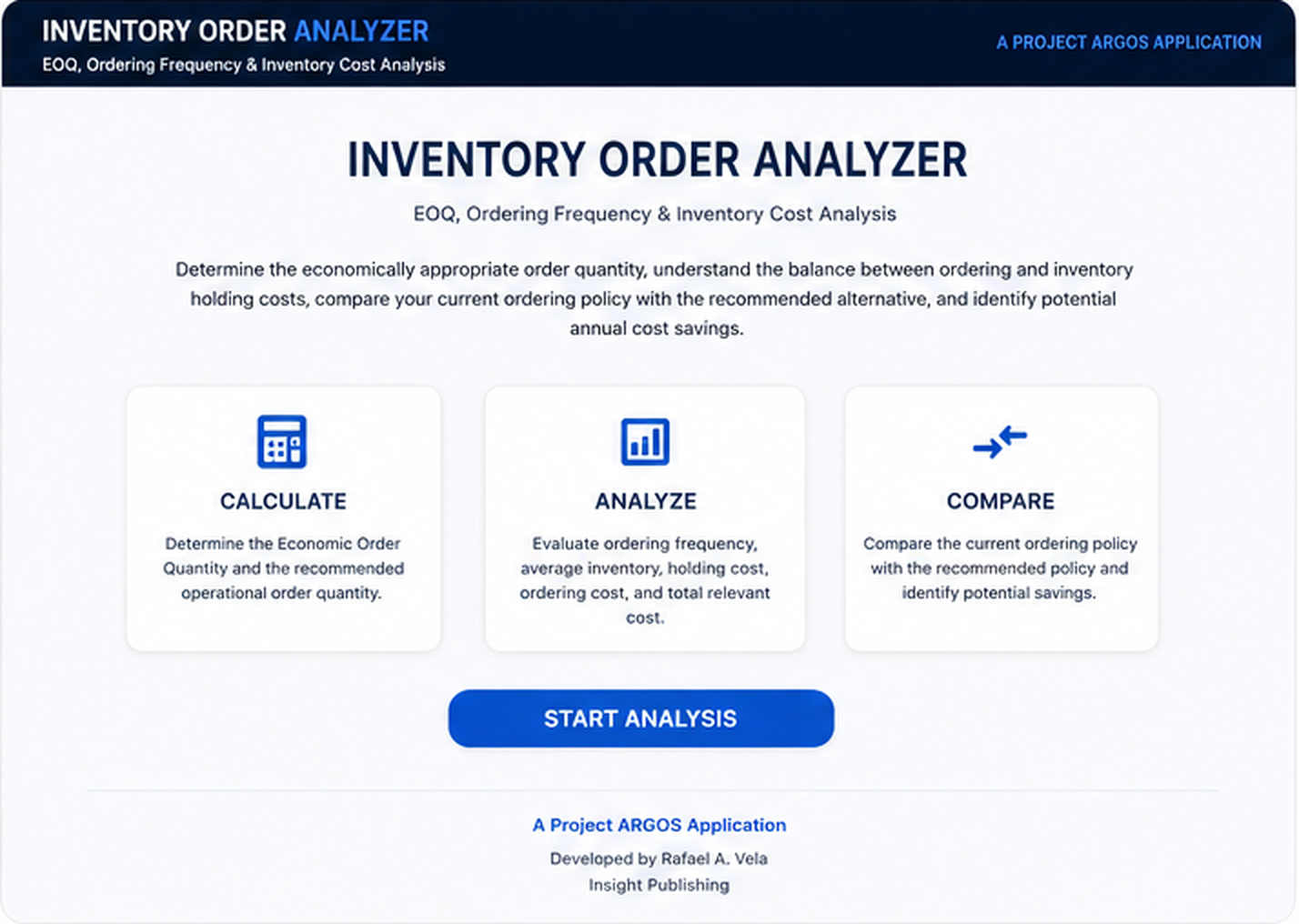
Inventory Order Analyzer is a web-based professional decision-support application designed to help procurement, supply chain, inventory, and operations professionals evaluate ordering policies, understand their cost implications, and identify economically appropriate order quantities.
Rather than functioning as a simple EOQ calculator, the application combines calculation, analysis, comparison, visualization, and interpretation in a single environment.
Using your own demand and cost information, Inventory Order Analyzer helps answer a practical question:
How much should we order, how frequently should we order it, and what are the cost implications of that decision?
What Inventory Order Analyzer Helps You Determine
The application calculates and analyzes:
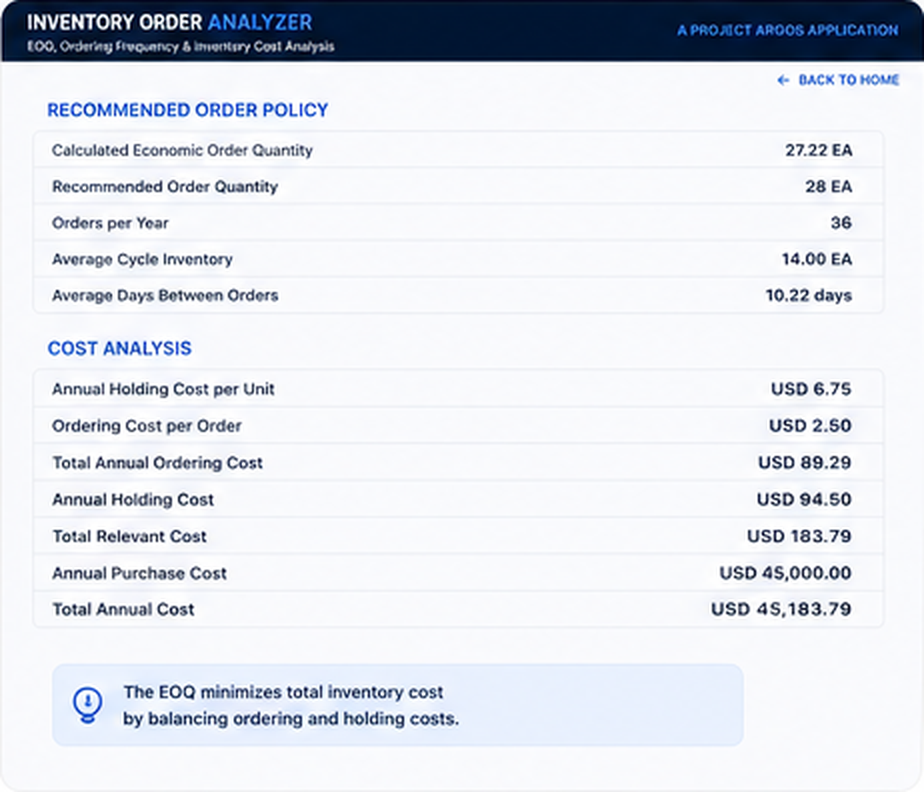
- Economic Order Quantity (EOQ) — the theoretical order quantity that balances annual ordering and inventory holding costs.
- Recommended Order Quantity — an operational quantity obtained by rounding the calculated EOQ upward to the next whole unit.
- Orders per Year — the approximate number of replenishment orders required annually.
- Average Cycle Inventory — the average inventory attributable to the replenishment cycle.
- Average Days Between Orders — the estimated ordering interval based on the selected number of operating or working days.
- Annual Holding Cost per Unit — the annual carrying cost associated with one unit of inventory.
- Total Annual Ordering Cost — the estimated annual cost of placing replenishment orders.
- Annual Holding Cost — the estimated annual cost of carrying cycle inventory.
- Total Relevant Cost — the combined annual ordering and holding cost associated with the ordering policy.
- Annual Purchase Cost and Total Annual Cost — providing additional visibility into the overall annual expenditure associated with the item.
- Compare Your Current Policy With the Recommended Alternative
EOQ by itself tells only part of the story.
When a Current Order Quantity is entered, Inventory Order Analyzer compares the existing ordering policy directly with the recommended policy.
The comparison identifies changes in:
Order Quantity • Orders per Year • Average Cycle Inventory • Annual Ordering Cost • Annual Holding Cost • Total Relevant Cost
It also calculates the potential annual savings and percentage savings associated with moving from the current policy to the recommended alternative.
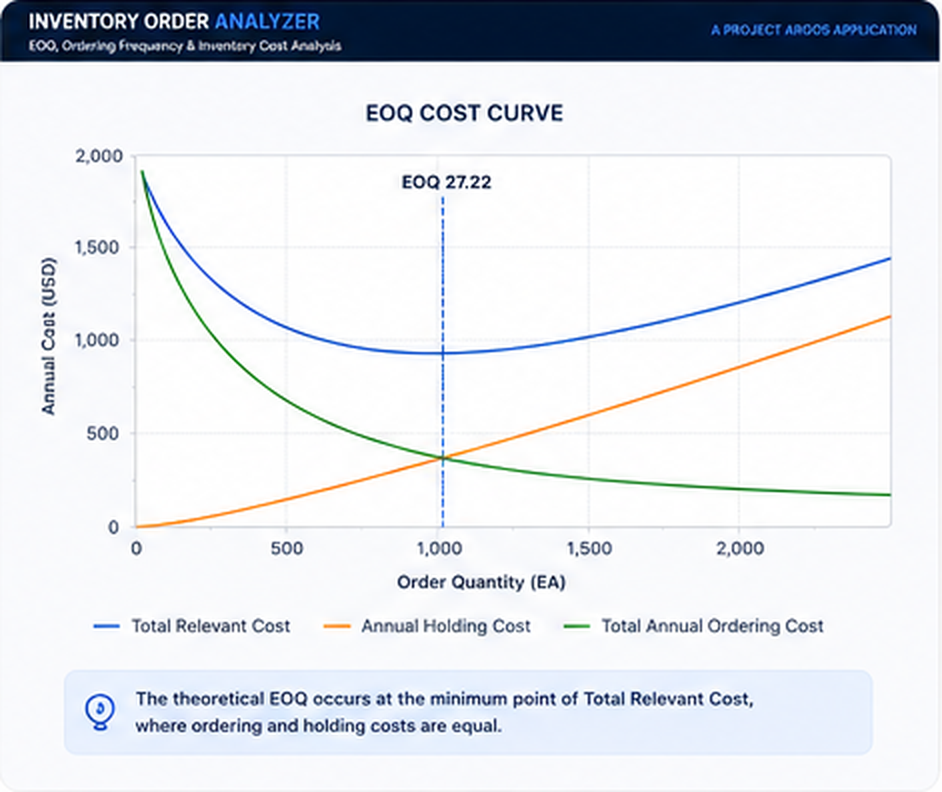
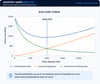
Inventory Order Analyzer includes an interactive EOQ Cost Curve showing the relationship between:
Total Annual Ordering Cost • Annual Holding Cost • Total Relevant Cost
The graph makes the underlying inventory economics visible, showing how ordering cost decreases as order quantities increase, while holding cost moves in the opposite direction.
The calculated EOQ is identified directly on the graph, helping the user visualize the point at which the relevant cost relationship reaches its economic balance.
More Than Numbers: Structured Analysis
The application does not stop after producing calculations.
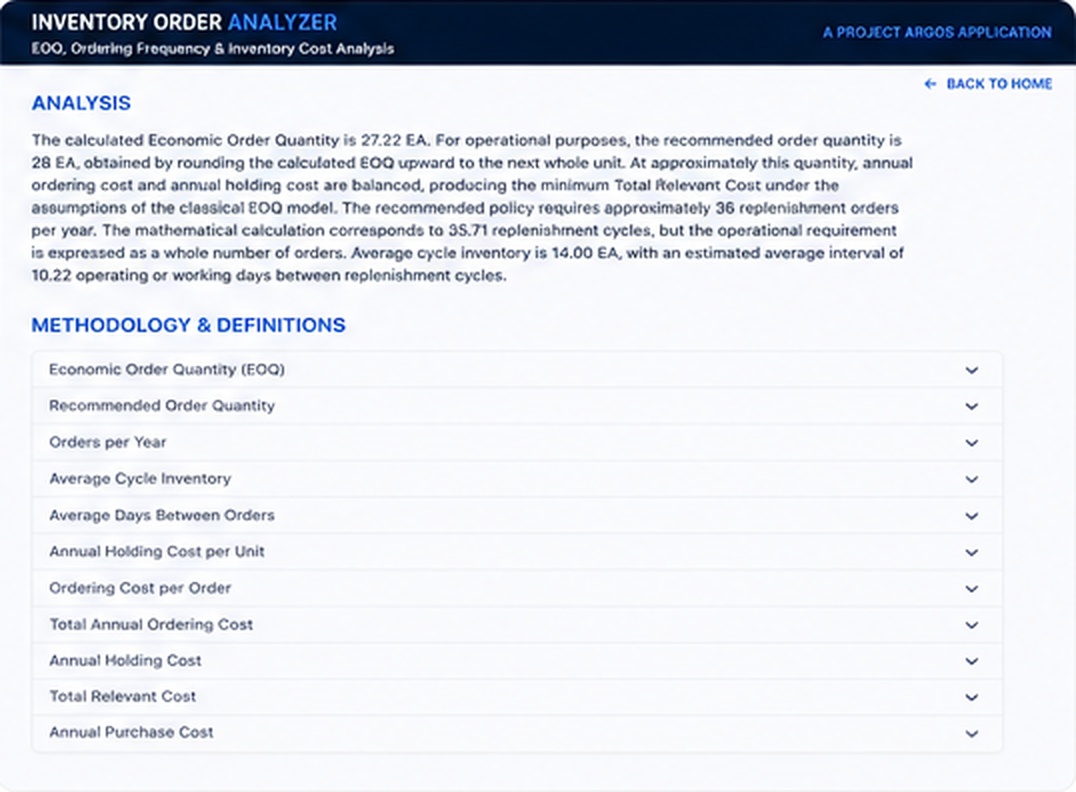
A dedicated Analysis section interprets the results in practical terms, explaining the calculated EOQ, recommended operational quantity, expected ordering frequency, average cycle inventory, ordering interval, relevant cost implications, and—when a current order quantity has been entered—the potential economic effect of changing the existing policy.
The objective is not simply to produce numbers, but to help users understand what those numbers mean for the ordering decision.
Built-In Methodology & Definitions Library
Inventory Order Analyzer includes an integrated Methodology & Definitions reference library covering the principal concepts used throughout the analysis.
Definitions and explanations are available directly within the application, allowing users to review the meaning and role of individual measures without leaving the analytical environment.
This makes the application useful both as a professional decision-support tool and as a practical educational resource for those developing their understanding of inventory economics.
Designed for Practical Decision-Making
Inventory decisions involve unavoidable trade-offs.
Larger order quantities can reduce ordering activity while increasing average inventory and carrying cost. Smaller quantities can reduce inventory exposure while increasing ordering frequency and associated administrative cost.
Inventory Order Analyzer makes these relationships visible and provides a structured analytical basis for evaluating them.
It can be used for individual materials, SKUs, components, supplies, or other recurring inventory items for which annual demand and the relevant ordering and holding-cost information can be reasonably estimated.
Simple to Use. No Installation Required.
Inventory Order Analyzer is entirely web based. There is no software to download or install.
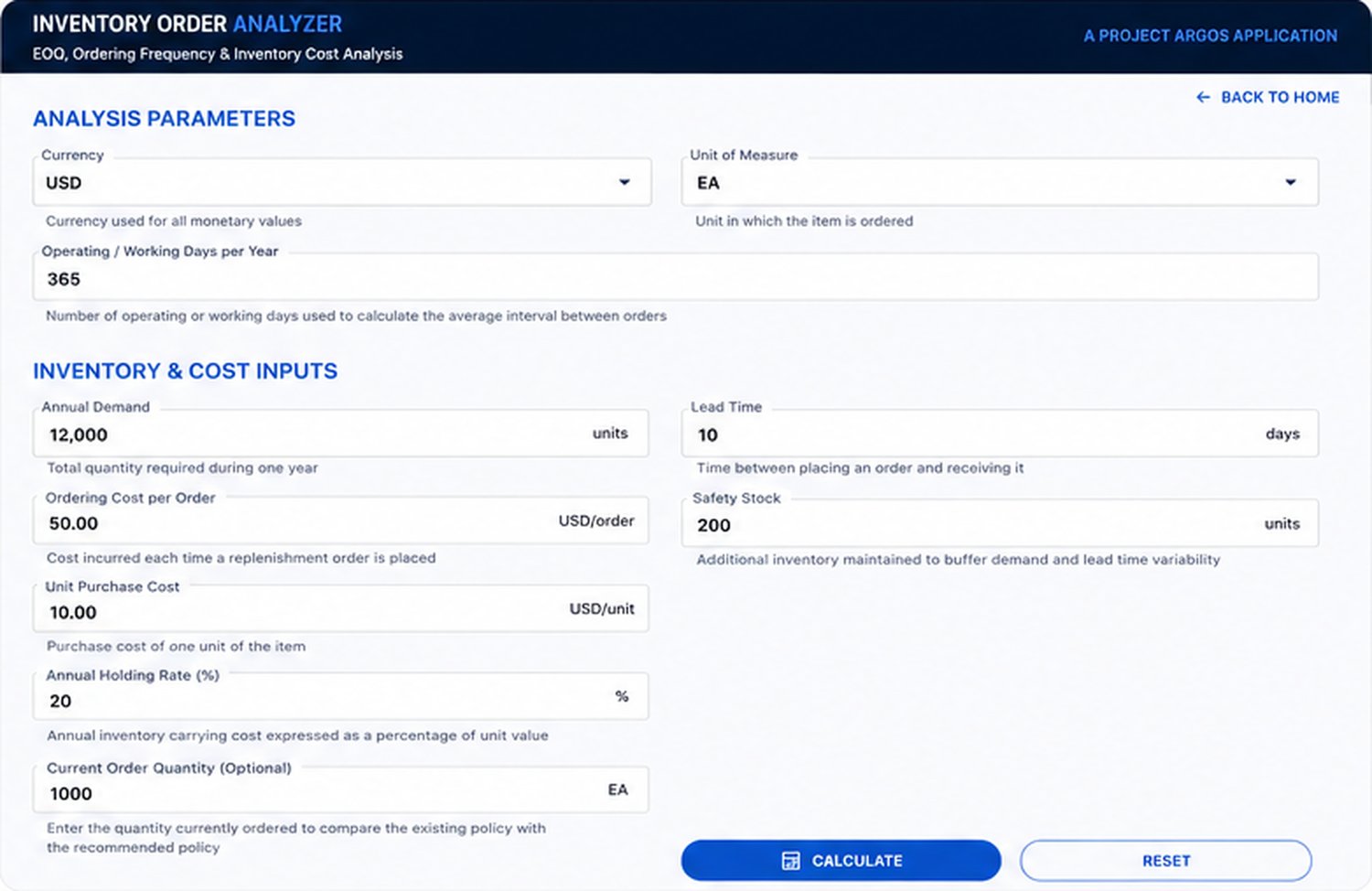
Enter the required information, select your currency and unit of measure, run the calculation, and receive immediate results through your web browser.
Your Purchase Includes:
- One individual license
- Use on up to 2 devices
- One-time purchase — no subscription
- Lifetime access to the purchased version
- Immediate web-based access
- Comprehensive Welcome Package & User Guide, including application screenshots, input guidance, explanation of results, EOQ cost-curve guidance, methodology and definitions, assumptions and limitations, licensing information, and support instructions
After purchase, you will receive your unique license information and instructions for accessing and activating the application.
Who Is It For?
Inventory Order Analyzer is designed for professionals involved in:
Procurement • Purchasing • Supply Chain Management • Inventory Management • Materials Management • Operations • Logistics • Production Planning
It can also serve as a practical analytical and educational tool for consultants, managers, business owners, educators, and students working with inventory-management concepts.
Inventory Order Analyzer is part of Project ARGOS, a growing portfolio of professional applications designed to transform established analytical methods and management frameworks into accessible, practical decision-support tools.