
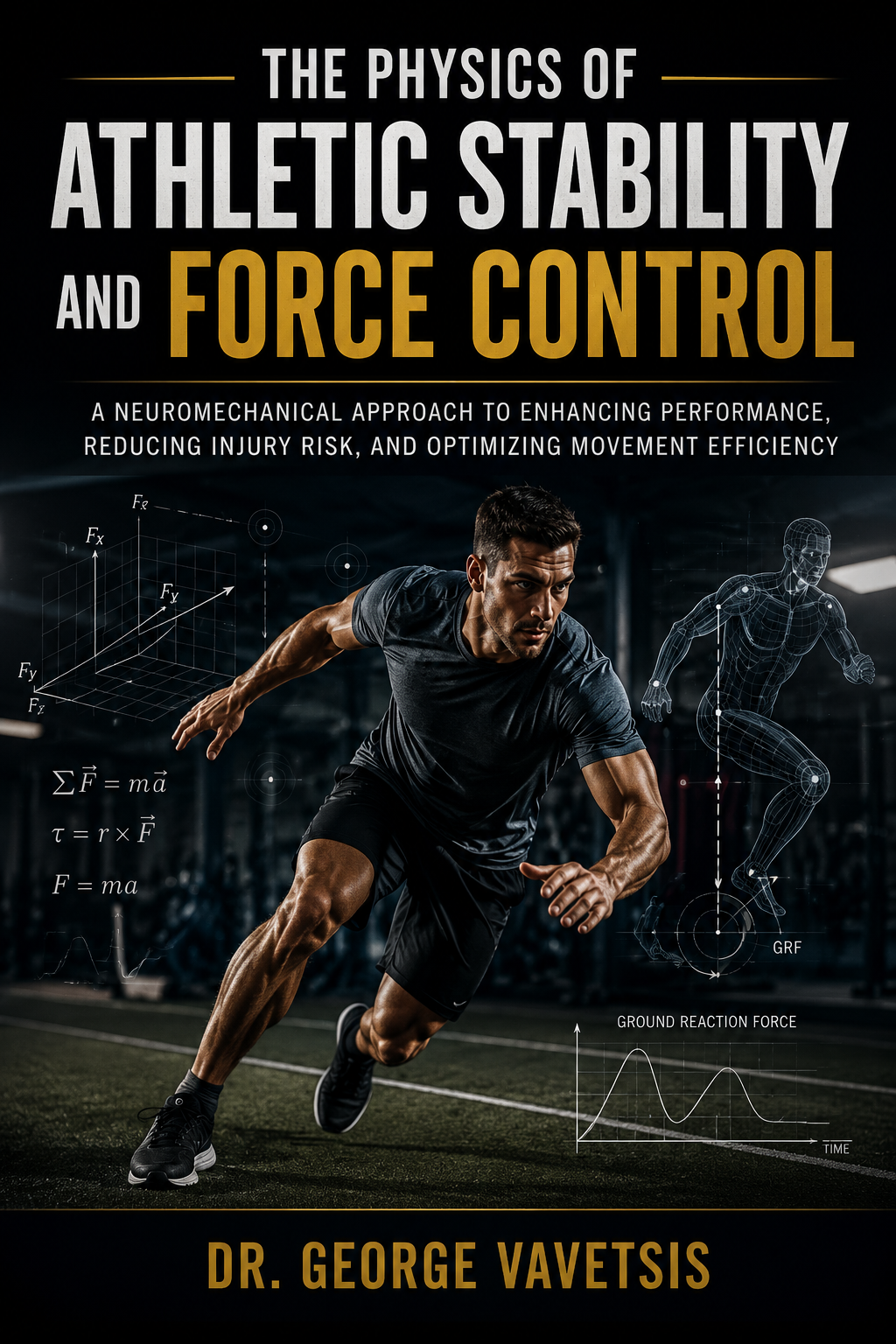
The Physics of Athletic Stability and Force Control
Pages: 575
Athletic performance has traditionally been interpreted through isolated constructs such as strength, power, speed, endurance, mobility, and coordination. Yet, at the highest levels of sport, performance is rarely determined by any single physical quality in isolation. Elite athleticism emerges from the capacity to control force under instability, redirect momentum during chaotic movement environments, preserve positional integrity under perturbation, and maintain biomechanical efficiency while exposed to fatigue, contact, velocity, and uncertainty. This reality positions athletic stability and force control not as secondary physical qualities, but as central governing mechanisms of elite movement performance.
The Physics of Athletic Stability and Force Control was written to address this exact paradigm.
This book was developed for strength and conditioning coaches, sport scientists, biomechanists, rehabilitation specialists, exercise physiologists, and high-performance practitioners seeking a deeper understanding of how athletes generate, absorb, manipulate, stabilize, and redirect force in complex sporting environments. Rather than viewing stability as merely “balance” or “core training,” this text approaches stability as a multidimensional neuromechanical phenomenon governed by the interaction of physics, motor control, tissue stiffness, kinetic-chain integration, sensory processing, and environmental dynamics.
Modern sport has evolved into a high-velocity ecosystem characterized by repeated acceleration-deceleration exposure, multiplanar directional changes, collision-based interactions, asymmetrical loading, tactical unpredictability, and progressive fatigue accumulation. Athletes no longer succeed solely through maximal outputs; they succeed through efficient force organization. The athlete capable of preserving center-of-mass integrity while producing high levels of force under perturbation possesses a decisive competitive advantage.
Throughout this book, stability is examined through the lens of applied physics and neuromechanics. The human body is interpreted as an adaptive force-management system operating under continuously changing mechanical conditions. Ground-reaction forces, joint stiffness modulation, intersegmental sequencing, elastic energy redistribution, inertial management, force-vector steering, and reactive stabilization mechanisms are explored as integrated components of athletic movement architecture.
One of the major goals of this text is to bridge the gap between theoretical biomechanics and practical performance application. Too often, scientific concepts remain disconnected from coaching environments. Conversely, many practical methods lack sufficient mechanistic understanding. This book attempts to integrate both worlds by translating advanced biomechanical principles into directly applicable high-performance methodologies.
The concept of force control is therefore treated not simply as force production, but as the precision regulation of force magnitude, direction, timing, stiffness, oscillation, dissipation, and transfer. Elite movement efficiency depends on minimizing force leakage across the kinetic chain while maximizing stability during rapid transitions between eccentric, isometric, and concentric actions. These concepts become especially critical during sprint braking, cutting maneuvers, collision exposure, reactive deceleration, rotational propulsion, and open-skill tactical movement.
The chapters within this book investigate a broad range of interconnected performance systems, including:
- Neuromechanical determinants of force-control efficiency
- Dynamic center-of-mass regulation during high-velocity sport actions
- Multi-segmental stiffness sequencing
- Force leakage and kinetic-chain dissipation
- Stability–mobility oscillation models
- Feedforward stabilization strategies
- Ground-reaction-force steering mechanics
- Dynamic bracing architectures in team sports
- Reactive limb stiffness regulation
- Tendon–muscle co-stiffness behavior during deceleration
- Vestibular contributions to movement stability
- Neuromuscular timing delays during force redirection
- Open-skill perturbation management
- Rotational stability preservation under multidirectional exposure
- Applied stability programming through yielding-isometric systems
These topics are explored not only theoretically, but also through practical coaching frameworks, diagnostics, monitoring systems, and exercise prescription models designed for elite sport environments.
Particular emphasis is placed on understanding how the nervous system organizes movement before contact occurs. Feedforward stabilization strategies, anticipatory trunk bracing, predictive core activation, and pre-activation sequencing represent some of the most underappreciated yet decisive components of elite athletic movement. In explosive sport actions, the body’s ability to anticipate instability is often more important than its ability to react to it.
The book also challenges simplistic approaches to “core stability” and “functional training.” Stability is not merely the ability to resist motion. In elite sport, excessive rigidity can be just as detrimental as insufficient control. Optimal performance requires dynamic oscillation between stability and mobility depending on task demands, velocity constraints, environmental uncertainty, and tactical context. This balance between controlled stiffness and controlled freedom forms one of the central philosophical and biomechanical themes of the text.
Importantly, the material presented here extends beyond conventional sagittal-plane thinking. Athletic movement occurs in three-dimensional space under continuous perturbation. Therefore, the book heavily emphasizes frontal-plane force dissipation, transverse-plane redirection, multiplanar deceleration systems, rotational force transfer, and asymmetrical stabilization mechanics. These principles are fundamental for sports such as basketball, soccer, rugby, combat sports, handball, volleyball, tennis, hockey, and American football, where athletes constantly operate within unstable, reactive environments.
Another defining feature of this text is its focus on elite-level application. The concepts discussed are specifically tailored for high-performance sport environments where marginal gains determine competitive success. The integration of force-plate diagnostics, neuromechanical profiling, reactive perturbation systems, movement variability analysis, and stiffness-based programming reflects the realities of modern sport science practice.
The future of strength and conditioning will increasingly move toward individualized force-control engineering. Performance preparation will no longer rely solely on generalized strength development but on the optimization of each athlete’s unique neuromechanical profile. Understanding how athletes stabilize movement, absorb force, regulate stiffness, and maintain positional integrity under fatigue will become central to injury prevention and performance enhancement alike.
Ultimately, this book was written with one primary purpose: to redefine how coaches and scientists interpret athletic movement.
Athletic stability is not passive.
Force control is not simplistic.
Movement efficiency is not accidental.
Elite performance is a product of highly organized neuromechanical orchestration operating under the laws of physics, biology, and adaptive human control.
It is my hope that this book provides not only scientific insight, but also practical innovation for those working to advance the future of human performance.