
Construction Quality Management System (CQMS) Manual
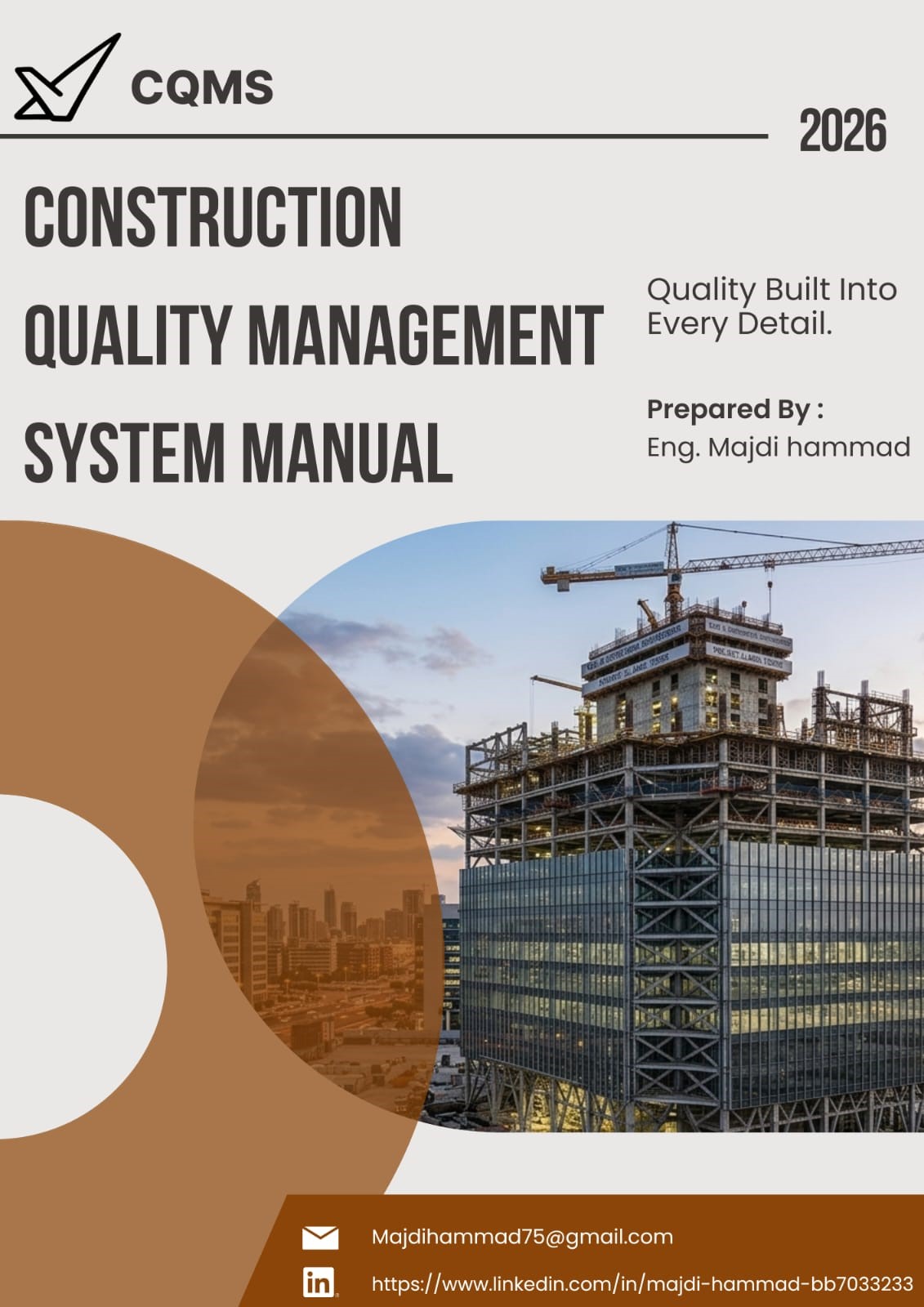
CONSTRUCTION QUALITY MANAGEMENT SYSTEM (CQMS) MANUAL
A Practical, Project-Focused Framework for Construction Quality Management
Build Quality Into the Process — Not Into the Final Inspection
The CQMS Manual is a comprehensive 283-page professional reference guide designed to help construction organizations, project teams, QA/QC professionals, engineers, and managers establish, implement, monitor, and continually improve a practical Construction Quality Management System.
Unlike conventional quality manuals that focus mainly on procedures and documentation, this manual translates quality management principles into practical construction processes, controls, checklists, decision points, quality gates, performance measures, root cause analysis, and continual improvement practices.
Developed from extensive practical construction quality experience, the manual provides a structured framework for managing quality from project planning and mobilization through construction, inspection, acceptance, performance evaluation, and organizational learning.
WHAT MAKES THIS MANUAL DIFFERENT?
This is not simply a theoretical explanation of ISO requirements.
It is a practical implementation guide that connects the quality management system to what actually happens on construction projects.
The manual brings together:
- Quality planning before construction starts
- Clear roles, responsibilities, authorities, and RACI principles
- Project Quality Planning and PQP requirements
- Inspection & Test Plans (ITPs)
- Method Statement controls
- Document and Record Control
- Construction Quality Processes
- Quality Gates
- Material verification and traceability
- Inspection, testing, and work acceptance
- NCR and Corrective Action management
- Root Cause Analysis
- Quality KPIs and performance monitoring
- Pareto analysis
- Risk-based audit planning
- Internal Quality Audits
- Management Review
- Client satisfaction and feedback
- Resource and competency management
- Supplier and external provider quality management
- Risk-based preventive controls
- Organizational learning
- Continual improvement
THE 10-CHAPTER CQMS FRAMEWORK
Chapter 1 — Introduction
Defines the CQMS framework, purpose, scope, quality policy, objectives, philosophy, and guiding principles.
Chapter 2 — Organization & Responsibilities
Establishes organizational responsibilities, authorities, RACI principles, quality accountability, and the roles required for effective CQMS implementation.
Chapter 3 — Project Quality Planning
Provides a practical approach to PQP development, quality objectives, risk-based planning, resources, ITPs, materials, quality records, and project start-up readiness.
Chapter 4 — Document & Record Control
Covers document identification, numbering, approval, revision control, distribution, external documents, records, retention, archiving, and electronic document management.
Chapter 5 — Construction Quality Processes
The core operational chapter covering how quality is controlled during construction through:
5 Quality Gates
- Pre-Construction Readiness
- Material Verification
- Inspection & Testing
- Work Acceptance
- Performance Review & Continual Improvement
It also establishes 8 Construction Execution Control Pillars, including workmanship, approved documents, site supervision, process monitoring, coordination, temporary works, interface management, and daily quality monitoring.
Chapter 6 — Measurement, Analysis & Improvement
Explains how to determine whether the CQMS is actually working through KPIs, Pareto analysis, internal audits, risk-based audit planning, management review, client feedback, performance reporting, and CAPA effectiveness.
Chapter 7 — Resource Management
Addresses competence, training, awareness, communication, knowledge management, infrastructure, inspection/testing resources, and external technical support.
Chapter 8 — External Providers Quality Management
Provides controls for supplier and subcontractor selection, procurement quality requirements, incoming materials, performance monitoring, nonconforming products/services, supplier evaluation, and improvement.
Chapter 9 — Risk-Based Quality Planning & Preventive Controls
Provides a structured approach for identifying, assessing, prioritizing, controlling, reviewing, and improving construction quality risks before they become nonconformities.
Chapter 10 — Organizational Learning & Continual Improvement
Completes the CQMS cycle by converting project experience, quality data, audit results, risks, lessons learned, and management decisions into organizational knowledge and future improvement.
PRACTICAL REFERENCE APPENDICES
The manual includes four substantial reference appendices designed to support implementation.
Appendix A — Chapter Implementation Checklists
Implementation readiness checklists covering Chapters 2–10.
The checklists are designed to verify whether the CQMS is actually ready for implementation rather than simply documented.
They can be used during:
- Project mobilization
- Periodic project reviews
- Scope or work-package changes
- Organizational changes
- Contractual changes
- Internal audits
- Management reviews
- Project close-out
Appendix B — Root Cause Analysis (RCA) Guide
A practical RCA guide covering:
- When RCA is required
- Root Cause vs. Symptom
- Five Whys
- Fishbone Analysis
- Corrective Action Planning
- Effectiveness Verification
- Recurrence prevention
- RCA implementation checklist
The guide includes practical construction examples and shows how to move from a visible defect to an underlying process failure.
Appendix C — Quality Forms & Templates
A reference library of 14 practical quality forms and templates, including:
- Inspection Request (IR)
- Material Inspection Request (MIR)
- Non-Conformance Report (NCR)
- Corrective & Preventive Action (CAPA)
- Internal Audit Report
- Management Review Minutes
- Competency Assessment
- External Provider Performance Evaluation
- Lessons Learned Register
- Quality KPI Dashboard
- Inspection & Test Plan (ITP)
- Method Statement Mandatory Content
- Quality Gate Release
- Weekly Quality Observation Report
These templates are designed to support actual project implementation and can be adapted to suit project-specific and contractual requirements.
Appendix D — Recommended Quality Performance Indicators (KPIs)
A structured library of 31 construction quality KPIs covering:
- Quality Planning
- Operational Quality Control
- Nonconformance
- Corrective Actions
- Internal Audits
- Training & Competency
- Supplier Performance
- Management System Performance
The appendix includes KPI definitions, calculation methods, monitoring frequency, suggested targets, calculation examples, dashboard concepts, traffic-light evaluation, and management decision guidance.
THE CQMS IMPLEMENTATION LOGIC
The manual connects the complete quality management cycle:
PLAN → CONTROL → SOLVE → MEASURE → AUDIT → IMPROVE
The objective is not to create more paperwork.
The objective is to create a system in which quality information generated during construction becomes evidence, decisions, corrective actions, organizational knowledge, and measurable improvement.
WHO IS THIS MANUAL FOR?
This manual is particularly useful for:
- Construction Quality Managers
- QA/QC Managers
- QA/QC Engineers
- Project Managers
- Construction Managers
- Site Engineers
- Quality Inspectors
- Technical Office Engineers
- Procurement & Material Engineers
- Document Controllers
- Consultants
- Contractors
- Developers / Owners
- Organizations establishing or improving a CQMS
It can also serve as a professional reference for construction organizations seeking to align their quality management practices with the principles and applicable requirements of ISO 9001:2015, while adapting them to contractual, statutory, regulatory, and project-specific requirements.
WHAT YOU GET
CQMS Manual — Version 1.0
- 283-page professional PDF
- 10 comprehensive chapters
- 9 chapter implementation checklists
- Root Cause Analysis Guide
- 14 quality forms and templates
- 31 recommended quality KPIs
- KPI calculation examples
- Quality performance dashboard guidance
- Quality Gate framework
- Risk-based quality planning framework
- Internal audit framework
- Management review framework
- Organizational learning & continual improvement framework
THE MASTER REFERENCE OF THE QUALITY PATHWAY PRODUCT FAMILY
The CQMS Manual is the parent/master reference behind the QUALITY PATHWAY quality management product family.
The practical tools and specialized toolkits developed by QUALITY PATHWAY are based on the concepts, processes, controls, forms, KPIs, and implementation principles established within this manual.
This makes the manual particularly valuable for professionals who want to understand the complete system behind the individual quality tools, rather than using isolated forms or registers without understanding how they fit together.
PROFESSIONAL DISCLAIMER
This manual is an independent professional reference guide. It is not issued, endorsed, approved, or officially affiliated with ISO, any certification body, client, contractor, consultant, government authority, or other organization.
The manual has been developed with reference to the principles and applicable requirements of ISO 9001:2015 and established construction quality management practices.
Users should adapt the guidance to their applicable contractual, statutory, regulatory, organizational, and project-specific requirements.
COPYRIGHT
© 2026 Majdi A. Hammad. All Rights Reserved.
This publication contains original professional intellectual property. Commercial reproduction, redistribution, resale, or unauthorized use of the content is prohibited without prior written permission.
QUALITY IS NOT ACHIEVED BY INSPECTION ALONE.
It is the result of effective planning, competent execution, systematic monitoring, evidence-based decisions, and continual improvement.
The CQMS Manual provides the framework to make that approach practical and repeatable across construction projects.
Build Quality Into the Process.