
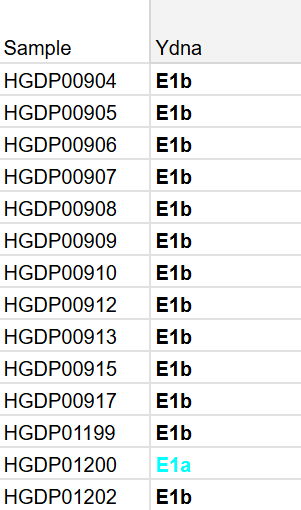
Mandenka.HO 14 samples 23andme format
The Mandinka are one of the largest and most historically influential ethnic groups in West Africa, belonging to the wider Mande ethnolinguistic family. Their origins trace back to a region spanning modern-day Mali, Guinea, Senegal, and The Gambia.
The Mandinka rose to prominence during the 13th century under the leadership of Sundiata Keita, who founded the Mali Empire after defeating the Sosso king Sumanguru Kanté around 1235 AD. The Mali Empire became one of Africa’s greatest medieval states, dominating trade routes that carried gold, salt, ivory, and slaves across the Sahara.
During the Mali Empire, Islam became closely associated with political power. Many Mandinka rulers, including the legendary Mansa Musa, were devout Muslims who sponsored mosques, Qur’anic schools, and scholars. However, Islam at that time was often blended with traditional animistic Mande beliefs, leading to a syncretic form of Islam that persisted for centuries.
By the 16th to 18th centuries, Mandinka elites in coastal regions, particularly in Senegambia, were deeply engaged in the Atlantic slave trade. They captured war prisoners and sold them to Portuguese, French, and British merchants in exchange for firearms, cloth, and other goods. However, not all Mandinka leaders participated willingly; some resisted both slave raiding and colonial intrusion.
One of the most notable Mandinka leaders of the 19th century was Samory Touré, founder of the Wassoulou Empire. A brilliant military strategist and statesman, Touré united various Mande-speaking peoples in modern-day Guinea, Mali, and Côte d’Ivoire. He resisted French colonial expansion through both warfare and diplomacy, creating a centralized, Islamic state modeled partly on the earlier Mali Empire. Despite fierce resistance, his empire was eventually conquered by the French in 1898.
For this video, I have gathered the raw genomes of 14 Mandinka men from the Human Origins dataset. I have used academic tools, such as Admixtools 1 and Admixtools 2, which are developed by Harvard, but also my own tools, such as Trait predictor and mageplot, to analyze their DNA and how they relate to other African and world populations.